
I’m All Lost In, #129: Upstairs on Pike St.; late-night poetry; ancient poetry; and the week in X > Y.
I’m All Lost In…
the 3 things I’m obsessing about THIS week…
#129
The Week in X > (is greater than) Y
Flossing with a Floss-Pick Attachment > Flossing with a Floss Pick by Itself or with Just Floss Four out of five dentists will surely disagree with me. As will all the women I’ve ever dated, expert and dedicated flossers one and all. Keeping your gums healthy with a sole piece of flexible floss is surely the most effective method. But as a sudden convert to this satisfying and salubrious bedtime ritual, I give credit to the more user-friendly option for turning me into a home hygienist: The toothbrush-floss-pick-attachment combo.

A blessing for home hygiene.
I’m not dexterous enough to angle around the interproximal back corners with an elusive and lone strand of floss. Nor with a floss pick. Those awkward options have been a longstanding deterrent. So, thank you to my dentist, an outlier among those proverbial Four-out-of-five. She was slick enough to drop a couple of these ingenious flossing contraptions into my complimentary goodies bag after my lengthy cleaning appointment last week. The reserve of attachable floss picks is an added delight.
Asking Questions > Making Statements ECB and I went to a town hall on Friday night where Mayor Katie Wilson took the stage to be interviewed about her disappointing view on surveillance cameras. Basically, the usually lefty mayor says she’s inclined to go along with her conservative predecessor’s tough-on-crime plan to expand CCTV police surveillance in a few more neighborhoods. My sense is that Wilson is stuck between two constituencies that are hard-earns for white progressives like her: POC elders who want the cameras and younger POC voters who don’t; the white left is against them obviously, which smacks of privilege to older POC voters.
In a supposed nod to her younger base, Wilson announced she’s pausing the expansion while she first contracts out a study to try and answer some basic questions: How effective are cameras at deterring and solving crime in the first place? And how much of a threat do they pose to privacy, particularly for immigrants, trans people, and people seeking reproductive care?
Surveillance opponents got organized and packed the room, dominating the follow-up Q&A portion of the program. Their concerns are legitimate and serious: They worry the authoritarian Trump administration will step in and use the cameras as part of MAGA’s war on brown people and the trans community.
It’s certainly smart for the left to hold one of their own like Wilson accountable. But…
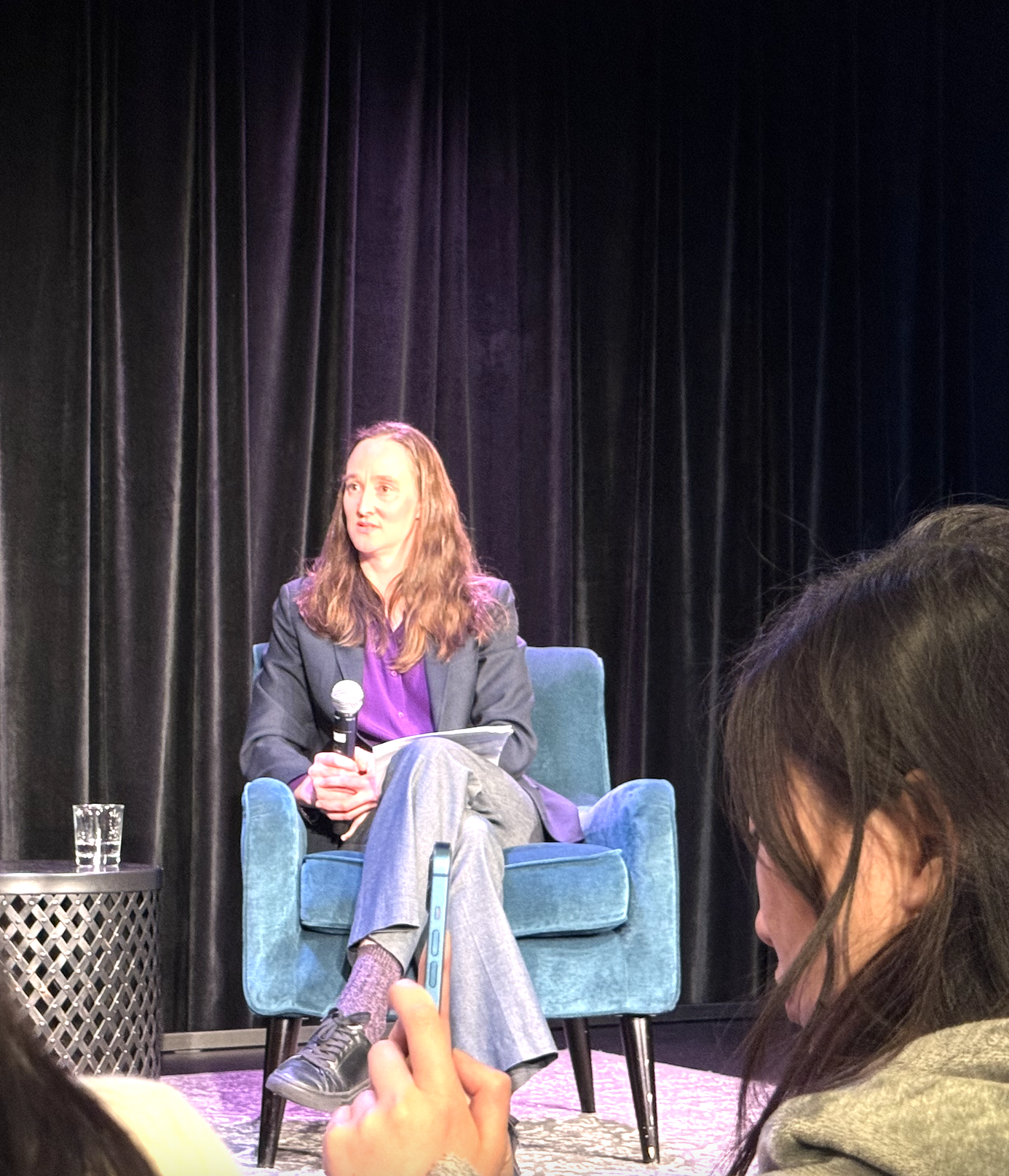
Seattle Mayor Katie Wilson, Town Hall, 3/27/26
But they’d empower their cause by asking questions at public forums rather than giving lectures (or demanding endorsements for socialist candidates in other races.)
Pressing Wilson to answer actual questions, such as asking her to identify the metrics she’ll use to evaluate her study, would heighten civic discourse rather than shut it down with performative, wide bro stances and folded arms.
Extensive Footage > Snippets I’m a fan of idyllic, rainy reels with hashtags like slowliving, calm_nest, cozyworkspace, serenyvibes, quietmoments, and stillness. I've been sprinkling my feed with them lately.
But these calming clips are sabotaging their own sweet intentions by ending abruptly after just five seconds. I don’t want to worry about impending endings when I’m trying to relax.
Drawn to slow media, I’ve switched to uninterrupted Youtube footage of long-form rainstorms.
This Week’s Obsessions
1) Paper Fan Cocktail Bar
Pro-housing YIMBYs advocated for and passed a bill in the state legislature this session that stopped local jurisdictions from prohibiting ground-floor housing in traditionally commercial districts. The bill, SB 6026, allowed housing wherever commercial development is allowed. I support the idea—any new housing is good housing. And doing away with housing prohibitions is smart public policy. But I think the opposite configuration is also MIA in Seattle: Commercial development in residential districts. I raised this point when the legislative session got underway in January [I’m All Lost In, #118, 1/18/26.]
And now for my second flip rejoinder to this legislation that allows housing development on the ground floor: How about allowing commercial development above the ground floor? I’m thinking of urbanism in Asia where commercial districts flourish in alleys [I’m All Lost In, #122, 2/15/26] and shops are stacked horizontally [I’m All Lost In, #109, 11/16/25.]
So, I was happy to discover the Chinese-owned, Hong Kong-themed Paper Fan Cocktail Bar this Thursday night. With seating for just 18 people, it’s a small, dimly-lit second-floor lounge tucked away up the stairs from noisy Biang Biang Noodles on Pike St.
I’m still going alcohol free (41 days at this point), so I had a sweetened matcha NA cocktail. However, my two comrades, Colby and Glenn who’d been before and were eager to return, ordered Paper Fan’s specialty: Boozy tea-infused drinks that alter your senses with floral and ethanol scents. They also tried a shot-glass sampler of smoky Baijiu, China’s popular grain liquor.
The food and drinks at Paper Fan are great—in addition to the matcha, I had a dripping and delicious tofu bao. But it’s the epic and chill-all-at-once mood that makes good on the dramatic promise of a second-floor spot.
I would definitely not go here on a first date. But it’s perfect for a third.
2) Russian Poet Marina Tsvetaeva
Marina Tsvetaeva described fellow early-20th century Russian-poetry icon Vladimir Mayakovsky as a “singer of gutter miracles.” This lyrical phrase comes from Tsvetaeva’s 1921 poem To Mayakovsky where she also dubs him: “clumsy-footed angel” and writes, “Hullo there, you who prefer/topaz to diamond!” Tsvetaeva was certainly writing about herself. As most of us do when attempting to explain our hero artists.
Tsvetaeva is my hero this week. I’m reading her Penguin Classics Selected Poems. I’m mesmerized by her “deeply faithless” vagabond verse. And her evening excursions where night is “the first mother of songs … in whose fingers lies the bridle of the four winds.”
Her post-midnight walks through the windswept streets of Moscow are a function of insomnia. And insomnia is a function of longing. Written in 1916 when she was 24, her Insomnia cycle is an after-hours mission statement of simultaneous disappointment and exuberance:
As I love to/
kiss hands, and/
to name everything, I/
love to open/
doors!/
Wide — into the night! …This night today I am alone in the night —/
A sleepless and a homeless nun!/
This night today I hold all the keys to this/
the only capital city …I am/ only a shell where the ocean is still sounding
These lines were enough to convince me. But then, on the heels of my current obsession with luminous neighborhood windows [I’m All Lost In, #127, 3/22/26] (an extension of a lifelong obsession I first contracted in the teenage suburbs of D.C.), she concludes with these supreme lines:
Here’s another window/
with more sleepless people!/
Perhaps — drinking wine or/
perhaps only sitting,/
or maybe two lovers are/
unable to part hands./
Every house has/
a window like this./A window at night: cries/
of meeting or leaving./
Perhaps — there are many lights,/
perhaps — only three candles./
But there is no peace in/
my mind anywhere, for/
in my house also, these/
things are beginning:/Pray for the wakeful house,/
friend, and the lit window.
3) Roman Poet Ovid
Tsvetaeva’s bohemian POV also embraced free love. For instance, her 1915 friends-with-benefits poem, I’m glad your sickness, includes the lines: “calmly now embrace/another girl in front of me, without/any wish to cause me pain, as you/don’t burn if I kiss someone else… you do not cause/my sickness. And I don’t cause yours.”
This is a great contrast to the other poetry collection I’m obsessed with this week, ancient Roman poet Ovid’s Heroides (Heroines).
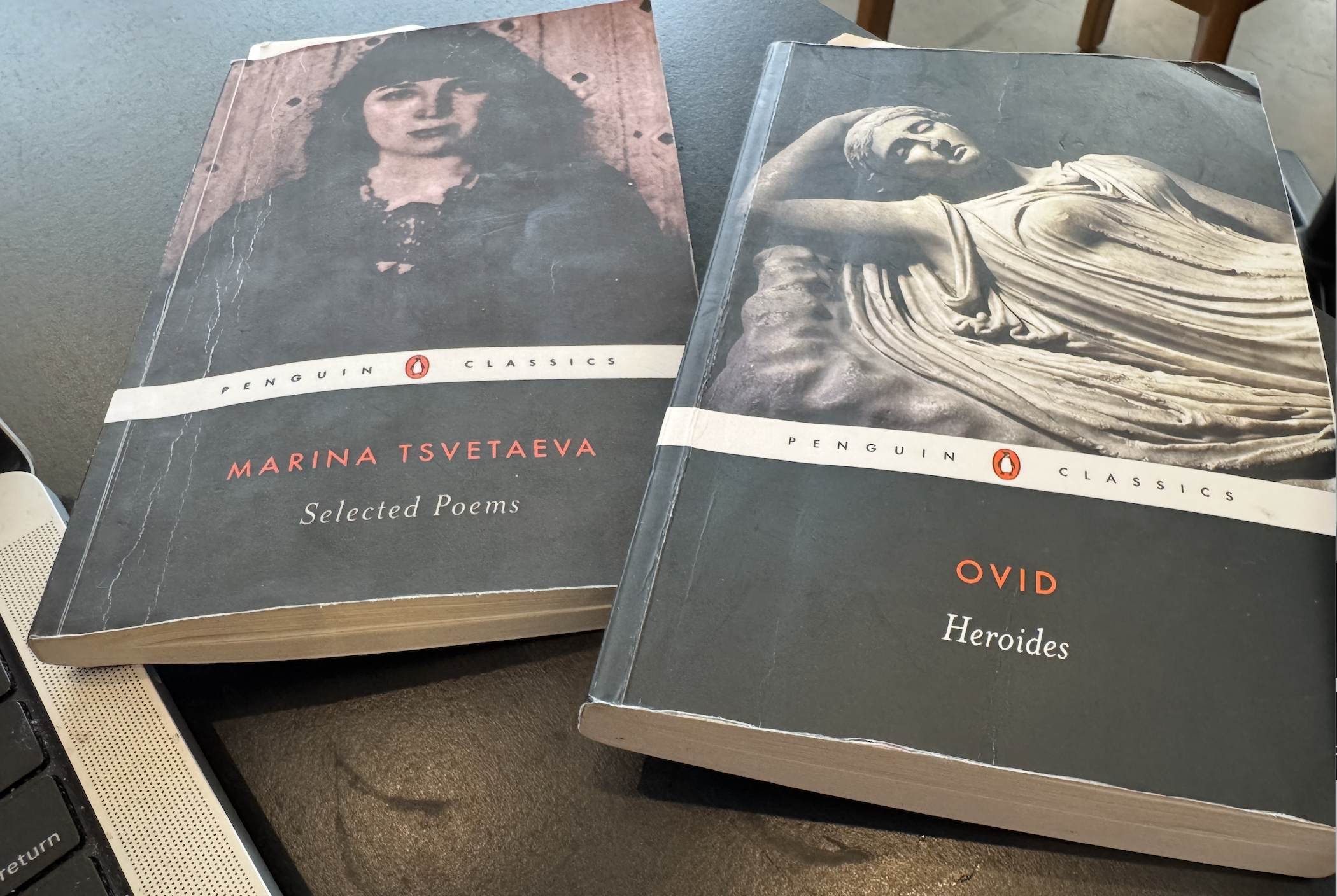
Judge a book by its cover. These cool-looking Penguin Classics are overflowing with divine poetry.
Ovid’s set of epistolary poems, with hilarious opening lines like “Will you read? Does your new wife forbid?”, features angry letters from mythological women such as Penelope, Briseis, Phaedra, Dido, Hermione, and Medea written to their boorish and villainous exes. The letters come with incisive ripostes: “both your ships and your promises/sail from this shore on the same wind;” “thus you spoke, with tears flowing down your false face;” and perhaps my favorite line, written by Hypsipyle in her letter to Jason, who abandoned her for the infamous murderer Medea: “I would have been Medea for Medea.”
In Ovid’s 8 BC feminism, flummoxed women anguish (through the voice of a male poet!) over the systematic sexism that traps them in Catch- 22 lives. It makes no difference if one is a slave like Briseis pleading paradoxically to the enemy’s general Achilles “what I received when you conquered me/give me again” or a queen like Penelope who’s discarded life leads her to conclude “Just remember, I was a young girl when you left;/ if you came at once you would find an old woman.”
As with Tsvetaeva (who committed suicide in 1941), many of Ovid’s heroines, like Phyllis who “longs for poison,” eventually take their own lives too.
——
Lastly, two recommendations: A coffeeshop and a movie. To mark the historic light rail opening across Lake Washington last Saturday—nice coverage from Ryan Packer at the Urbanist—I caught a new 2 Line train from Capitol Hill late in the afternoon for a casual 30-minute ride to Bellevue’s Spring District.
“District” is a misnomer. It’s mostly a desolate cement landscape with a prefab park in front of a brewery that looks like the school bus-zone in front of my old high school. But I did manage to find a miracle coffeeshop about three blocks away. Like the excellent Mintish [I’m All Lost In, #127, 3/22/26] Diwan Coffeehouse is Palestinian owned. And committing to Levant lusciousness, they serve lattes with shredded, sweet kataifi dough on top. Also a miracle: It’s open until 10 pm on Friday and Saturday nights.
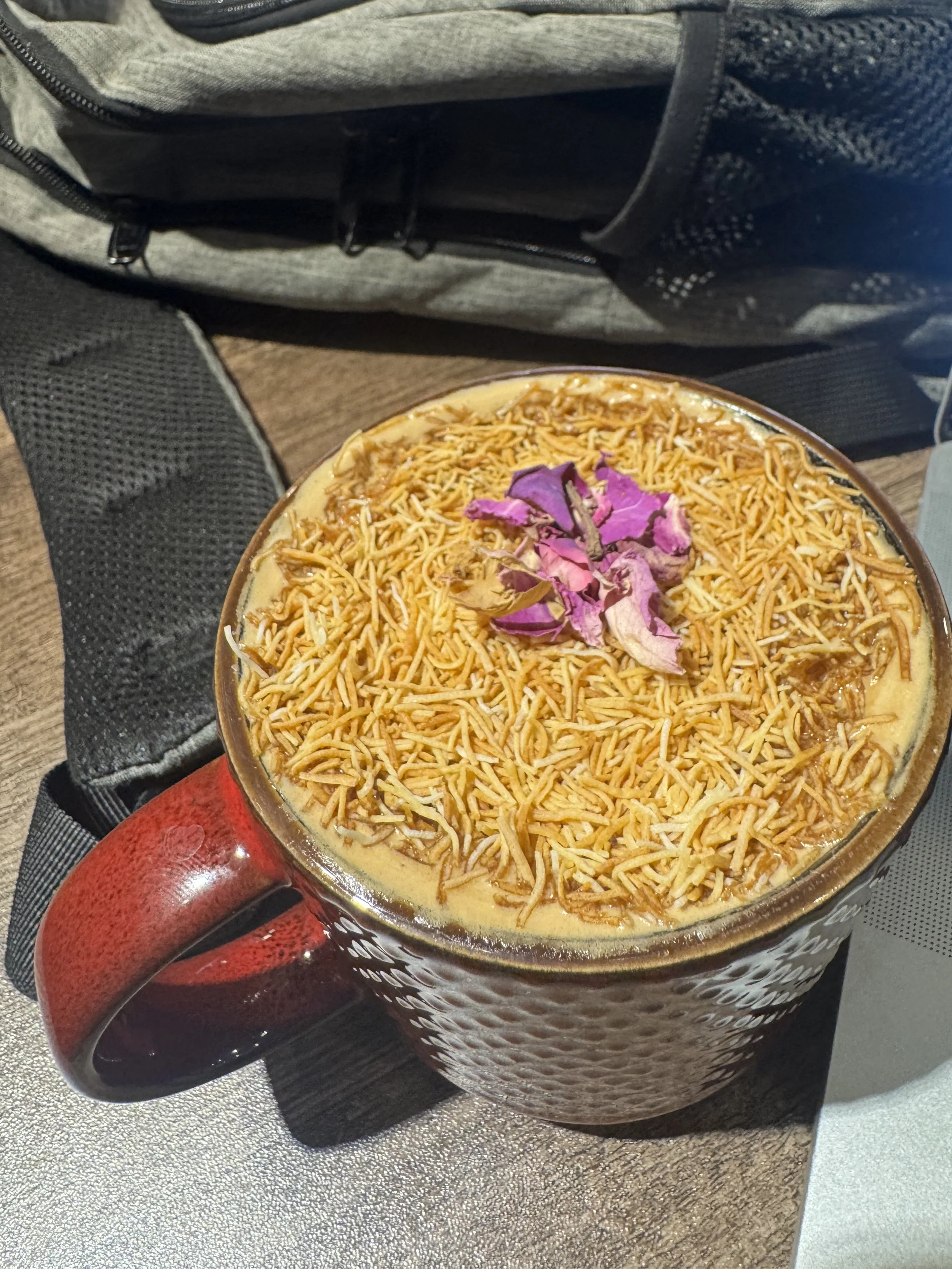
Coffeeshop Oriented Development, Diwan Coffeehouse in Bellevue, 3/28/26
Given my well-documented obsession with genius American novelist Edith Wharton [I’m All Lost In, #99, 9/8/25], it may be surprising to hear that I’d never seen Martin Scorsese’s 1993 adaptation of Wharton’s Pulitzer Prize-winning 1920 novel, The Age of Innocence. I haven’t read the book either, to be honest. But now that I’ve seen Scorsese’s riveting, straightforward version, and now that I’ve fallen for Michelle Pfeiffer’s nuanced Cousin Olenska (as hard as Daniel Day-Louis’ Newland Archer fell for her), Wharton is on my must-read list again.