I’m All Lost In, #118: Private Symbolism; Protest Urbanism; Coffee Oriented Development.
I’m All Lost In…
the 3 things I’m obsessing about THIS week.
#118
First: An X-is-Greater-than-Y recap of the week.

This week in X is Greater than Y…
Allowing Housing in Residential Zones > Allowing Housing in Commercial Zones: I read and re-read the bill summary to SB 6026, this year’s supposedly big-deal pro-housing proposal in the state legislature: “Any city or county … is prohibited from excluding residential uses in areas zoned for commercial or mixed-use development.”
Unfortunately, I was reading it correctly. And to my eye the sponsors, Democrats, have it backward. Look, I understand that allowing any housing where it’s not currently allowed is a win. But this approach tiptoes around the real issue and takes the pressure off the biggest barricade against housing density: Predominantly low-rise residential zones.
In addition to the fact that there’s a much better approach to creating new housing—allowing a wide range of multifamily housing options in residential zones—I’d also suggest amending the language of SB 6026.
Legislators should flip it around to say: “Any city or county … is prohibited from excluding commercial or mixed-use development in areas zoned for residential uses.” Ah. Much better. While that’s not a literal mandate for more housing, I bet adding commercial development to residential blocks would eventually create an insuperable demand for more housing on those suddenly-activated streets.
Woke History > Trump’s Fake History: Trump has blithely begun checking off the initial items on his KKK to-do list. For example, he’s directed the National Park Service and the Smithsonian to expunge any documentation of American slavery or acknowledgment of America’s history of racism from museums, exhibits, and national sites. Also Under Trump’s direction, the national parks have taken MLK Day and Juneteenth off the list of holidays that allow free entry. Similarly, the Trump DOD has been erasing tributes to Blacks, women, and minority service members belittling past heroes as DEI hires.
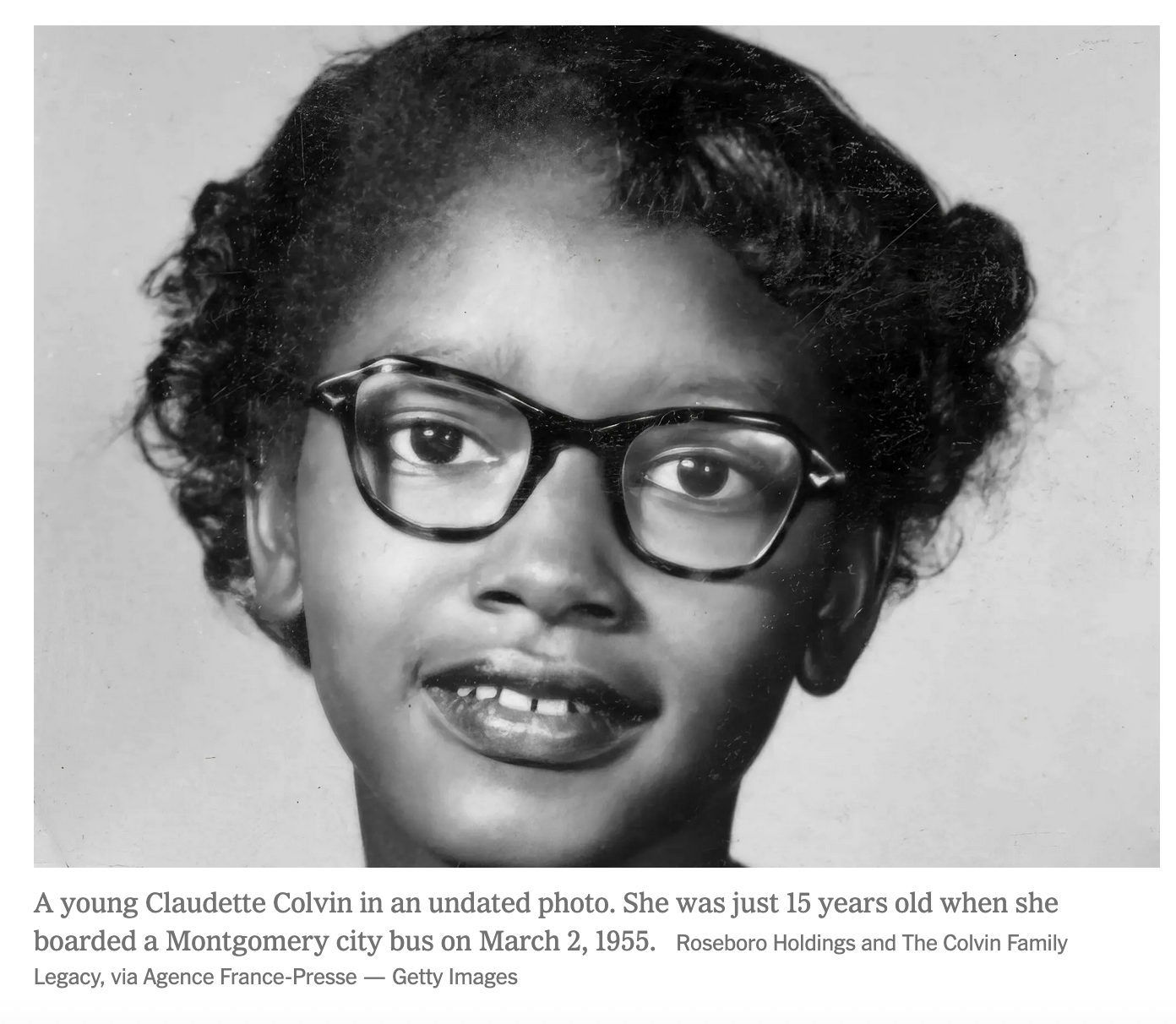
It’s in this context of the Orange Wizard’s love for fake history that I attentively read 1950s civil rights activist Claudette Colvin’s obituary in the NYT this week.
Colvin was the Alabama teenager who refused to give up her seat on a Montgomery bus in March 1955. This was several month before Rosa Parks did the same thing. The local NAACP didn’t think the unruly fifteen-year-old would make a good symbol for the cause; she got charged with assaulting an officer when the cops showed up to drag her out of her seat and off the bus. Movement leaders waited for upstanding citizen Parks to go for it the following December.
Colvin’s obituary also turned me on to this wry quote:
In 2021 a local court expunged her assault conviction from her record. A crowd awaited her outside the courthouse.
“I guess you can say that now I am no longer a juvenile delinquent,” she told the well-wishers.
The #8 > The L8
Thank you new Seattle Mayor Katie Wilson for telling SDOT to come up with a plan that will speed up the infamously unreliable and late #8 bus.
Wilson issued her first executive order, Executive Order 2026-01, this week, directing the department to come up with a plan by mid April to design and install at least one dedicated bus lane on Denny Way. While the executive order isn’t specific, she told reporters “at a minimum” SDOT should build a bus lane between 5th Avenue N and Fairview Avenue, the most delayed portion of the popular Denny Way arterial.
Under her predecessor Mayor Harrell, the city said prioritizing buses over cars on Denny was unfair.
Wilson’s other out-of-the-gate executive order, by the way, directs the city to come up with a plan to “expedite the expansion of shelter and affordable housing” to address the city’s ongoing homelessness crisis.
Before I get to this week’s three official obsessions, I’ve got a Quote of the Week. Maybe you’d have to hear host Catherine Whitaker’s mix of posh British indignation and bemusement (go to the 59:52 mark) to fall apart laughing like I did, but during The Tennis Podcast’s Australian Open preview this week she was utterly flummoxed.
“Who on earth is Luciano Darderi?” Whitaker cries in reference to a player she’d never heard of. “And how is he 22nd in the world?”
She and co-hosts David Law and Matt Roberts were going over the men’s and women’s draws. I don’t know if the fact that David and Matt simply ignored Catherine’s urgent inquiry meant they’d decided to shrug off her latest dose of hilarity or if, like her, they themselves had zero idea either.
I’d certainly never heard of the fellow, though it turns out he’s real. To honor Catherine I chose Luciano Darderi for my Australian Open fantasy roster.
Yes, I’ve reached the point in my tennis dork fanaticism that I’m now in an Australian Open fantasy league; my game-theory, math friend Dave in Brooklyn invited me to join.
In addition to the Australia Open, I’m also obsessed with…
1) Private Symbolism
I’m (still) all lost in former Utah poet laureate and current University of Utah English professor Paisley Rekdal’s practical poetry primer, Real Toads, Imaginary Garden [I’m All Lost In, #115, 12/28/25.]
This week I was taken with Rekdal’s section on “Private Symbolism” where she uses cryptic references from Octavio Paz’s poem Motion—“the forest of clouds,” “the amber mare,” “the basket of oranges,” “the sleeping land … and the green cane”—to help show readers how to approach evasive verse.
Rekdal analyzes the poem right before our eyes with the friendly touch of a veteran prof. Following her own directive, she starts by interrogating the specifics of Paz’s poem. For example, she focuses on: its title; the (lack of) punctuation; who’s speaking (and to whom); and the relationships between Paz’s secretive metaphors, all to help us get a foothold.
These lines of small-scale inquiry often prompt further questions such as Are there differences (tension) between metaphors? And What might a contradiction in the metaphors tell us?Orare there similarities in the metaphors (ground)?
These poetry forensics, as Rekdal calls them, often prompt her to say utterly beautiful things. In looking for “what all these different scenes have in common” in Arthur Sze’s flickering poem First Snow she concludes: “we see the world before we perceive its essential transience, and our own inability to finally claim or inscribe ourselves on it.”
I’m obsessed with Rekdal’s appreciation of “private symbols”—”images we haven’t heard before, [which move] us away from conventional symbols … to make language new”—because my own poems rely on suis generis imagery. Relieved to read Rekdal’s acknowledgment that private symbols are necessary and rich sources for poetry, I texted my poetry pal Dallas, a high school English teacher: “[I’m] liking Paisley Rekdal on ‘Private Symbols.’ Hoping she provides more guidance on how to ‘construct their meanings … over the course of a specific text.’ … My current poem has about 12 private symbols. ….”
It’s true! “I’m like John Wilkes Booth/or some other strange lodger in town.”
2. Urban Resilience, Urban Resistance
Calling out President Trump’s preference for “governance by intimidation,” American historian Heather Cox Richardson released a video about Minneapolis this week that cites public resistance to ICE’s presence there as a hopeful sign in this dark era of Trumpism.
The lefty Instagram account Voteinorout summarized:
Historian #HeatherCoxRichardson points to Minneapolis as a turning point. After ICE agent Jonathan Ross shot Renee Nicole Good, the Trump administration surged more federal agents into the city, pulling them from other operations. The goal was intimidation. What happened instead was mass refusal. People did not stay home. They showed up anyway, despite fear, and openly rejected federal actions they believe violate the Constitution. According to Richardson, this matters because the administration does not have majority public support and does not have the personnel to control communities that refuse to comply.
This is what authoritarian systems rely on. Fear that causes people to obey in advance. Minneapolis broke that pattern. When people stop complying, intimidation fails. The lesson is structural, not symbolic. A government without consent cannot impose its will on a population that will not cooperate. That is the shift Richardson says we are watching in real time.
Any catalog of hope from Minneapolis should also note the ingenious, resourceful, and comedic creativity of their resistance as well. Their car FOB trick, for example.
But mostly, two phrases jump out to me from the summary of Cox Richardson’s video: “[ICE] does not have the personnel to control communities” and “a population that will not cooperate.” Both observations point to the messy beauty of cities, which I believe is the antidote to authoritarianism. Trump’s obsession with cities will ultimately be his undoing.
The defining elements of cities are kryptonite to Trump’s aspiration for top-down rule. The mishmash of different ethnicities and cultural tribes. The networked and organized chaos (think bus and subway systems). The elite hospitals and major universities (brains and youth). The MO of sharing resources (electric grids are more cost-efficient when they serve density). The abundance of arts and artists.
This list of urban attributes is why MAGA hates cities. Irrepressible cities threaten MAGA’s control-freak world view. It also explains why Trump is obsessed with going after American cities.
Too bad for Trump: The very things that make cities epicenters of human achievement, economic success, and fast-forward culture are the same things that make it historic folly to try and bully metros into submission. Trying to contain their elegant chaos, their diversity, their cooperation, and their abundance of brainiacs and original thinkers will be the ruin of any occupying force.
Perhaps an overdramatic comparison. But I point you to Warsaw’s stalwart and vibrant underground during Nazi rule. Check out historian Ben Wilson’s 2020 book Metropolis, which casts cities as “humankind’s greatest invention” and dedicates a chapter to Warsaw, 1939-1945 as a way of dramatizing the irrepressible DNA of urban culture. Like the proverbial flowers growing in cracked sidewalks, Warsaw’s underground network of social services, schools, and opposition plagued an outraged Hitler who was, to his own detriment, fixated on destroying the city, then home to Europe’s largest population of Jews. ”At one point the ghetto had 47 underground newspapers,” and people cleverly used the streetcars to communicate covertly.
Throughout history, urban infrastructure has repeatedly been reimagined as rebar for resistance. Roads and bridges between Lexington/Concord and Boston. The buses of Montgomery. The hi-jinxed street signs of Prague versus Soviet tanks. A gay nightclub rope-a-doping cops on Christopher St. And today, Kyiv’s underground Metro stations as bomb shelters.
“‘The streetcar sympathized with us,’” Wilson quotes one Warsaw memoir. “‘People relished traveling by the tram, for it was there that jokes and rumors were whispered between passengers.”
Not only was Hitler apoplectic about Warsaw’s steely stamina but his fixation drew much-needed resources away from the German’s Eastern front. “The self-proclaimed destroyer of cities, Hitler was destroyed by cities,” Wilson concludes in his Warsaw chapter.
I understand that this is a morbid analogy. And, in fact, after six years of occupation and failing to crush Warsaw, Hitler ended up deracinating the city in 1944 by burning buildings, psychotic door-to-door warfare, mass deportation, and genocide. Wilson acknowledges this, noting the horrific extremes the Nazis eventually took as a way to actually show the folly of Hitler’s apocalyptic Warsaw end-game. It is illogical to level and depopulate a city in order to conquer it. There’s nothing left but rubble. What have you gained?
What does this contradiction tell us? I believe it’s emblematic of the twisted program of authoritarianism and, simultaneously, the magic of cities.
3) Coffee Oriented Development & the Piedmont Café
More of a discovery than an obsession. But wow. What a find.
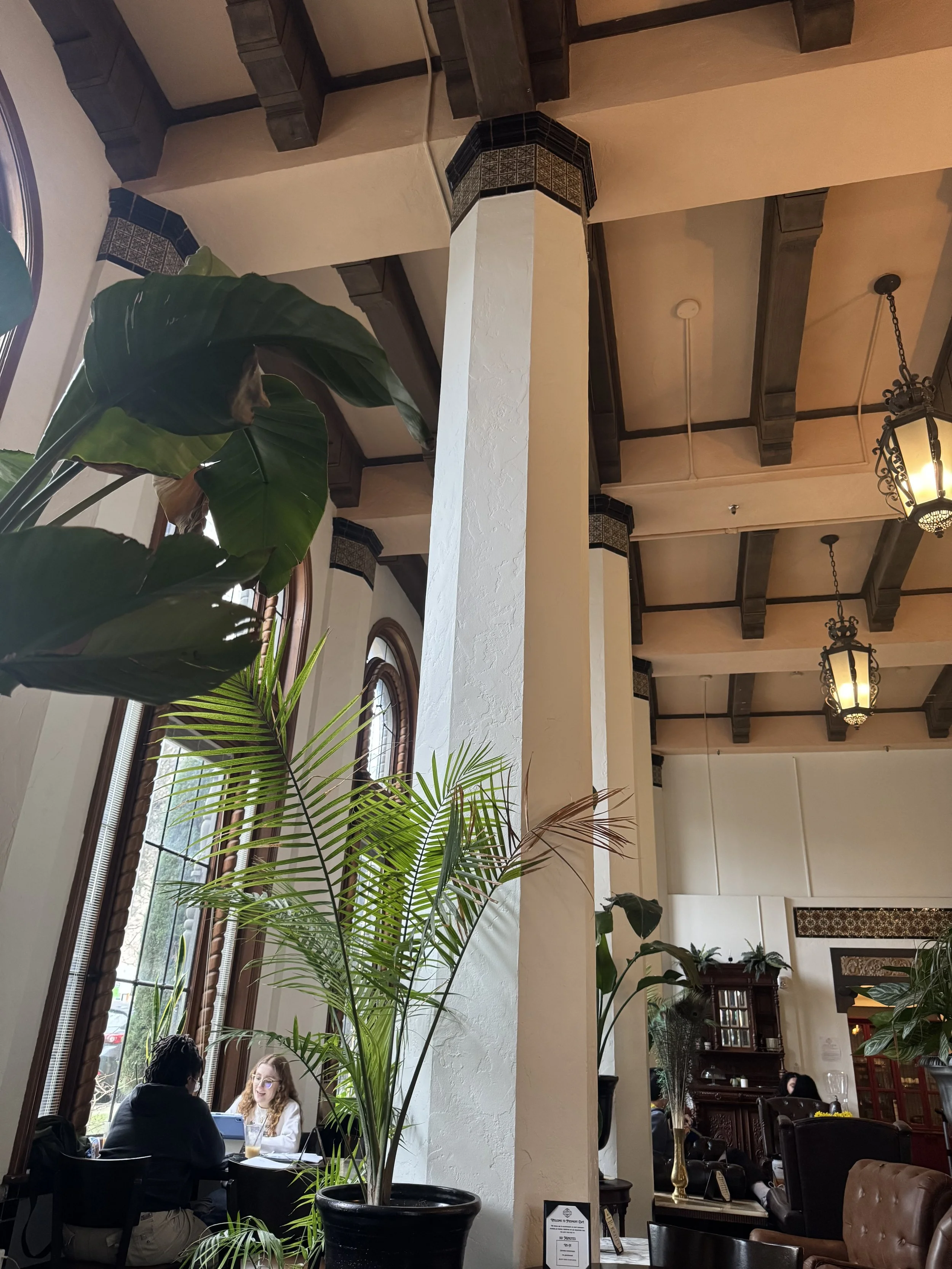
The time machine at Seneca & Summit, 1/15/26.
When I asked XDX how she found out about the epic Piedmont Café, a Seattle coffee shop I’d never heard of, she said: “It’s across the street from the #2 bus.”
This kind of transit-line serendipity and discovery in which you happen upon places beyond your neighborhood is one of the great things about city life.
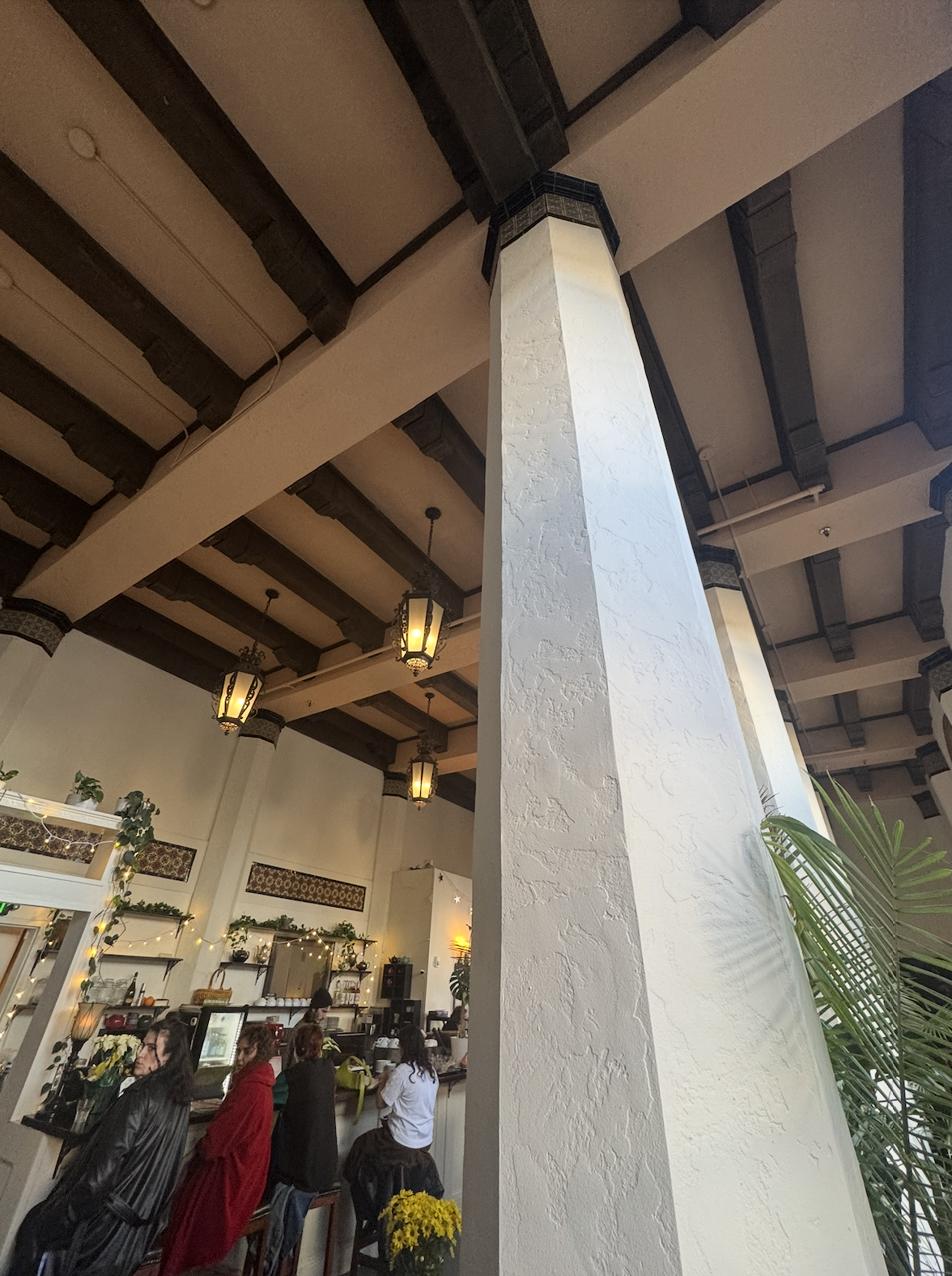
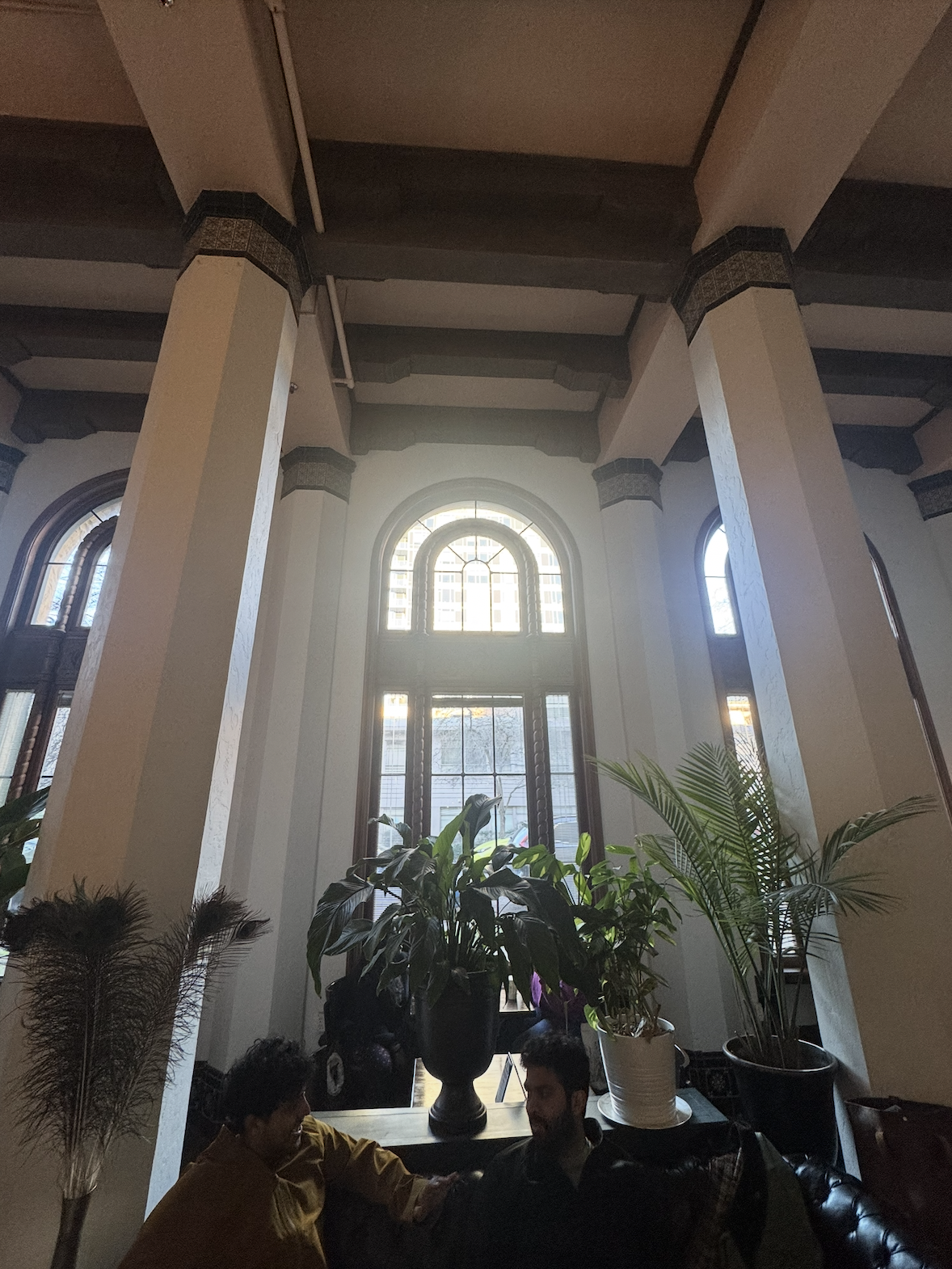
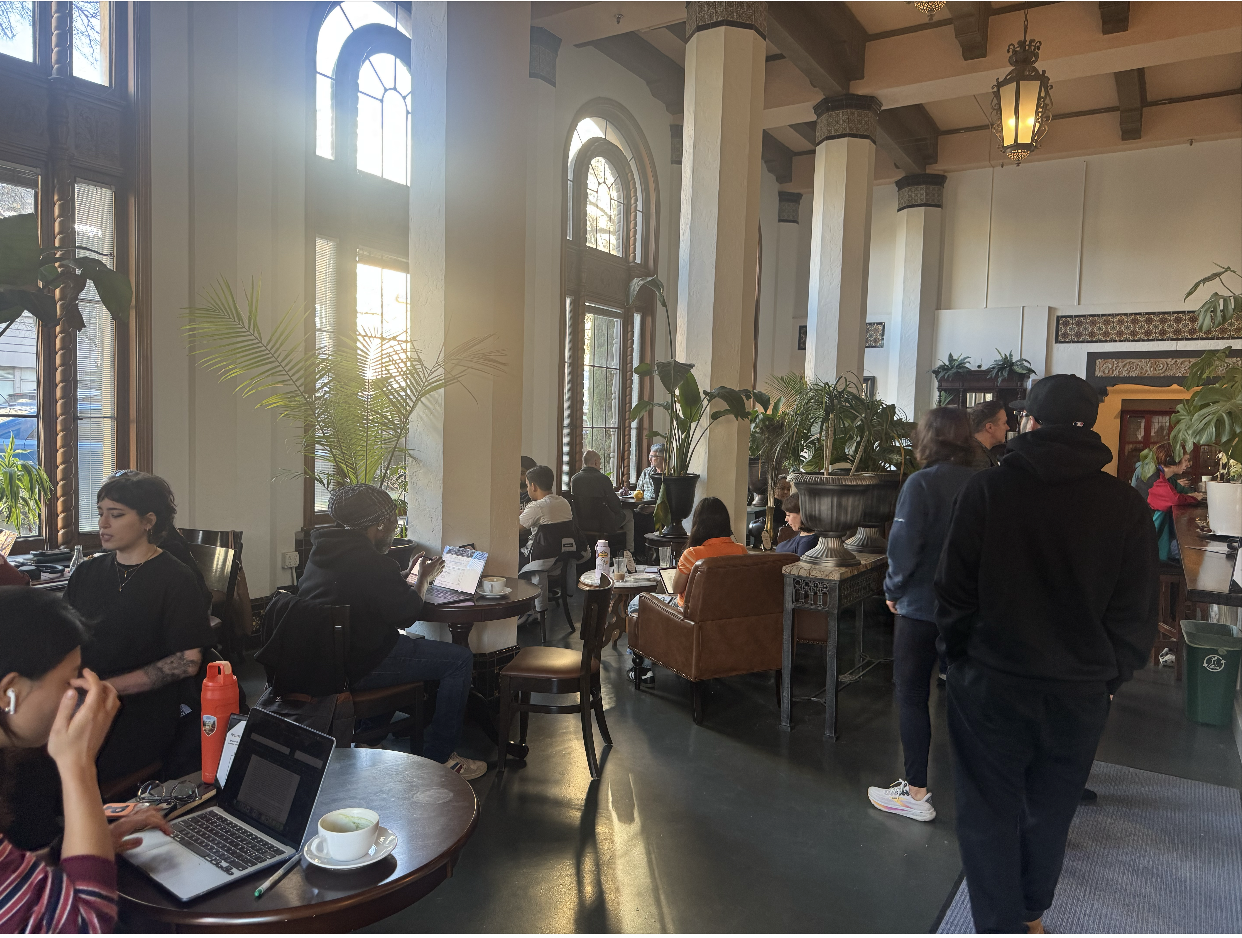
Piedmont Café opened a year ago in the refurbished grand lobby of the old Piedmont Hotel, a 1928 Italian and Spanish-colonial building tucked incongruously between apartment towers and medical buildings at the corner of Seneca & Summit on First Hill. .
This place is breathtaking. There’s no other coffee shop in town like it. Soaring white pillars. Hanging wrought-iron lamps. Giant arched windows. Trailing ivy. Brown leather wingback chairs. Intimate but sturdy round tables with proper cushioned seating. All laid out under a church-high ceiling with touches of Azulejo (Portuguese) tiling. Slip in off Seneca and into a time machine. It feels like you may run into Dorothy Parker, Tallulah Bankhead, or some droll columnist for the long-lost New York Evening Mail.
On my two visits this week, I grabbed a seat at the long mahogany coffee bar because it was the only spot left.