
I’m All Lost In
the 3 things I’m obsessing about THIS week
#160
The Week in X > (is greater than) Y
Beta Blockers > Whiskey I was sitting at my hotel desk at work on Tuesday afternoon idling in anxiety about the election. Visions of whiskey were filling my imagination. A tumbler of bourbon on the rocks at a warm bar would relax me. But I’ve cut booze from my life this year. So, I messaged a simpatico and trusted work colleague who I’ve often bonded with about pharmacology. She attentively appeared at my desk moments later with a capsule of Propranolol, my drug of choice [I’m All Lost In, #36, 6/21/24], [I’m All Lost In, #92, 7/21/25]. The large pill she handed me was cartoonish in its perfection. And magical in its effect. As it reliably does, the beta blocker deflated the pressure in my chest from frantic red to halcyon blue. Feeling this shift also added a dose of endorphin euphoria to the oceanic calm.
Ironically, after work I found myself at a cozy bar (with couches and settees and drapes), sipping a club soda, reading a novel, and monitoring the election returns. More seismic relief: The results were clear right away with the initial counts from Georgia showing the Democrats won the senate race there by 20 points and elected a Democrat for governor, the first Black female governor in U.S. history.
Taking a Shower in the Dark with My Night Light Aglow > Taking a Shower with the Overhead Lights Blaring I suppose this is simply my version of taking a bath Emily-Dickinson-style with candles flickering on the brim of the tub. But my simple personal innovation of showering in the dark with just a night light clicked on beyond the curtain is a real revelation.
Florescent bathroom lighting is grating, so I’ve tried taking showers in pitch black darkness, hoping to enhance the soothing effect of these daily respites. But finding the shampoo and soap is cumbersome in the dark. As is finding a toothbrush and toothpaste, unscrewing the toothpaste cap, and squeezing a dab onto my toothbrush. Typically a comic disaster.

Now, with my night light glowing and some ambient electronica playing, I have transformed showering from one of life’s simple pleasures into a legit joy. I can also find the shampoo, my ex’s coconut milk spray, my toothbrush, and floss with ease.
Staying for Iroiro’s Second Set on a Work Night > Leaving at 10:15 pm to Go Home to Bed My favorite theremin-based, psych-rock trance band, Seattle’s own Iroiro [I’m All. Lost In, #104, 10/12/25], played an album release show on Thursday night at Chop Suey.

They played a brief warm-up around 8pm before the eccentric supporting acts—witchcraft mystics Mt. Fog and meta industrial duo the Ononos—wowed the crowd. I stepped outside to cool down after enjoying those epic performances with the lulling fall weather luring me to head home.
Fortunately, a sentimental conversation with Iroiro’s keyboard player Michiko, an old acquaintance who happened to be standing outside as well, and the surprise arrival of my good friend Dan, who I’d invited but hadn’t expected to show up at this point, reanimated me. I headed back inside to watch the band play their second set at 10:30.

Iroiro at Chop Suey, Capitol Hill, Seattle, 11/5/26
Iroiro crosses Velvets drone with the same psychedelic acid rock sound the Velvets supposedly countered. And Michiko updates her band mate’s 1967 gloom-room-a-go-go electric guitar attack with swirls of glitch-era synth pop on keyboard. This mix of neo-wave synthesizers, shredding electric guitar hypnosis, ghostly theremin, and straight alt-rock bass and drums conjures rock music’s 60-year history of underground clubs all at once. After a final elegant crescendo of noise, Iroiro guitarist and theremin expert Kento Oiwa segued into a dreamy arrangement for solo theremin to conclude the night.
Happy that I’d stayed for the rock-venue lullaby, the evening once again lured me home. I hopped on the #12.
This Week’s Obsessions
1) The 2026 Midterm Election
The best way to understand the midterms is to understand that Stephen Miller doesn’t matter.
Who cares that Trump named Miller as White House Chief of Staff on Friday. The joy of Tuesday is that I can’t be bothered with what Trump does anymore. Watching fellow Democrats chase the Miller story this week with the usual outrage strikes me as to miss the point of the election. And it doesn’t help that the New York Times fell for it too as they amplify Trump’s post-election cry for attention by playing along. Their willingly gullible headline ponders Trump’s decision to “forge ahead with an agenda that many voters rejected.” More accurate headline: Trump reverts to class-clown form by taunting Democrats with obvious troll.
Trump thrives on driving the Democratic base crazy. Appointing Miller as a response to election day’s thundering anti-MAGA vote was Trump, in a state of denial, attempting to get his usual round of attention as if he still had that power over us. The point Democrats need to take in is that he doesn’t. Or shouldn’t anymore. He's a lame duck saddled with a movement that utterly collapsed on Tuesday night in the biggest popular vote backlash in fifty years.
And practically speaking, Miller has already had teacher’s-pet prominence in the White House anyway. Miller’s elevation to COS now doesn’t represent anything new. Trump and Miller have been destroying America with their KKK politics for years. Miller is the policy architect behind ICE and its terrorist mission, one that has imprisoned an estimated 70,000 people in abusive detention centers to date.. Feeling outrage over Miller’s new role is redundant. The only thing that’s new is that Democrats have the power now to stop him. Let’s act like it. The historic blue wave means that rather than taking Trump’s bait and flipping out about his every latest knee jerk ploy, we can take the initiative. Let’s.
The commanding Democratic majorities can block any new Miller policies and also hold Miller accountable for his reign to date, including conducting a congressional investigation into the deaths of Renée Good and Alex Pretti. By the way, as I wrote 11 months ago, ICE’s defeat in Minneapolis is when the mainstream anti-Trump backlash began [I’m All Lost In, #118, 1/18/26].
This week’s historic rebuke is also a historic mandate. We should take the initiative by passing Democratic policies. Trump will be the one who’s now stuck reacting.
It’s fitting that the last time either party won the House popular vote by such a decisive margin (at least 13 points) was when the Democrats did so in the immediate aftermath of Watergate in 1976. This comparison isn’t potent simply because of the analogy between two historically corrupt presidents, but more because the American project to expand rights was in full bloom in 1976. It was nice to wake up in America again this week.
As this becomes the “Shove that ballroom up your fat ass!” election, it’s worth pointing out this now-famous taunt happened at a rally in Mississippi in late October where Trump was campaigning for Republican incumbent Sen. Cindy Hyde-Smith. The Democratic challenger, District Attorney Scott Colom is now poised to win and flip another red senate seat blue.
2) Stanley Kubrick’s The Shining (1980)
I arrived at the movie theater before XDX and ECB and Daniel. We were seeing Stanley Kubrick’s classic 1980 chiller, The Shining. It was playing on the big screen at SIFF Cinema downtown last Friday night for Halloween weekend. With some time to kill, I slipped next door to a swank hotel bar where the evening got off to a promising start: After I took a seat on a bar stool, ordered a club soda, and told the bartender I was about to see The Shining, he got a glint in his eye, curled his lips into a sinister smile, and said “I’m not here.” Well played.
It turns out that’s not actually the line from the movie, though it evoked those great scenes at the Overlook Hotel bar between Jack Torrence (Jack Nicholson) and the haunted bartender Lloyd (Joe Turkel). We burst out laughing in our shared memory of the movie’s spooky 1920s mood. The line my bartender was channeling (if a bit inaccurately) comes in a scene between Jack Torrence and one of the hotel’s other ghosts, Grady (Philip Stone), a waiter at the hotel.
JACK: Mr. Grady, you were the caretaker here.
GRADY: I’m sorry to differ with you, sir, but you are the caretaker. You have always been the caretaker, I should know, sir. I’ve always been here.
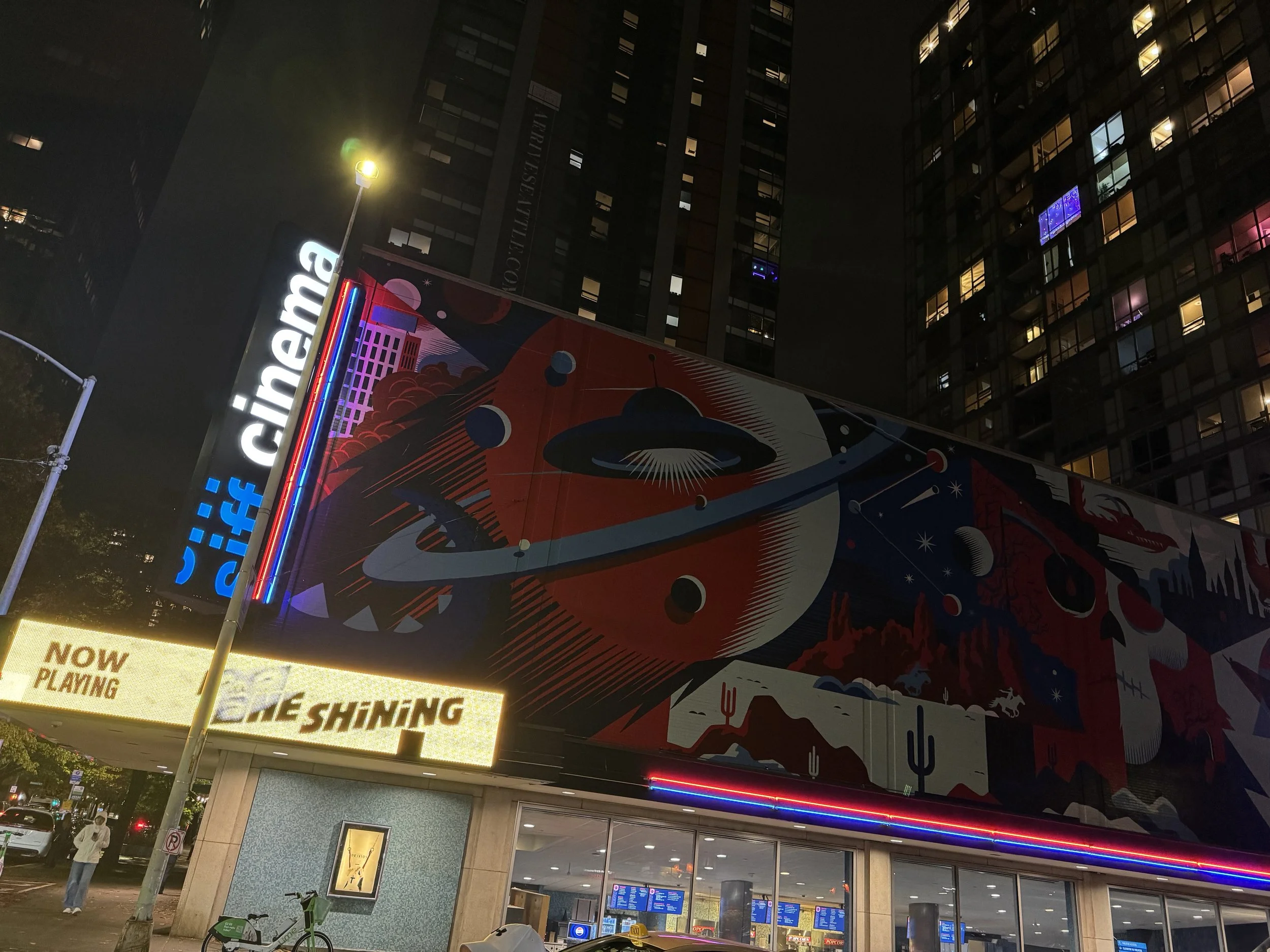
Downtown Seattle, 10/30/26
I originally saw The Shining when it first came out, in the theater with my mom when I was 13. I actually talked about this movie outing when I spoke at Mom’s funeral this June: How she wanted to have a deep conversation about the movie as she drove us home. For example, she asked me if I thought it was about the deracination of Native Americans.
Seeing it again on Friday, I picked up a number of references to America’s war on Native Americans. The hotel manager’s story about how the Overlook was built on an “Indian burial ground” and his follow-up line about how during construction the owner’s had to "repel a few Indian attacks.” There’s also Nicholson’s colonialist reference to the “white man’s burden.” And there’s the Native American motif in the hotel decor, including the carpets and indigenous artwork and the cans of Calumet baking powder with their Native headdress logo looming in the kitchen scenes. Mom may have been onto something. (A 1987 essay titled "Kubrick's 'Shining' Secret: Film's Hidden Horror Is the Murder of the Indian" evidently lays it all out.)
And of course, directly related to these allusions about American oppression, one of the movie’s pivotal characters, the Overlook’s head chef, Dick Hallorann (Scatman Crothers), is Black. At one point, Nicholson and his ominous, imaginary friend Grady refer to Halloran with the N-word.
As a telepath who bonds with Jack’s troubled young son Danny (who has an imaginary friend of his own!), Hallorann is the film’s only ray of hope. He’s a sort of guardian angel who Nicholson brutally murders with an axe in the main lobby of the hotel. (Ironically, Kubrick’s politically conscious script is driven by stereotypes in its own right when it comes to Hallorann.)
Ultimately, I’m still having trouble tying any of these political themes to the movie’s other threads, including Danny’s domestic trauma, the idea of writer’s block, and the interplay between hallucination, ghosts, and the real world.
Even if you could spin The Shining as a political parable about colonialism, I’m not convinced that would clarify this exquisite yet kind of bewildering film. For example, how do all the ghostly parallel worlds connect? I count at least three different overlapping decades with three stories that don’t match up. For me, the Grady character is the perfect example of how unwieldy these threads are. Grady supposedly murdered his family in 1970 when he was the caretaker. But here he is in Jack’s hallucinations about the 1920’s when Jack himself was supposedly the caretaker as he is again in the present.
Despite The Shining’s confusing plotline, XDX, ECB, Daniel, and I left the theater wowed and frightened by this obvious masterpiece. We stood in the lobby having a deep conversation as if we’d all just seen the movie for the first time. It was not unlike the conversation Mom wanted to have. An usher had to nudge us out the door into the night.
3) The Unexpurgated Sister Carrie
This is the third week in a row that Sister Carrie, Theodore Dreiser’s Naturalist American classic, has made my obsessions list. [I’m All Lost In, #158, 10/25/26] and [I’m All Lost In, #159, 11/1/26.] That’s because it’s taken me three weeks to read the 500-page novel. And I’ve been obsessed the whole time. Especially reading the last 150 pages this week as the plot gathered momentum on Dreiser’s glamorous and grim Manhattan street grid.
I certainly didn’t see the labor unrest story line coming. ”The city was invested with militia” Dreiser writes in Chapter XLIV as the novel takes on a gloomy eloquence about the internal contradictions capitalism fosters in the working class. “Strip him of his uniform and he would have soon picked his side,” Dreiser writes about a police officer who “sympathized with the strikers,” but “felt the dignity of the police force, which commanded order.”
This personalized juxtaposition is itself juxtaposed against the external world: Broadway’s glamorous “region of theaters hotels;” its “opera coats;” “Cabs and carriages, their lamps gleaming;” and “rosy restaurants filled with the merry lovers of late hours.” The novel’s main character, Hurstwood, spiraling into privation, is Dreiser’s bitter witness to “the importance of this” class divide, giving Dreiser a platform to write candidly about poverty:
Once he paused in an aimless, incoherent sort of way and looked through the windows of an imposing restaurant, before which blazed a fire sign, and through the large, plate windows of which could be seen the red and gold decorations, the palms, the white napery, and shining glassware, and, above all, the comfortable crowd. Weak as his mind had become, his hunger was sharp enough to show the importance of this. He stopped stock still, his frayed trousers soaking in the slush, and peered foolishly in.
"Eat," he mumbled. "That's right, eat. Nobody else wants any."
The contrast is finally too sharp for Hurstwood as he descends into homelessness. Dreiser’s descriptions of the isolation, vilification, and absence of options that come with being homeless, written some 125 years ago, could have been written today.
The one recourse left him was to doze when a place offered and he could get the money to occupy it.
He was beginning to find, in his wretched clothing and meagre state of body, that people took him for a chronic type of bum and beggar. Police hustled him along, restaurant and lodginghouse keepers turned him out promptly the moment he had his due; pedestrians waved him off. He found it more and more difficult to get anything from anybody.
At last he admitted to himself that the game was up. It was after a long series of appeals to pedestrians, in which he had been refused and refused every one hastening from contact.
"Give me a little something, will you, mister?" he said to the last one. "For God's sake, do; I'm starving."
"Aw, get out," said the man, who happened to be a common type himself. "You're no good. I'll give you nawthin'."
Equally devastating are the few unnerving moments late in the novel when Dreiser depicts Hurstwood’s creeping transition into mental instability. First, unemployed, sitting in his reading chair in the “sheer loneliness” of his increasingly barren W. 13th St. apartment, then homeless in Madison Square Park, and lastly, sitting on the edge of a cot in a twelve-cent Bowery room, Dreiser shows Hurstwood in reverie or perhaps fugue state, reciting memories of his lost life, unaware that he’s doing so out loud.
This all leads to the shocking and bleak finale which was left out of the original edition and not restored until 1980 when Penguin published this unexpurgated version.