
I’m All Lost In…
the 3 things I’m obsessing about THIS week
#159
The Week in X > (is Greater Than) Y
Take Out > Delivery This was about to be a heretical paragraph from an out-and-about city zealot like me; I was going to write that eating at home is better than eating at the restaurant. This was based on Thursday night when I got dinner to go rather than dining in; I got my favorite order, the savory Pad Ped with tofu from The Patio, [I’m All Lost In, #100, 9/14/25.] Sure, landing at home with a bag of takeout boxes, fixing myself a plate of the sizzling veggies, rice, and red curry sauce, and then settling into my apartment was a perfect segue to bed time. But what made the night special was not so much that cozy sequence. It was the on-the-fly decision to call ahead while en route home and pop into the restaurant, where, magically, the white plastic to-go bag was waiting bow-tied on the counter. I chatted with the guy at the register and then strolled back to my apartment, takeout in hand. So, I realized: The juxtaposition is not between eating at home versus eating at the restaurant. The juxtaposition is between takeout and delivery. Either shutting in as Doordash comes to you or being on the go in the city yourself.
Not Getting Your Hopes Up about the Israeli Election > The Israeli Election Here are two demos I recorded in 1989 of a sad song I wrote in 1988 as the settler movement sickness set in: “Election Day in Israel Slip Version” and “Election Day in Israel”
Going to an Art Gallery When it’s Closed on a Friday Night to Write While My Friend Sets Up Her Exhibit > Writing at a Bar on Friday Night, Which is What I Usually Do.
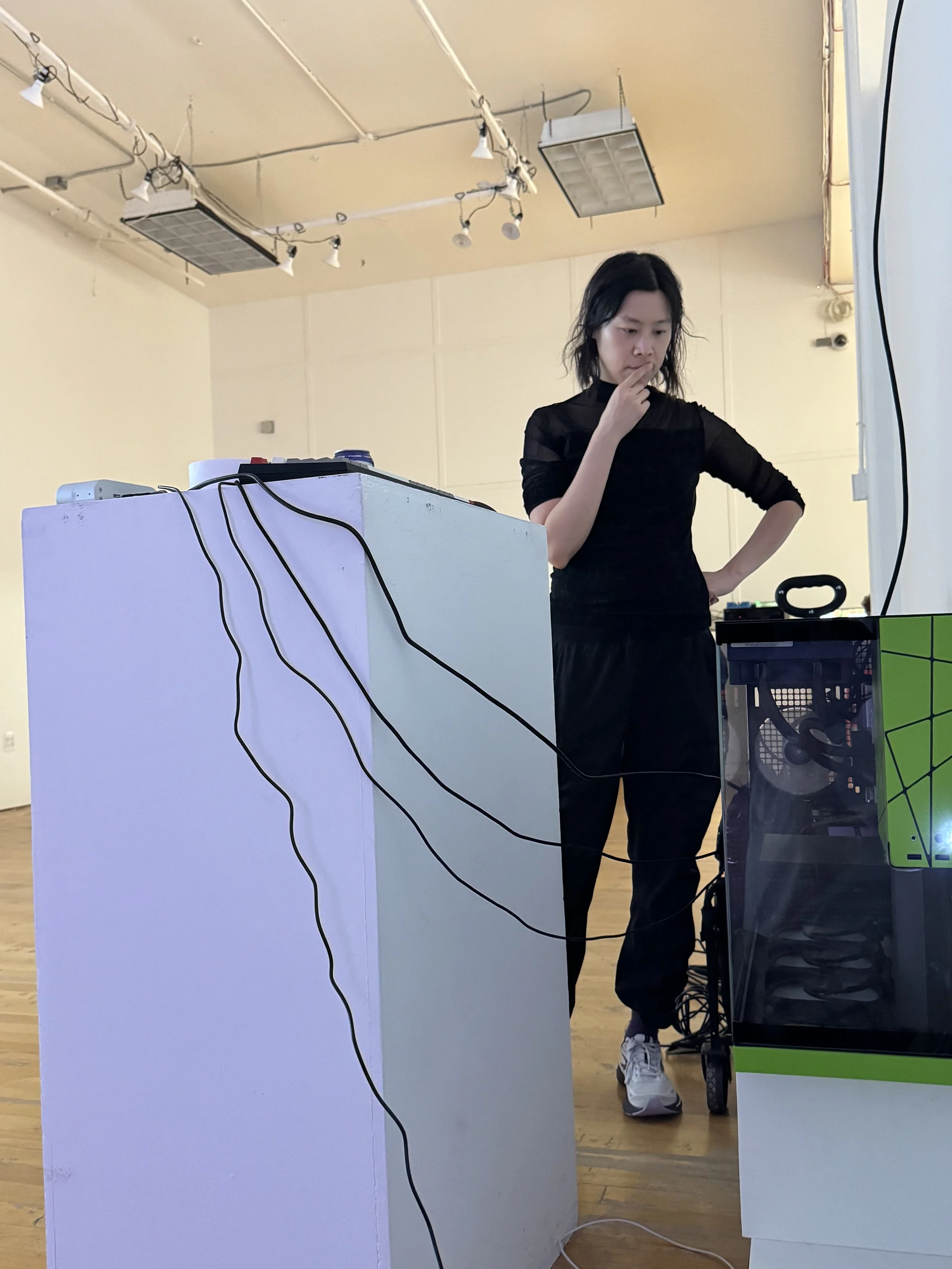
XDX at 9th Ave. Gallery, Cornish College of the Arts, 10/23/26
She’d occasionally ask me to help stack some plinths or tape down a cord or help position a stand. Or she’d ask my opinion about a color pattern. But as XDX and all the other digital artists at the quietly bustling 9th Ave. Gallery tended to their installations in advance of their PNW Arts and Tech Symposium debut, I took a seat, legs folded on the oak wood floor with my MacBook, and slipped into a night of writing.
Having all these busy people nearby reminded me of the comforting feeling I used to get when my parents were chatting in the kitchen, and I was in my room safely tucked in bed. Rather than making me feel sleepy, though, I was energized this Friday evening by all the work going on around me. I communed with the creative din by doing some focused tinkering of my own.
“Have you been writing this whole time?” one of the artists asked as the place started to empty out around 10:45 and the overhead florescent lights started clicking off one by one. I was the last to leave.
1) Art and A.I. Panel Discussion, PNW Art and Technology Symposium
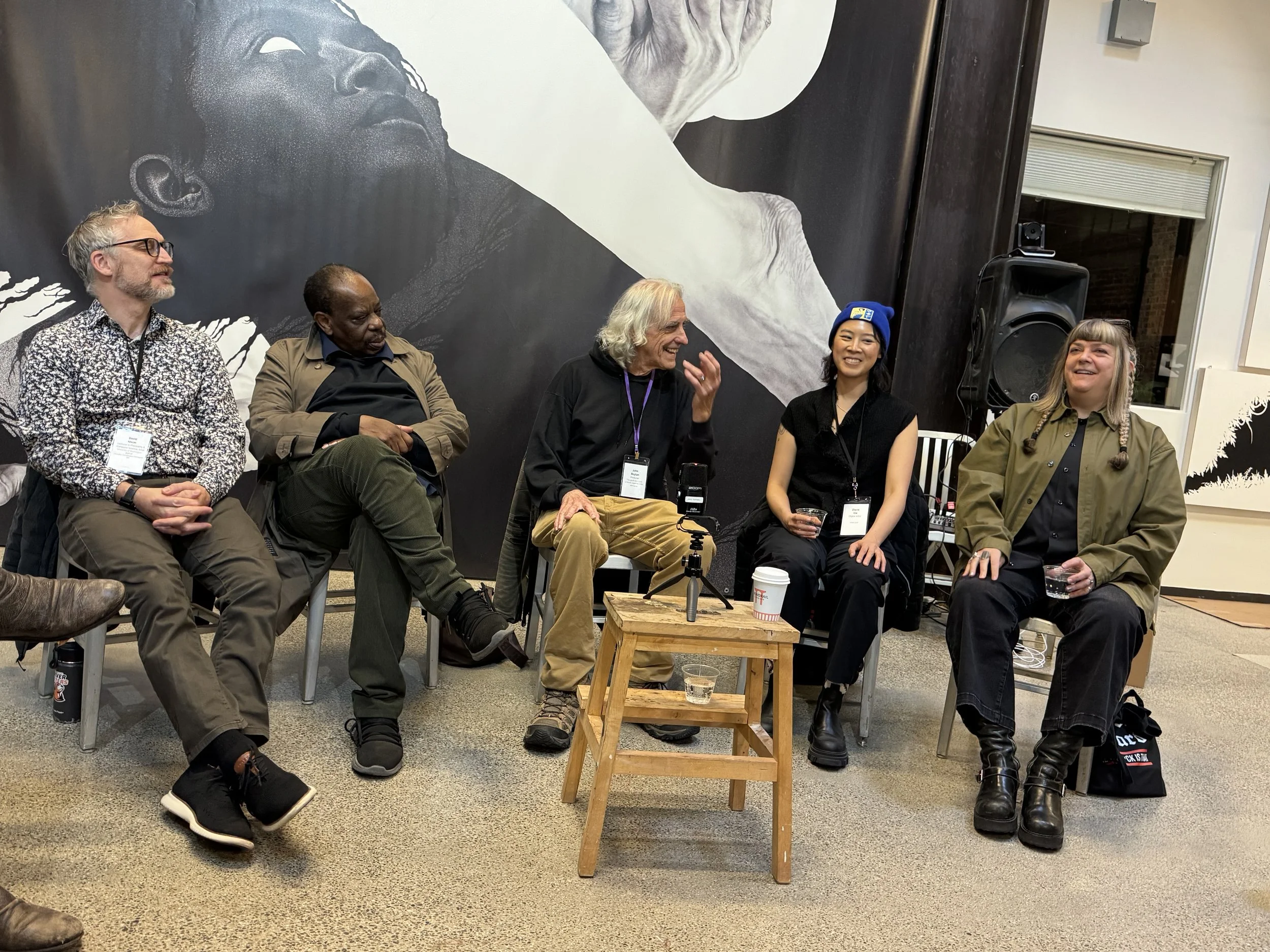
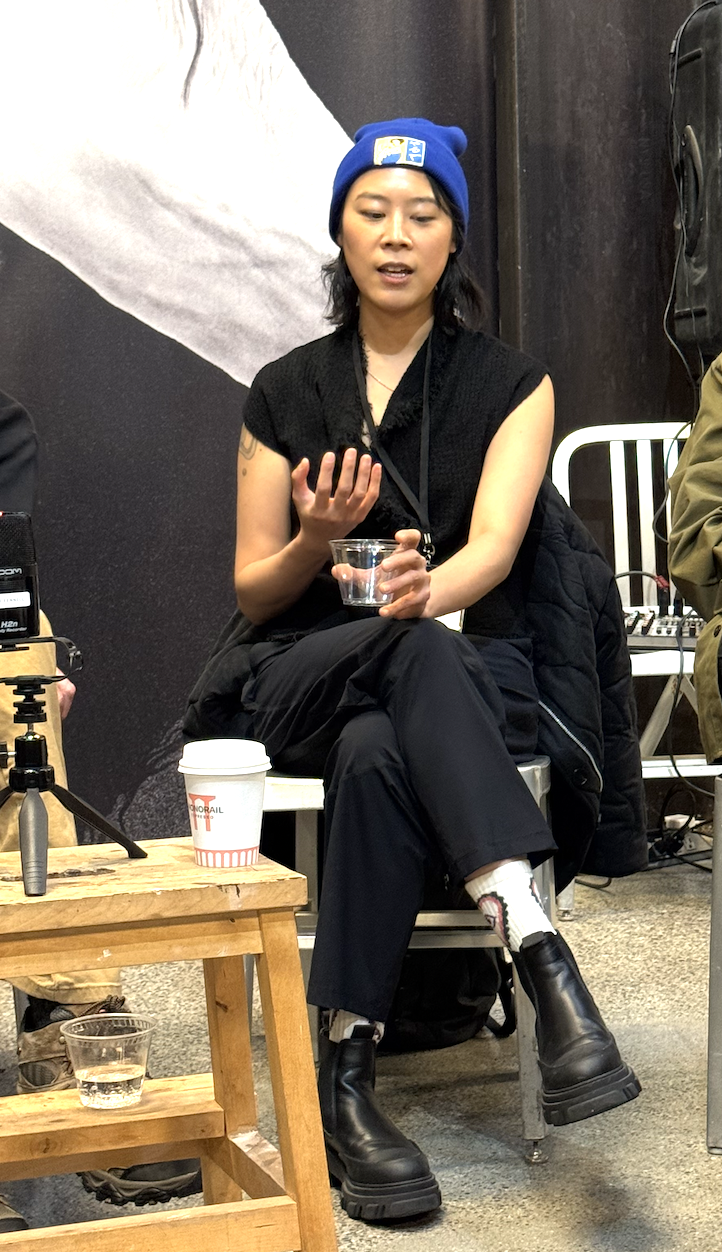
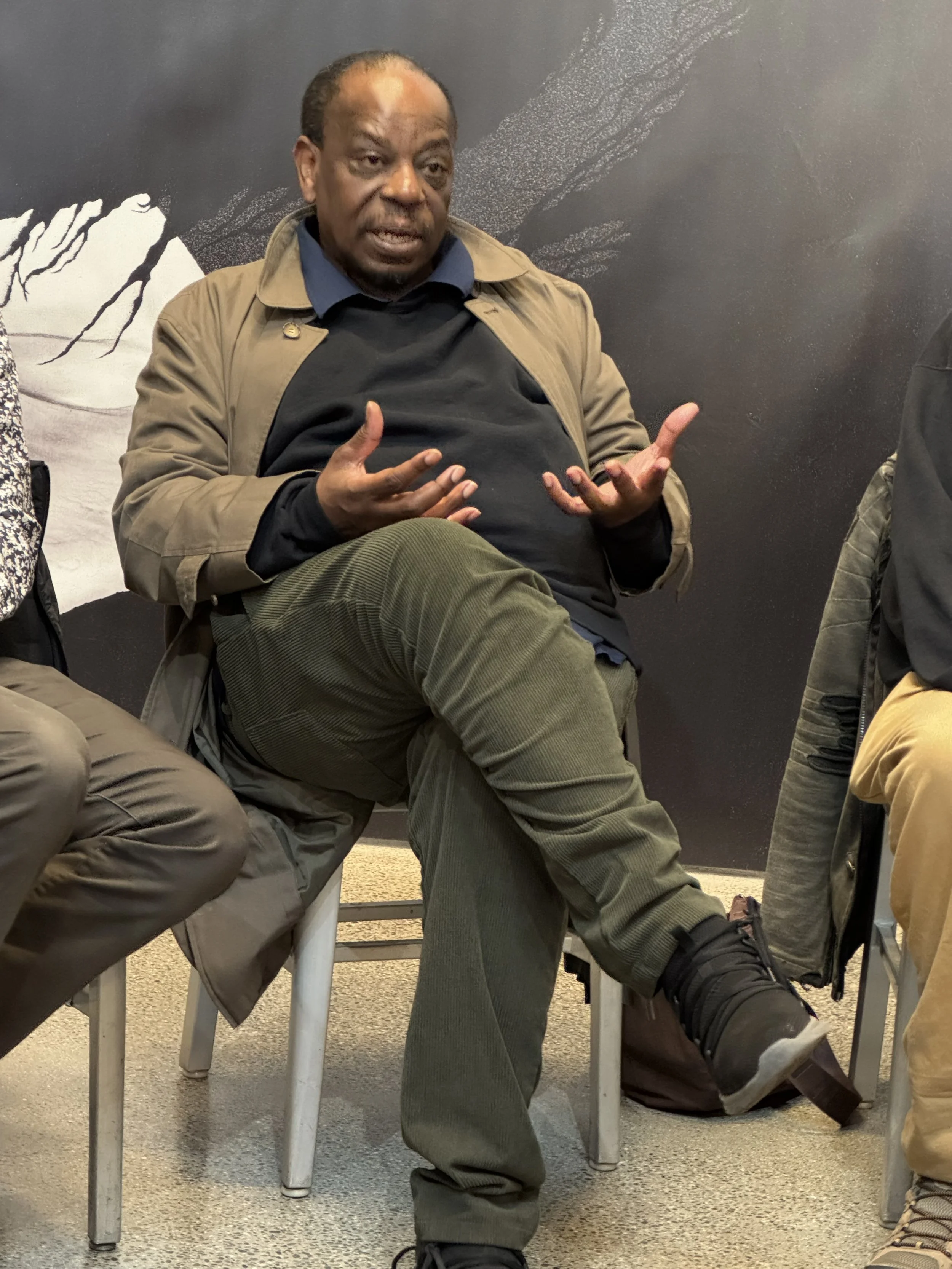
Art & A.I. panelists, 10/25/26, L-R, David Nixon, Charles Mudede, moderator John Boylan, Diana Xie, and Janet Galore.
I’m close friends with two of the panelists who headlined last Sunday afternoon’s discussion at Xispa gallery about A.I. and art (Charles Mudede and Diana Xie, aka, XDX). So, I know their raps well. Charles, for example, a Marxist and contrarian, has a thesis about the surplus value of labor. He says it’s metaphysical as opposed to mechanical. And that as soon as A.I. computes this fact, A.I. agents will become capable of spirituality. Meanwhile, even creepier than that, Charles added this warning about humans themselves: It’s not that A.I. is becoming more human, it’s that human’s are becoming more like A.I. As for Diana, she threw some water on Charles’ dystopian scenario. She identified intention and connection as the human watermark. “You can’t offload intention to A.I.,” she said.
I was enraptured by this hyper-zeitgeist conversation. Taking on the topic of art and A.I. brought all the pressing LLM-era questions to the fore: What does it mean to be human? What is a soul? Can robots achieve self consciousness? And what is art? Is it ultimately the labor and skill that that wows us rather than the art itself? “I’d feel cheated if I was told a song I liked was actually made by A.I.,” panelist and professor David Nixon said.
The brainy audience, crowded around in black plastic folding chairs several rows deep, took an active role in the discussion. Aren’t artists just mining the human catalog themselves in order to make art too?, pioneering tech artist and local light Gary Hill asked a bit cynically.
It was Nixon who eased my fears about the potential robot takeover. What distinguishes human art from A.I. art, he said, is this: The beauty we experience in art is prompted by a two-way conversation. The human artist on one end and another human on the other. Both people are connected by their shared human experience, he reasoned.
Because Nixon had leaned into the word experience, Hill, standing in back, called out a clever rejoinder that cast doubt on the human advantage. Isn’t access to vast data a kind of experience too?
I’d say yes, but it’s not a human one.
Afterward, like late night college students, XDX and I continued the conversation over crispy fried veggie sandwiches at Milk Drunk in Beacon Hill. The delicious dinner led us to agree that the human experience was something A.I. couldn’t replicate.
I texted Charles on the sly though, to make fun of one of humankind’s definitive musical geniuses. I posited that human artists may be no different from A.I. agents. Duke Ellington used Billy Strayhorn as his A.I., I tapped out on my iPhone.
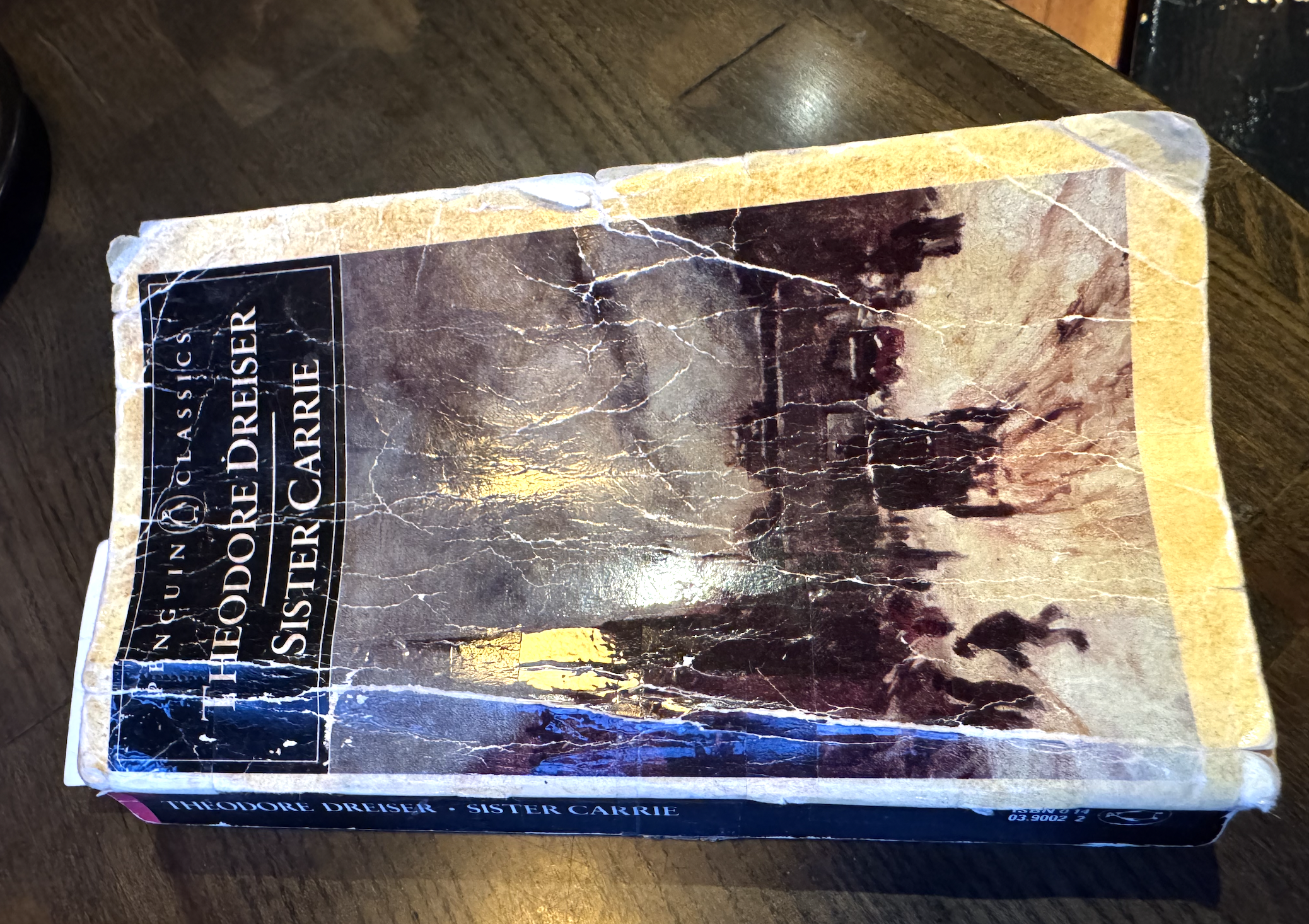
2) Theodore Dreiser’s Sister Carrie
This is the second week running that Theodor Dreiser’s Penguin Classic, Sister Carrie, has made my obsessions list [I’m All Lost In, #158, 10/25/26.] This is mainly because it’s a 500-page novel (so I’m still reading it) and because it gets even better in the second half. That’s when hotel bar manager George Hurstwood, in a heated panic not unlike Alfred Hitchcock’s Marion Crane, absconds with $10,000 from the till ($400,000 in 2026 dollars), kidnaps his estranged paramour, Carrie, and “flies” cross country on a 1 am train.
Let us not forget therefore that Carrie, the untraveled, was traveling.
Valium Tom has been urging me to read this city-centric novel for decades. And when I told him I finally was, he warned me: “Poor Hurstwood.”
And it’s true. Running away does not go well for the once-confident and refined bar manager. Dreiser drags us along step by humiliating step through the slushy streets of Hurstwood’s unemployment, into the desperate hotel lounges of his idle time, and alongside his slouching home to heated arguments in unheated apartments.
Tom’s original comment, that Sister Carrie is exemplary city stuff, is also evident.
Dreiser’s text is contemporaneous, on-the-ground reporting about the turn of the 20th century’s lasting imprimatur on the world: The development of modern cities. Some of his reports sound like a science fiction novelist patiently describing a newfangled technological wonder. For example, listen to Dreiser write about the buzz-in technology at apartment buildings: “One day Carrie’s bell rang and the servant, who was in the kitchen, pressed the button which caused the front door of the general entrance on the ground floor to be electrically unlatched. When Carrie waited at her own door on the third floor, to see who it might be coming up to call, Mrs. Vance appeared.”
Dreiser’s expository forays also read like urban planning policy papers:
“Where is the residence part?” asked Carrie who did not take the tall five-story walls on either side to be the abode of families.
“Everywhere,” said Hurstwood, who knew the city fairly well. "There are no lawns in New York. All of these are houses."
3) The Irony of Not Drinking and Then Drinking
With a few exceptions, including at my epic birthday celebration in August and also the night I found out Mom died in May, I haven’t had any alcohol since late February. One other exception was last Saturday night.
I was at a work colleague’s wedding; it was a spiffy, traditional affair (luckily I brought a tie just in case.) It was crowded as well. 220 guests. And while there was a contingent from work, I was feeling disconnected. Our table, Table 20, was in an adjoining room. A kids’ table setup. Fair.
I glommed onto one of my favorite colleagues, but I was still feeling separate. And anxious. And so I had two drinks from the bar.
Soon enough I was bleak and despondent. Alcohol is a depressant. And now I’m obsessed with that fact. Not that it’s a revelation. But there was definitely a revelation on Saturday night: Avoiding alcohol all year has made the blues more prevalent because I’m not using booze to escape. But since I’m not drinking booze regularly, the downer effects hit harder when I do.