
I’m All Lost In, #149: Watching Olivia Wilde’s The Invite; learning the Chantels’ “Maybe;” and reading Bryan Washington’s Palaver. Plus the Week in X>Y, including misinterpreting Joni Mitchell.
I’m All Lost In …
The 3 Things I’m Obsessing About THIS Week
#149
This Week in X > (is Greater Than) Y:
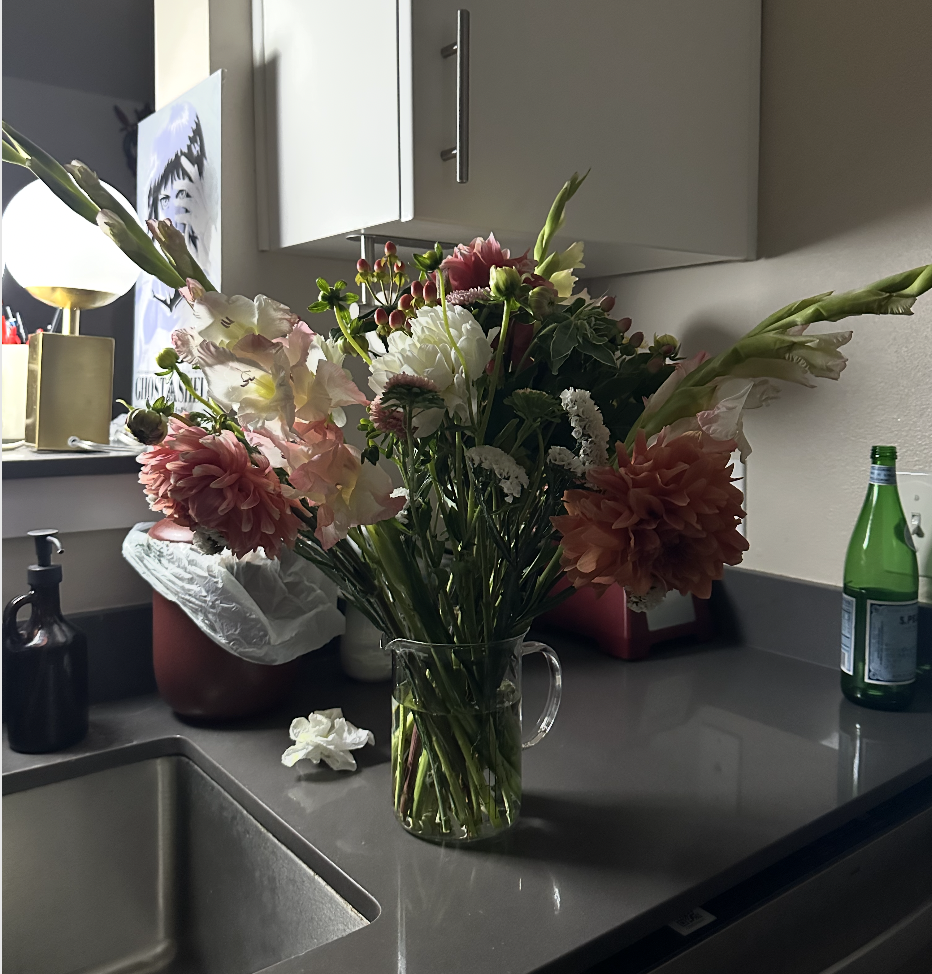
A Farmer’s Market Bouquet > A QFC Bouquet Obviously. But the leap in quality stands out like a peony on a sidewalk. Twice as expensive ($16 versus $8), but exponentially more lovely.
The flowers, which I bought from Simple Bloom at the Tuesday evening Capitol Hill Farmer’s Market this week also came securely set in a plastic bag—like the ones you got as a kid when you bought a goldfish—with a water-balloon serving of cool water sloshing at the bottom. A convincing touch.
8/18/26
The flowers were for XDX; she got some exciting news in her artist guise as Soft Portals this week. Given the botanical mode of her digital creations, a bouquet was befitting.
High Rises > Parking Lots Another obvious one, but the headline to this NYT story about opposition to a new housing development made my day. It was a clever play on the famous Joni Mitchell line “They paved paradise and put up a parking lot” from her 1970 eco hit Big Yellow Taxi.
“Landmarks Panel Approves Designs to Replace Parking Lot With High Rises.”
The story is about a city commission vote to replace a parking lot with two apartment buildings, including 200 units and 50 that will be affordable. And it noted : “Advocacy groups and residents opposed the plan because they said it did not preserve the neighborhood’s historical elements and aesthetic”
I derisively refer to this facile anti-development POV as Joni-Mitchell politics. Liberal Boomers and Xers often quote Mitchell’s parking lot line in their proud NIMBY testimony at city hall. But unwittingly, their knee-jerk "Development=Bad” mantra prioritizes car-dependent lifestyles; stalling new housing development locks pervasive car culture in place by thwarting the density needed to create walkable neighborhoods and expanded transit service.
Admittedly, the parking lots they’re supporting are mostly metaphorical, but perfectly, in this story, the parking lot was real.
A spokesman for the developer, Edward J. Minskoff Equities, said the proposal … would add housing to “a site that previously functioned solely as a parking lot.”
Watching Tennis on the Tennis Channel in My Apartment > Watching at a Bar This is a 180 from an X > (is Greater Than) Y-item I wrote in February [I’m All Lost In, #120, 2/1/26]. And it also contradicts my out-and-about urbanist code.
I don’t know if this is about the sad bar on my block or more about me, but: Excited for this week’s Cincinnati Open quarterfinal match between the WTA’s two most exciting and athletic players, World No. 4 superstar Coco Gauff and red-hot World No. 10 Marta Kostyuk [I’m All Lost In, #117, 1/10/26], I was looking forward to my Friday night plan: Cheering in the privacy of my apartment while watching what I thought might be the most glorious tennis match of 2026. Gauff and Kostyuk have the same superhuman court coverage skills, though Kostyuk looks more like the FTD flower delivery logo when she’s at it while Coco looks a bit more like Charlie Chaplin. But with their equally heroic ability to defend and smash back winners, they’re both breathtaking brick walls.
Unfortunately, their match turned out to be a total dud. Kostyuk brought zero game; she had 38 unforced errors and 8 double faults and Coco cruised to an uncontested 6-2, 6-2 win. Kostyuk’s own coach, Sandra Zaniewska [I’m All Lost In, #140, 6/21/26], was teasing and laughing from the players’ box throughout the lackluster second set.
Also from the Cincinnati Open this week, what I’ve known all along [I’m All Lost In, #15, 1/25/24]: Despite her World No. 1 ranking, some time ago the tennis gods put a deep jinx on my favorite player, Aryna Sabalenka. Blowing it yet again, Sabalneka lost her Round-of-16 match in two ugly sets against World No. 35 Sara Bejlek by unraveling in the first-set tiebreaker 7-9 after being up 5-1, and then losing the second set by dropping five games in a row after being up 4-1. Saby’s Peter Parker status should be clear to everyone at this point. She certainly won’t score a three-peat at the upcoming U.S. Open.
This Week’s Obsessions:
1) Watching Olivia Wilde’s The Invite
You’ll be as uncomfortable watching Ed Norton and Penelope Cruz as the enlightened upstairs neighbors propositioning Seth Rogen and Olivia Wilde, the neurotic and hilarious downstairs couple, as you’d be in real life if a similar, cloyingly empathetic and handsy Burning-Man couple hit on you .
But the frantic Who’s-Afraid-of-Virginia-Woolf? run-up to this calamitous overture … and the bittersweet fallout … makes A24’s The Invite a much-welcome jewel-box-theater drama in our endless era of prefab blockbusters like Christopher Nolan’s Odyssey.
The camera careens around the lone set—a gorgeous, Victorian San Francisco apartment—chasing four separate character studies at once as these lurching couples sally and crash into one another, exposing the fissures in their respective relationships.
Even as Rogen and Norton (and Cruz to a lesser extent) go all out delivering energized and entertaining performances, Wilde steals the show. She directed the up-tempo movie. And her spastic comedic timing, minutely exaggerated silent-film faces, and uneasy beats are captivating. They’re also a worthy, RIP tribute to Diane Keaton, per the film’s dedication.
The quiet ending shot of Rogen’s broken character, a former musician, and Wilde’s character, his unhappy wife and lost soul herself, sitting together at the apartment piano plunking out a sentimental memory together, is a pitch-perfect metaphor for their unresolved story.
2) Learning the Chantels’ “Maybe” on Piano
8/21/26
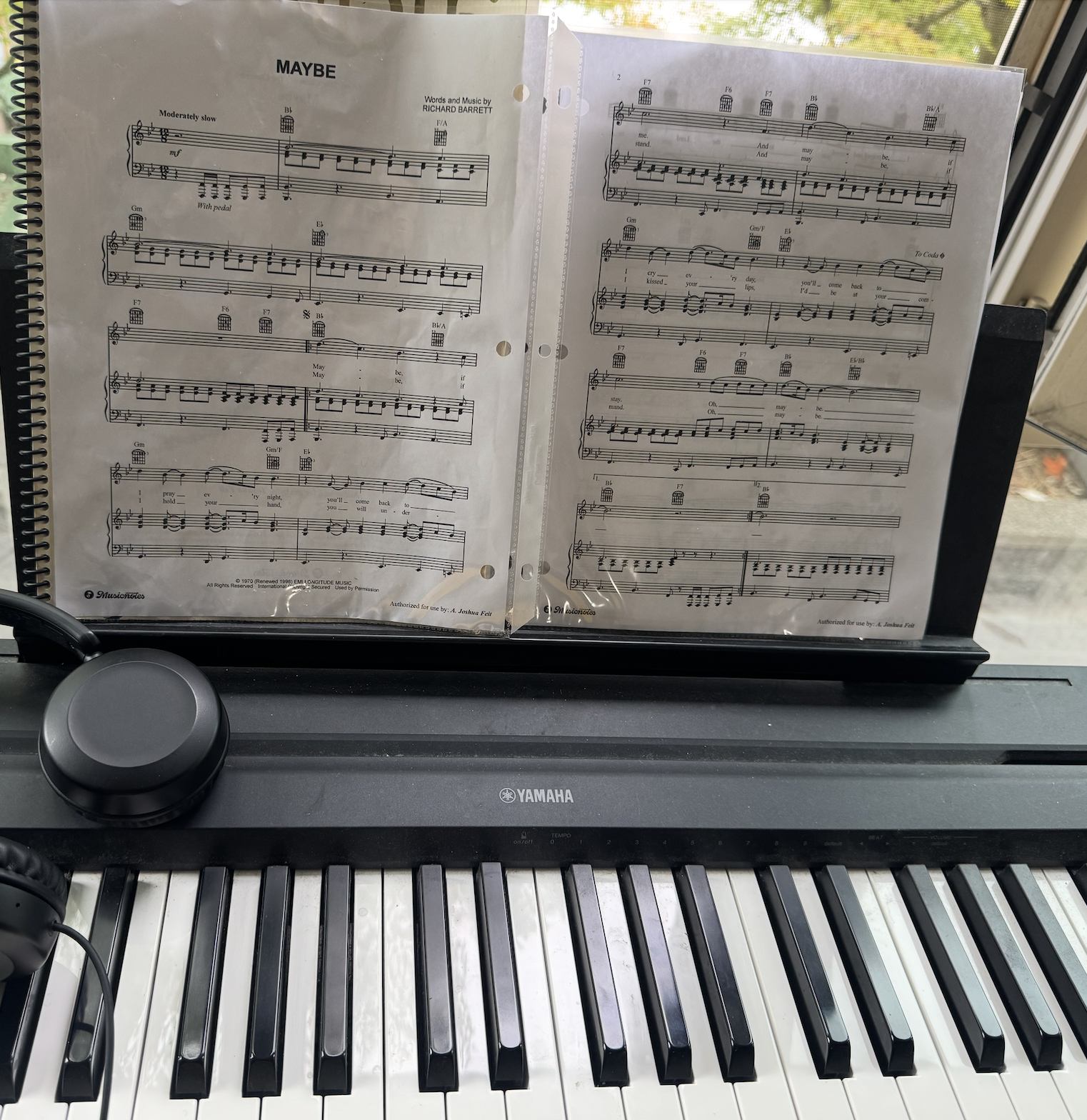
Prompted by my recent obsession with the Chantels’ dynamo debut album We Are the Chantels [I’m All Lost In, #148, 8/16/26], I printed out the music for “Maybe,” the LP’s hit single. The 1958 teen lament was written by the group’s 16-year-old lead singer Arlene Smith and not, as the sheet music says, by the band’s manager, Richard Barrett (a legit songwriter and doo-wop singer—the Valentines—in his own right to be sure.)
While “Maybe” is yet another iteration of the bright I-vi-IV-V “50’s chord progression,” Smith adds some clouds. The passing notes heighten the progression’s heart tug by giving us early looks at the F and C from the Dominant Five chord; “Maybe” is written in B-flat Major (B♭, C, D, E♭, F, G, and A.)
When the song finally does land on the Five (an F-Major chord), Smith channels her classical training and adds a minor seventh note (E flat) and a 13th (a D at the top) relocating the 1950s soda shop to an alternate dimension.
All this trickery makes the teenage formula’s traditional route to the Five via the Subdominant Four Chord land with even more growing pains than usual. Counterintuitively, Smith just plays it straight—E-flat, G, B-flat—making it the prettiest chord in the mix. And the most satisfying to lean into.
3) Reading Bryan Washington’s Latest Novel, Palaver
I’m a fan of Bryan Washington’s short stories [I’m All Lost In, #9, 12/15/23]. Scroll down here for my review of his notable 2019 collection Lot, a book that could have been included on an econ or urban-studies syllabus. Lot’s thirteen linked short stories bring Houston’s Black, Hispanic, immigrant, queer, and working-class caste to life; ECB grew up in suburban Houston and first recommended Lot to me a few years ago.
Washington’s aimless 2024 follow-up novel Family Meal disappointed me, though. So, I was happy to see he had a promising new short story in the July 20th issue of the New Yorker this summer.
And now his new novel, Palaver—a word that, more than simply meaning “cluttered chatter,” specifically alludes to a confusing back and forth between people from different cultures. In Palaver, Houston-native Washington brings his city studies lens to Tokyo.
By leaving America Washington has returned to form.
The novel focuses on a 50-something Jamaican-American woman and her estranged prodigal son; the gay son has fled to Tokyo (from their home in Houston … surprise) where he’s now teaching English, drinking at gay bars, and hooking up with a “straight” married man named Taku. As the novel begins, the mom surprises the son by showing up in Tokyo unannounced; she moves into the son’s tiny apartment on a mission to mend their frayed relationship.
Splicing together backstories (a homophobic brother back in Houston who’s in jail for dealing drugs) and real-time dynamics (the mom’s affair with a shopkeeper named Ben in the son’s Shin-Ōkubo neighborhood) Palaver introduces us to Tokyo at the street level.
My only complaint: The two characters are identified simply as “the mother” and “the son.” Seems like a minor gripe, but it gives every sentence too much weight—”That’s not the answer I was looking for,’ said the mother”—as if each line functions as some important metaphor. It can can trip up the flow of Washington’s iterative moments, his actual and gentle way of building the novel’s touching metaphors.
When he finally made it to Shinjuku-sanchōme Station for the final train of the evening, the son stumbled as bystanders passed him, wobbling against a vending machine until the car’s doors shut, leaving him alone on the platform, and he peered down at the tracks.