
I’m All Lost In, #140: Sandra Zaniewska’s woo Substack; the Psychedelic Furs’ plaintive dusk; my poem about a 1970s hairdo. Plus the Week in X>Y.
I’m All Lost In…
the 3 things I’m obsessing about THIS week
#140
The Week in X > (is greater than) Y
An Ice Pack > Massage My left arm is sore and strained. It’s either because I carried XDX’s air conditioning unit to her car; because I scroll and type too much; because I played tennis for two hours last Saturday; or because I’ve been practicing piano a lot (the Clash’s version of “Police and Thieves.”) I’m left handed.
I was momentarily excited to find an unused, brand-new massage gun buried in the back of my closet during last week’s apartment purge [I’m All Lost In, #139, 6/14/26], but it turns out the ice pack in my fridge is the far better antidote.
Pulverizing my arm with the massage gun feels good in the moment, but the lasting effects are nil. For example, after using it on my arm Saturday morning before tennis this weekend, I nonetheless wasn’t able to enjoy playing; I was protecting my bedeviled arm and hit nearly every backhand, usually my favorite shot, into the net.
I subsequently turned to the 3M Nexcare First Aid Reusable Cold Pack that I have in my freezer. The salubrious result was tangible as the pain receded for hours. I could picture my inflamed, red muscle tissue relaxing into a shade of blue that matched the Nexcare cold pack itself.
Sticking With a Book > Giving Up Midway Through Even though Atsuhiro Yoshida’s novel Goodnight Tokyo was on my list of obsessions last week [I’m All Lost In, #139, 6/14/26], I almost moved on to another book this week before finishing it. Goodnight Tokyo is engaging and well-written, but the whimsical mood sapped any urgency I had about reading through to the end.
Luckily, perhaps still curious if Kanako would ever find her missing brother Ren or if Anyao and Shuro would ever hook up, I checked in on this book of overlapping stories one more time. I’m glad I did. Otherwise, I never would have gotten to Atsuhiro’s grand finale of cosmic anecdotes.
There was the one about about the collection of stairs—just the individual footboards between each step marked Nos. 1-14, —that Ibaragi was selling in his mysterious recycled junk shop:
So the twelfth step will be called three-more-to-the-second-floor. Naturally, the thirteenth one will be called two-more-to-the-second floor, and the fourteenth one one-more-to-the-second-floor. What do you think? Which step would you like?
Alongside Anyao’s impulsive junk shop buy, there’s also a set of mixed narratives that coalesce over Eiko’s grandmother’s unfulfilled death-bed wish for a cola. First there’s Maeda, the aging movie-set stagehand, flexing his bartender skills from a previous life, lovingly preparing an icy whiskey and Coke from provisions he’d hidden in a secret fridge for his younger colleague, the prop-procurer Mitsuki. A few scenes later, Eiko “raises a toast to my grandma” with a frigid glass of whiskey and Coke at the new hit bar Maeda has started at Mitsuki’s urging.
From the first sip, she felt not that she was consuming alcohol, but rather as if her mouth was filled with the essence of the quiet late-night solitude of the bar itself.
An inexplicable sense of joy at discovering this new side of nighttime Tokyo seeped into her throat.
Preparing > Doing Speaking of alcohol: With the exception of having two glasses of wine the night my mother died on May 30th, I haven’t had any booze in four months. And so it was with Juneteenth kicking off a three-day weekend on Thursday night that I had a great plan in the works. I was going to stay up late to watch a tennis match broadcast from the Berlin Open while high on gummies.
At about 6:30 pm, I went to the pot shop on 15th and asked for gummies that would make me giddy rather than stoned. At the salesperson’s recommendation, I got some watermelon kiwi gummies called “Doozies” with 10 mg of THC and 30 mg of another cannabis compound called CBG; the salesguy said the CBG would give me the “boost” I was looking for. They came in a blueberry-smoothie-pink zip-locked package.
Next, anticipating the munchies, I loaded up on junk food from the Walgreen’s—a pint of Kit Kat Ice Cream, Cheez-Its, a box of “InnovAsian” frozen veggie fried rice, and Walgreens in-house nice! brand frozen pizza.
Supplies in tow, I spent the next few hours walking around my neighborhood in anticipation while taking in the beautiful summer evening.
Unfortunately, just as planning a vacation can somehow turn out to be more thrilling than the vacation itself, my best-laid plans were a bust. The ice cream seemed to be curdled and the Cheez-Its gave me a stomachache. And so, I never made it to the rest of the celebratory snacks. And the gummy, which I cautiously portioned into slivers, never quite kicked in. I quietly watched one set of tennis from Berlin before falling asleep.
This Week’s Obsessions.
1) “Torch” a 1989 Song by 1981’s Psychedelic Furs
In an alternate universe, I did not fall out of touch with the Psychedelic Furs.
The Furs were an early-’80s post-punk band starring the inimitably snide baritone frontman, Richard Butler. The band’s 1981 LP, Talk, Talk, Talk was my high-school bedroom favorite.
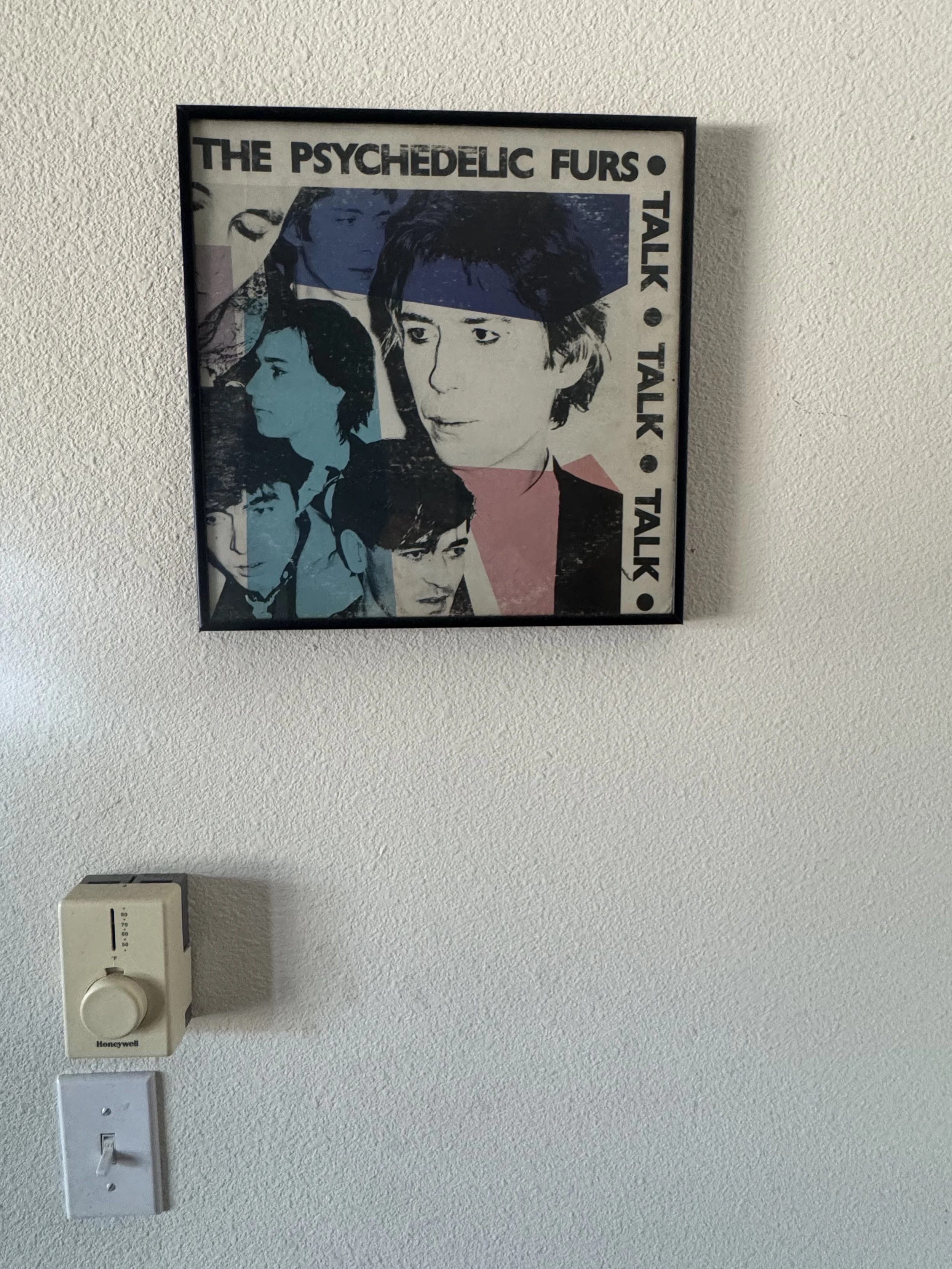
I have my high school copy of the Psychedelic Furs’ 1981 album Talk Talk Talk framed on my apartment wall.
My memory is that I bought the album for their song “Pretty in Pink,” the catchy single that was getting plenty of airplay on WHFS, our local underground station. But then upon listening to the whole record, I realized “Pretty in Pink” was the least of this stunning album with its abundance of vicious guitars, detached poetry, and clever cool songwriting. If you want to get a sense of what this droll and noisy troupe was up to, check out Talk Talk Talk’s two set pieces: “All of this and Nothing,” and “She is Mine,” or the dissonant show stopper “Dumb Waiters.”
I don’t know why I didn’t buy their 1982 follow-up Forever Now, though I did get the next one, 1984’s unimaginative Mirror Moves, which I pretended to like out of loyalty when I reviewed it for my high school newspaper the spring of senior year. Apparently, the Psychedelic Furs kept making records after that and on into the early 1990s.
When I was sure I heard Butler’s unmistakable, ashtray croon coming over the sound system at the bookstore on Monday, I quickly Shazamed the surprising jam. It was a gorgeous song I’d never heard called “Torch” from a 1989 Psychedelic Furs album called Book of Days. Clearly recorded under the influence of late-1980s REM and the then-burgeoning alt-rock sound that had displaced new wave bands like the Furs, this stripped-down, introspective track was all folk guitar strum, cello gloom, and tambourine jangle backing Butler’s languid stream-of-consciousness.
I’ve continued to treasure Talk, Talk, Talk over the years as peak high school. But it was peak mid-life this week catching up on what my high-school-bedroom confidantes had done after we’d gone our separate ways.
Having obsessively listened to this mournful track on repeat all week, I’d posit it’s less an REM knock-off than a return to Butler’s roots: Early 1970s Bowie ballad meets Mott-the-Hoople glam melancholia.
2) 1970s Hairdos
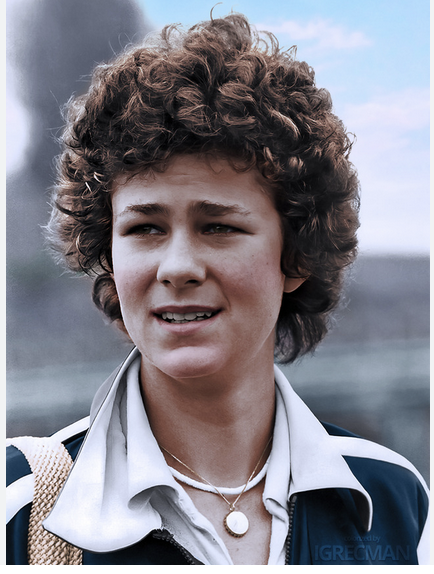
Not John McEnroe (nor Tatum O’Neal, nor Kristy McNichol) Pam Shriver, 1978
I’ve obsessed over this before [I’m All Lost In, #103, 10/4/25]. And mainly because of this great quote: “I manifested it on the subway.”
These are the words of former 1970s teen tennis phenom Pam Shriver recently reminiscing about her historic run to the 1978 U.S. Open championship match; she lost to the reigning champion and World No. 1 Chris Evert.
Backstory: A week before the tournament, Shriver, only 16 at the time, was riding the 7 train to the U.S. Open grounds in Flushing Meadows, Queens, NYC with fellow player Wendy Turnbull. They were practicing together and Turnbull gave Shriver—who was seeded last in the upcoming tournament—a pep talk; Turnbull had the same lowly designation the year before, but ended up making the final!, she reminded Shriver.
Prompted by an idea I came upon last week [ I’m All Lost In, #139, 6/14/26] that pretending to be someone else may be a better path than trying to reach enlightenment (specifically, I was channeling Polish tennis star Iga Swiatek when I was serving against Valium Tom on Saturday), I wrote a poem this week about Shriver channeling Turnbull.
Of course, the prerequisite for being someone else is remaining yourself the whole time. And so my poem ended up being about Shriver’s memorable 1970s locks.
The last few stanzas:
It’s easy to be someone else. Pam, the lowest ranked seed at the grand slam and still only a high school student, belied her Peter Frampton tresses to reach the championship match by becoming her older friend Wendy.
I manifested it on the subway, she remembers.
A week before the tournament, the pair were riding the 7 train to the stadium practice courts when Wendy reminded her: I was the lowest seed last year, yet I ended up making the final.
Lo and behold, Pam repeated Wendy’s feat.
though it remains true that
her head of hair was her own
3) Sandra Zaniewska’s Woo Substack
This could easily be an X > Y item. Patience > Revelation.
“When we stop questioning something, we stop discovering it,” writes Sandra Zaniewksa; Zaniewksa is ascendant Ukrainian tennis star Marta Kostyuk’s coach.
Zaniewska, a former WTA tennis player herself, publishes a Substack called The Unseen Court where she translates tennis-tour observations into yearning essays that add up to a kind of life philosophy. Her distinctly feminine voice puts vulnerability, uncertainty, and discovery at the center of her inquisitive worldview.
Zaniewska is expert at expanding tennis situations into inquiries about everyday life. In one essay titled The Space Between Intention And Execution, she writes about the microsecond allotments players get for making on-court decisions; the post, catalogues things like “pressure, residue of the previous point(s), the awareness of the score, and the urge to make it perfect” that can affect how a player’s decision might pan out.
This leads Zaniewska to write a concise description of how tricky it also is to navigate life itself. For example, how to get the outcome you want from a hard conversation.
On court, that space is measured in milliseconds. In life, it can be days, weeks, even years. But the mechanism is the same: the intention is there, but the execution is filtered.
One of my favorite dispatches from Zaniewska’s woo journaling (see the aphorism I quoted at the very top of this item) turns tennis into a thought experiment about the counterintuitive magic of shutting out reality to manifest a new one. Zaniewska describes the state of believing in success even when the fact-pattern lines up against you: “It just requires the willingness to not let the current information be final,” she writes, elevating the notion of possibility—over the more sought after superpower of confidence. (I told you she was woo.)
Another favorite: An essay titled The Illusion of Suddenly where Zaniewska interrogates the conventional idea that Marta Kostyuk’s recent breakout to World No. 12 (and swiftly moving in on the Top 10) comes with some notable, exciting, and tangible turning point. Nope. Kostyuk’s contemplative coach refuses to identify any inflection point even though fans and journalists desperately want there to be one. Rather, she sees “the payoff of a long, quiet accumulation finally becoming visible.”