
I’m All Lost In, #141: Non-rush-hour ridership; the Wimbledon draw; poetry revisions. Plus the Week in X>Y.
I’m All Lost In…
the 3 things I’m obsessing about THIS week
#141
The Week in X > (is greater than) Y
Clocks without Second Hands > Clocks with Second Hands The large, institutional wall clock I’ve had for the last 30 years keeping time in every apartment I’ve lived in shuffled off this mortal coil last week. Yes, I tried installing a new battery.
The new clock I got is more stylish; it has a lima-bean-green face unlike my old clock’s white one. But also unlike my longtime clock, it has a distracting second hand. I first noticed this second hand racing its way around the dial after I mounted the clock on the kitchen wall.
I don’t need to know what time it is that badly.
Sidewalks > Desire Paths Like an urban planning version of Occam's razor, i.e., the least complicated solution is the best solution, “Desire Lines” or “Desire Paths” are popular hacks of official street design. It’s like ignoring Google Maps to take a quicker way. Classically, a desire path shows up as a worn footpath mocking the sidewalk.
Here’s a photo I snapped of a desire path in North Capitol Hill at E. Roy St. and Federal Ave. E.
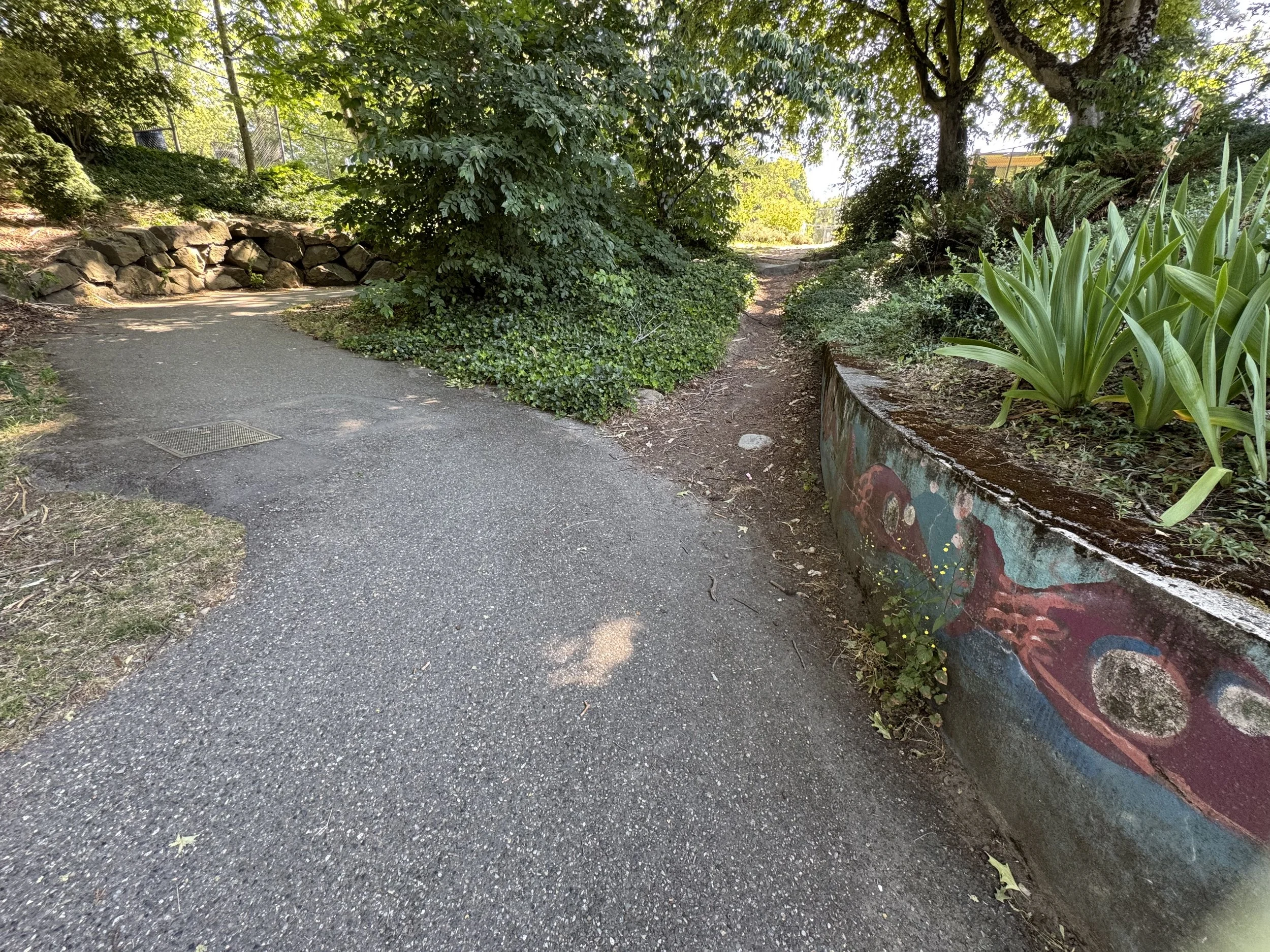
6/24/26
However, I always find myself sticking with the paved route here. I like the serpentine way it moves gently left then right.
Close to the Madding Crowd > Far from the Madding Crowd Apologies to Romantic poet Thomas Gray and the cool sequester’d vale of life. But after spending the earlier part of Friday night hanging out with my friend Dan at a languid wine bar on the outskirts of the main drag—and on the fringes of the madding gay pride festivities—we stepped out onto the street to consider our 11 pm options. East, for a quiet nightcap away from the crowds, or West, straight into them for serendipity?
At my prompt, we chose to jump into the swirl. And I’m glad we did. Making our way through the decked out revelers on the street, we landed at a spot I’d never been to before. It couldn’t have been a better find. Up the stairs on the second floor of the ornate, turn-of-the-(19th) century Oddfellows building, we come upon a lively yet somehow mellow speakeasy called Art Table. The house band, a jazz combo, was playing in the corner framed by the brick walls and the second-story windows. Occasionally, a woman in a black, floral print top and black skirt would consult the keyboard player before taking the microphone to sing a standard.
The spacious and intimate room was crowded with chatty groups of friends huddled around tables and divans, gathered at the radiant bar, and swaying on the hard-wood dance floor. Or, like Dan and I, sitting down at the cushioned settes in the drawing-room section off to the side.
This Week’s Obsessions.
1) Non-Rush Hour Ridership Transit guru Jarret Walker published an important column on his blog Human Transit this week titled: Public Transit Is Not “Coming Back” … It’s Doing Something Better.
I would have framed the point differently, but the crux of Walker’s post is true: Non-rush hour ridership on public transit is surging [I’m All Lost In, #136, 5/24/26.] My own quick math on local light rail ridership found that non-rush-hour ridership has grown at nearly twice the rate of rush-hour ridership in recent years—11% growth versus 6% growth.
Walker’s frame—stop using ridership as a metric for success—is an ill-conceived message. Nothing is more compelling to taxpayers than hearing about increased ridership.
But I think Walker’s angle, which is skewed by his aversion to comparing current rush-hour ridership to pre-Pandemic rush-hour ridership, is his roundabout way of saying something compelling: Public transit is about much more than rush-hour service these days. As a fundamental part of a city’s 24-7 operating system, public transit is about making a city click in general.
This certainly includes work commutes, but our understanding of ridership should expand to catalog the many reasons people use public transit. Running errands. Going to the doctor or to school. Working a late shift. Going to a friend’s place. Getting to the airport. Going shopping. A weekend at Marymoor Park. Going to cultural events such as FIFA World Cup soccer games, NBA championships, and music shows.
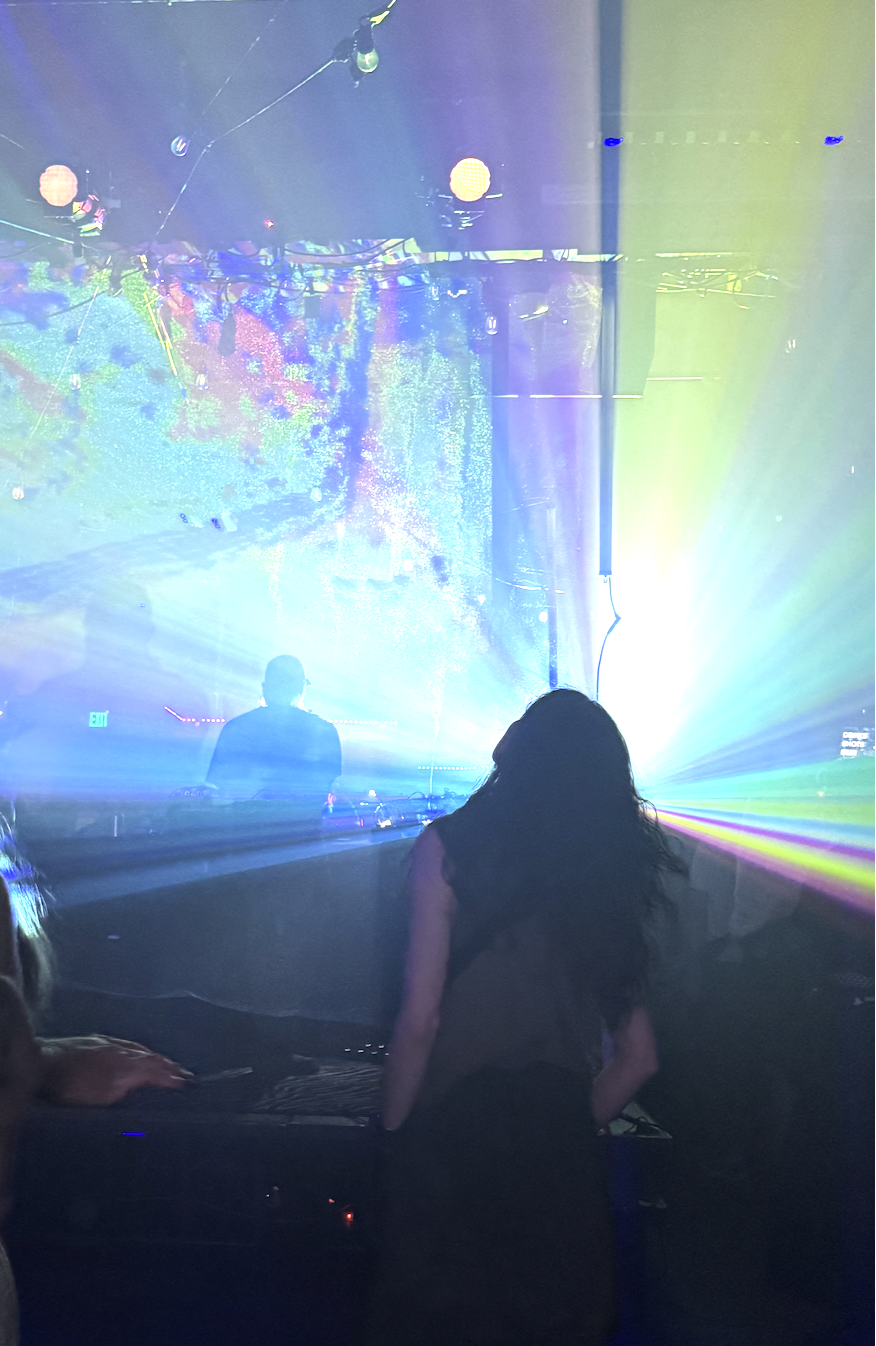
I took the #12 to the #40 to the EdIT show at Substation Saturday night, 6/27/26
Here’s Walker on making public transit not just about rush-hour anymore:
The best transit agencies are shifting their service to address other markets where there’s potential to grow ridership, … that means:
We are attracting new riders, not getting riders “back”. Any new growth in ridership will be in new and different markets. Smart agencies have already made these adjustments by shifting service to weekends and to more regular all-day patterns, instead of the old intensive peak. (Increasing numbers of agencies are above pre-COVID Saturday ridership as a result.) The great mass of briefcase commuters is gone but there are many others who will use our service if it is useful. So it makes no sense to talk about getting “back” to 2019 performance. Even if that were possible, it’s not a fair description of what we are doing now.
2) The Wimbledon Draw: I’m Rooting for Maya Joint
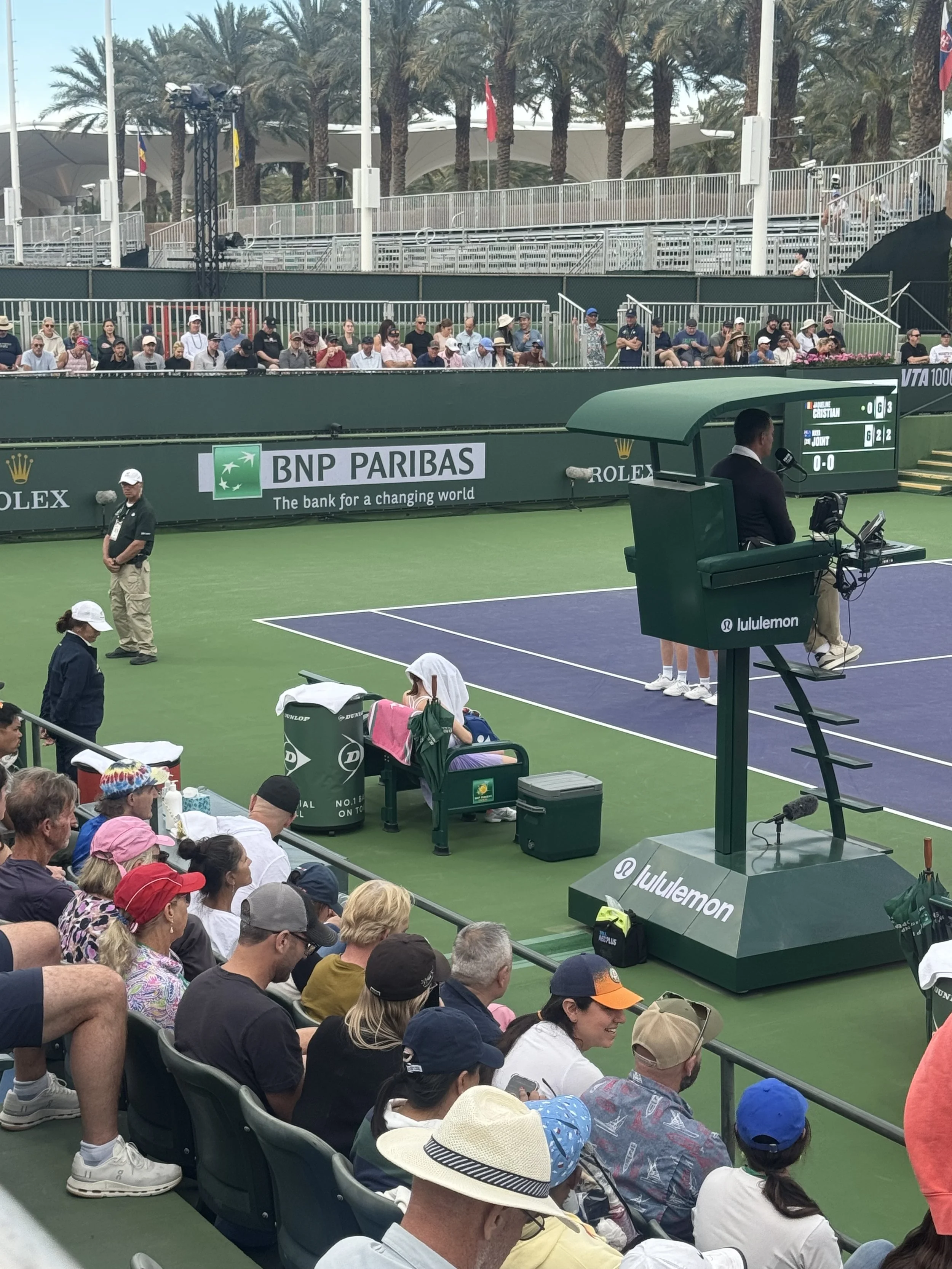
Maya Joint with a towel over her head during her losing match at Indian Wells, 3/6/26
The tennis world was eagerly awaiting the news from Wimbledon all week. Specifically: Titillated by tennis legend Serena Williams’ comeback announcement, fans and sports journalists alike were impatient to find out who the seven-time-Wimbledon champion would be playing in the first round. The draw was announced Friday, and now we have the answer. In Williams’ first singles match since retiring four years ago, she will face 20-year-old Australian Maya Joint.
The world will be rooting for Williams. I’ll be rooting for Maya Joint.
One of my most colorful 2026 memories (so far) stars Joint. Or more so, it stars the kooky Australian woman who sat in the stands next to me at Court 7 during Joint’s Indian Wells match this past March [I’m All Lost In, #125, 3/9/26.]
With Joint’s signature cyberpunk (Racer X) glasses looking as conspicuous on court as her decisive backhand, the young Australian had bolted up the rankings last year after winning her first WTA championship titles. One at Rabat in Morocco against Jacqueline Cristian. And a second at Eastbourne in the South of England against Alex Eala. And so Joint started 2026 as World No. 28 (she had been No. 119 just a year earlier). I was eager to see her play, and I happily left my friends behind at one of Indian Wells’ larger stadiums so I could watch her match. Joint was officially part of the youth uprising that was crashing the women’s tour. The young Turks list included American Iva Jovic, Russian Mirra Andreeva, Canadian Victoria Mboko, Czech Tereza Valentová, and Austrian Lilli Tagger. All those players are still on the list. Joint is not.
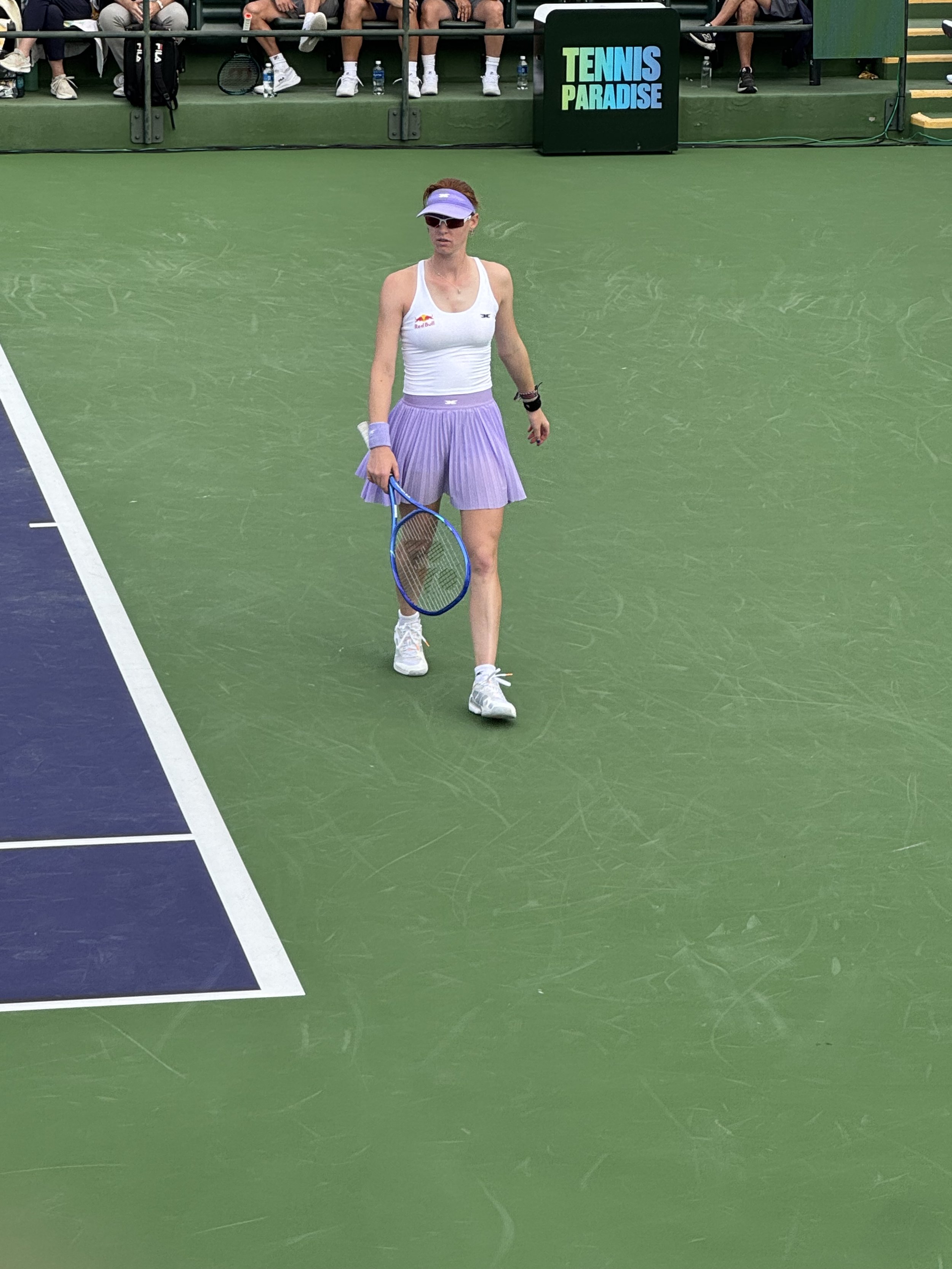
Maya Joint, Court 7, Indian Wells, 3/6/26
The match I watched live at Indian Wells turned out to be foreshadowing. In what’s now the norm for Joint’s disappointing 2026 season, she imploded midway through the match. She lost to the woman she’d beaten at Rabat last year, Cristian. Joint’s now faltering at No. 87. I actually checked a few days before the Wimbledon draw this week to see if Joint had even qualified for the tournament. Williams couldn’t have asked for a better first-round opponent.
“You an Aussie?” a woman holding a tall can of Corona and wearing a summer dress asked as she climbed over two rows of seats and scooted across a few more to join me.
“Come on MYYY-UH!” she shouted in a thick Australian accent. “Stay steady, MYYY-UH!” These dedicated shows of support came between talking my ear off. This woman had once been an up-and-coming player on the Australian circuit, she told me. And added that she was now an invaluable member of Australia’s tennis coaching infrastructure. Her name was K___. She had long, wavy brown hair. She was in her early 30s. And it seemed to me, as her beery voice pierced the afternoon air, that she was more of a gadfly than a coach. And something of a nuisance at that. At least to Joint and Joint’s team. Like me, they seemed stuck here on quiet Court 7 with K___ and her insistent “Come on MYYYY-UHS!”
Offering me a beer, K___ told me her Slavic surname and announced that her father was “friends with Novak Djokovic.” She was oblivious to the possibility that her boasts were landing on deaf ears. What do I know from insider, pro-tennis echelons?
Nonetheless, something about K___’s fabulist chatter, her tipsy intimacy, and her volume were charming. I wish I’d been less guarded and more amenable to her mischievous flow state that afternoon. After Cristian broke Joint’s serve in the ninth game of the decider and went on to beat Joint 7-5 in that last set (all exactly as K___ had predicted), I was in a rush to get back to my friends for the evening match at Stadium 3. I never saw K___ again.
I’m not foolish nor delusional enough to think this young woman was flirting with me, but I do regret not following her camaraderie into the desert evening for another beer.
As for next Tuesday when Serena Williams’ takes the court at Wimbledon, I say: “Come on MYYY-UH!” “Stay steady, MYYY-UH!”
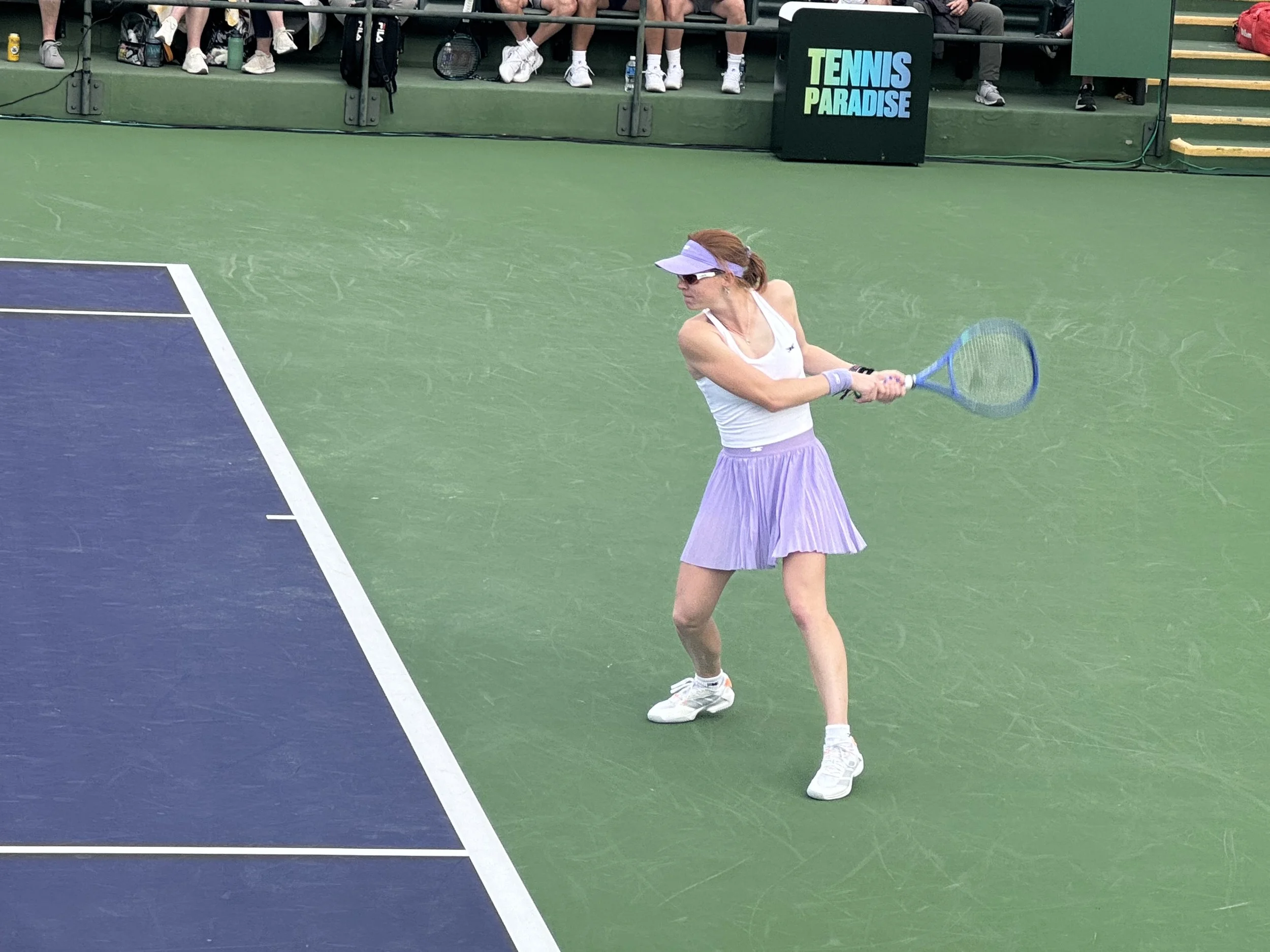
Maya Joint, Court 7, Indian Wells, 3/6/26
I predict Serena Williams will beat Joint handily next week, but then Williams will lose in the second round to her next likely opponent, the player Joint beat last year at Eastborne, 21-year-old Filipino star Alex Eala.
I want to be on the record with one other Wimbledon prediction: In a fraught and seismic second-round upset, World No. 53 Oleksandra Oliynykova, a Ukrainian whose game is fueled by righteous anger about the Russian invasion, will beat my favorite player, World No. 1, Belarusian Aryna Sabalenka.
3) My Poetry Manuscript
With rejection letters piling up, I’ve been feeling blah about my poetry manuscript lately.
Setting out to do revisions last week, I ended up spiraling into gloom when I realized several of the poems were not working. One poem in particular, Her Debut as a Public Singer—which was previously published in August 2024—was gnawing at me. With its longstanding excellent opening line working as the centerpiece of my manuscript—”Choosing to live in the city is not a retreat from the natural world”—my sense of urgency to revise the rest of the flailing poem accelerated into anxiety.
Thankfully, I came across a beautiful word this week: Sinusoidal (pronounced sigh-nuh-SOY-dull), which means the graphic representation of a sine wave. As in: “Sinusoidal: Anything shaped like or varying in the manner of a sine wave. It refers to a smooth, continuous, and repeating oscillation…”
Figuratively, sinusoidal means moving up and down.
With this excellent word in hand I was able to rewrite Her Debut as a Public Singer. Here’s the new, penultimate stanza:
Choosing to live in the city is not a retreat from the natural world. It is the sinusoidal sight of our respiratory systems as she fell into the minor key.
On a roll, I upgraded several other poems, including a new one called Marina Tsvetaeva is Not a Tennis Player. And then I updated my cover letter and started sending the manuscript out once more.
Dear ——- Literary Journal,
Please consider these five poems for publication. My poetry is often prompted by city planning policy and mass transit to reflect the hopes that cities generate in the human heart. However, lately I’m more into the WTA (Women’s Tennis Association.)