
I’m All Lost In, #139: Goodnight Tokyo; Purging my apartment; Empty libraries. Plus the Week in X>Y.
I’m All Lost In …
the 3 things I’m obsessing about THIS week
#139
The Week in X > (is greater than) Y
Long Lines > Short Lines Lines around the block—at shops, shows, and restaurants—represent a public policy victory for any municipal government.
One local line that delights me every year is the crowd that forms on summer evenings at the ice cream shop below my apartment. I’ve even memorialized it in a poem:
My neighborhood would score even higher/
if the DOT surveyed at night/
when youth appear in clinamen lines.
But there’s trouble afoot. For the first time in memory there are no lines forming. As we head into summer 2026, it’s eerily quiet at the ice cream shop on my block.
Madison Square Garden > All Other NBA Arenas The packed crowd leaning into the action at Madison Square Garden during this week’s NBA finals is a metaphor for Manhattan. Specifically, for its density; at 28,000 people per square mile, NYC is the densest major city in America. And, in turn, the most electrifying.
Madison Square Garden’s unique geometry—steep raked seating, concave bowl, low ceiling—creates a distinct, intimate and energized feel that mirrors NYC itself. The Garden is notably different from all other stadiums in the NBA where the seating sprawls out rather than stacks up.
This serving of urban energy is infectious. And as Knicks Nation captured America’s imagination this week, it’s hard to ignore the other metaphor flowing out of Madison Square Garden: The joyous urbanism of New York City, MAGA’s ultimate bogeyman, is countering Trump’s bitter, shrinking, nativist regime with big city hope.
Channeling Iga > Channeling Self 2 When Valium Tom went up 4-0 in the first set, I knew I was running out of time to change the course of our Saturday morning tennis match. I didn’t, however, turn for help to the classic tennis primer The Inner Game of Tennis [I’m All Lost In, # 134, 5/10/26] by 1970s tennis coach W. Timothy Gallwey. Gallwey wants players to find their “Self 2,” one’s free-flowing, unconscious physical persona that’s capable of transcending the analytical, often critical, cognitive “Self 1.”
Instead, I thought of WTA tennis star Iga Swiatek. Iga’s an oddball—even a headcase [I’m All Lost In, #127, 3/22/26]—and she’s been struggling on court for the last two years since losing her No. 1 ranking. Last year’s Wimbledon trophy (!), notwithstanding.
But I find her inspirational. Before every serve, Iga goes into a spooky, reverent Zen-murmur (which reminds me of Franny-Glass’ nervous breakdown.) I get comfort and ASMR just watching Iga go there as the camera angle zooms in on her service motion.
I started thinking about Iga’s serve mantra as I stepped into my own serves midway through my match; I’d been out of sync and double faulting up to that point. By channeling Iga, I nudged my game into a flow state; I fell into a spry groove for the next 10 games, even winning one service game 40-love as I iteratively built up from solid serve to solid ground strokes.
Valium Tom ultimately won the match, but I had turned it into an exciting contest by pretending I was someone else.
Perhaps, there’s a best- selling book idea called the outer game of tennis where the way to get outside of your head isn’t, as Gallwey has it, by creating a physically intuitive version of yourself, but instead by just being someone else entirely.
This Week’s Obsessions:
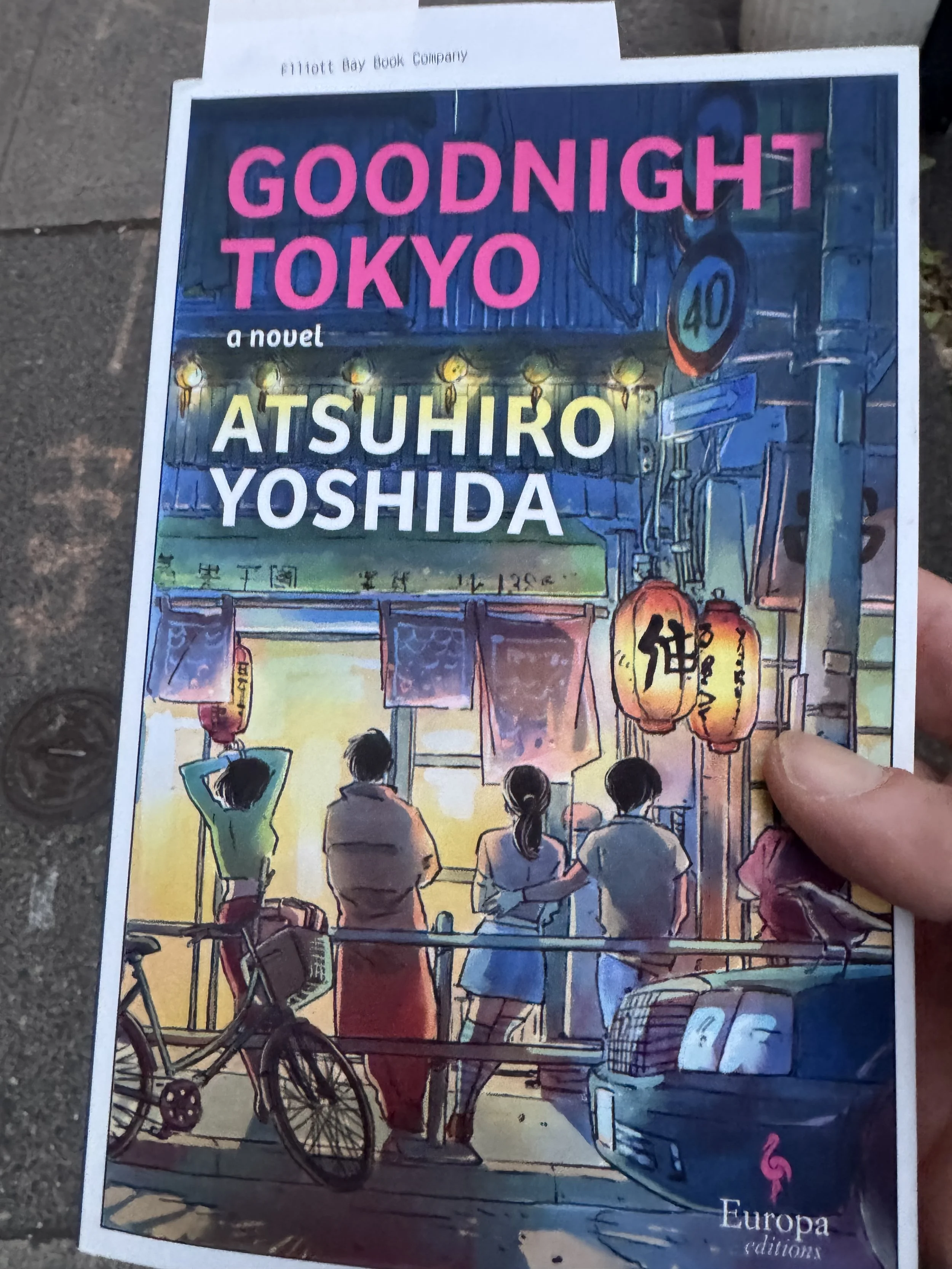
A new entrant in my City Canon; my Elliott Bay stamp card was filled up, so I got this Tokyo novel for free Tuesday night, 6/9/26.
1) Goodnight Tokyo by Atsuhiro Yoshida
Maybe I’m not obsessed with Atsuhiro Yoshida’s short novel as much as I am obsessed with keeping his sprawling cast of characters straight.
Mitsuki, a props procurer for movies. Kanako Fuyuki, a hotline therapist who doubles as an orchard thief on her days off; she’s also searching for her long lost brother, Ren. Moriizumi, who runs a phone disposal service. Matsui, a cabbie. Shuro, a real-life, gumshoe detective who has evidently inspired a film franchise. Chatty Kisa, Yorie, Fumina, and Ayano, who run a late night restaurant together; Ayano was once in love with the mysterious Shuro back when he was a struggling magician. Haruka, Ayano’s confidante, who it turns out, works at the film company that’s making movies about Shuro. Ibaragi, who runs a re-fab junk shop. Eiko, a young actress who’s been cast in a movie that’s in production at Haruko’s company. And Emi Fukuda, an elevator operator who’s in love with a bat that hangs around her backyard. She’s apparently “waiting for it to transform into a beautiful young man dressed entirely in black” who would “linger on the veranda behind the curtain hoping desperately to be reunited with the woman inside.”
These are just some of the eccentric characters in this light-hearted and lightly philosophical novel of intertwined stories about Tokyo in the wee hours.
The stories also establish intertwined themes, such as the search for a missing puzzle piece—or person.
As for lightly philosophical:
The item might have seemed like no more than a broken telescope. Ibaragi, however, was always happy to see broken goods put to new uses. … Whenever something created for a specific purpose wore down—and this was true of most tools that humans built—it was liberated from its human-imposed application. Only then was it set free.
2) Purging My Apartment
Inspired by boxing up Mom’s apartment last week [I’m All Lost In, #138, 6/9/26]—and more so, by finding a few meaningful souvenirs from her life, such as her 1951 high school diploma, her laminated teenage social security card, some lovely black and white photos, and some family-heirloom paintings that I wanted to put on display back home in Seattle, I was prompted to purge my own apartment this week.
I imagine cleaning out your own place is a classic psychological response to a parent’s death … Setting the stage for the next phase of your own life?
Regardless, there I was Tuesday cleaning out my closet, hauling bags to the dumpster in my building’s garage, and tossing out old clothes and keepsakes. My apartment feels 1,000 pounds lighter.
One thing I unearthed in my closet, but definitely didn’t throw out was the Watergate Blanket. Mom knit the blanket while rapt in the historic televised hearings during the summer of 1973. It remained part of our household during the rest of the 1970s and '80s. She mailed it to me sometime in the early 2000s.
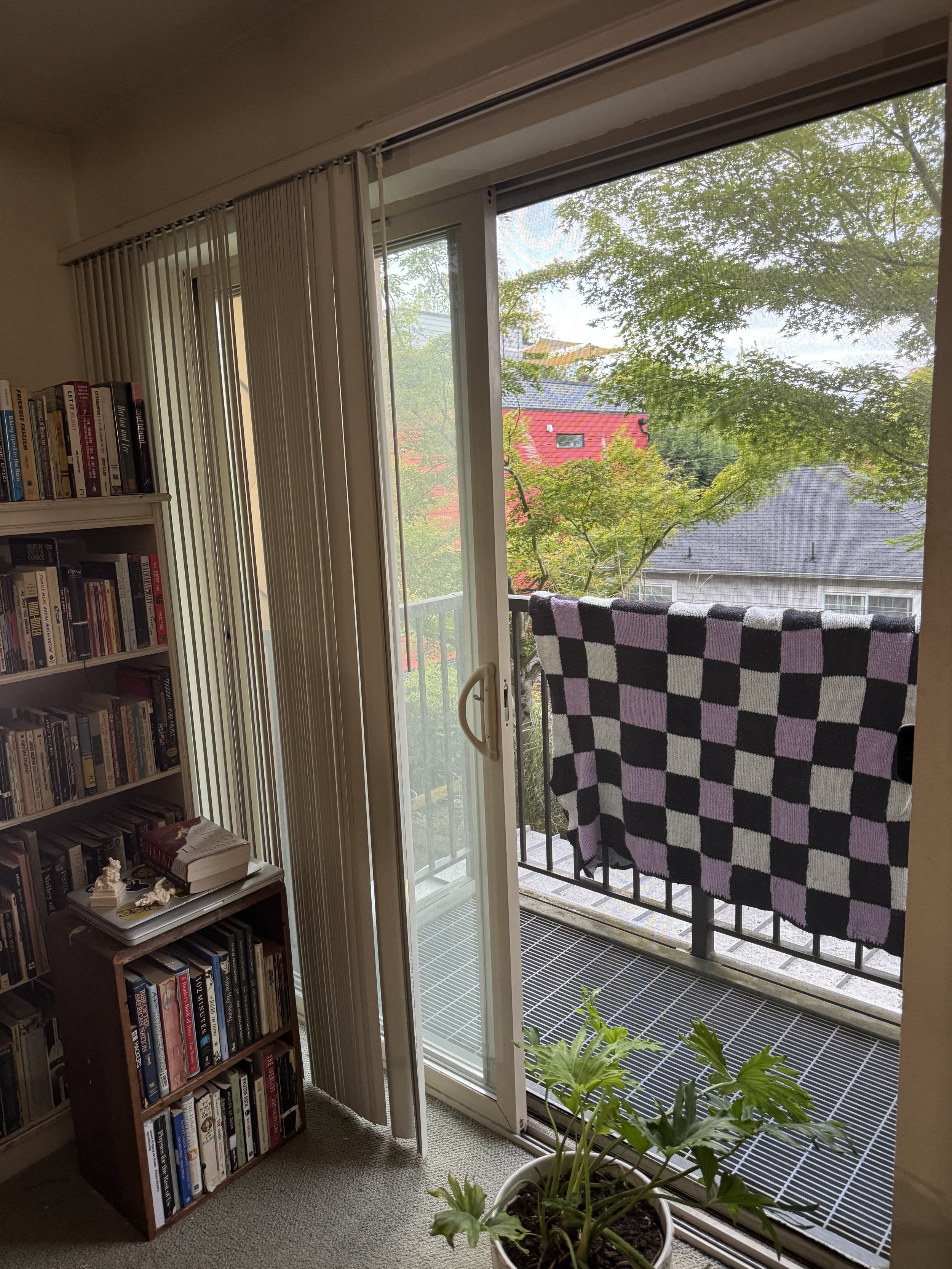
After unearthing the Watergate Blanket from my closet, I aired it out in the June weather all week.
3) The End of Libraries
My default is to be skeptical of manifestos that proclaim righteous defiance to change, new technology, and the modern world. MAGA slouches toward originalism. Leftists fetishize authenticity. I see fire and brimstone politics as they both demonize phantom conspirators.
It’s with that major caveat, that I actually side with the curmudgeons and recommend this recent essay in the Yale Review by writer and academic Shiela Liming who sees—in the “exsanguination” of university libraries—an ominous sign of the times about technology’s destructive affect on the brain.
Liming writes the essay from her POV as an Edith Wharton scholar. She spent years immersed in Wharton’s own personal library where she (Liming) saw evidence of Wharton’s intellectual evolution in the marginalia of her (Wharton’s) books.
And so I give you as curmudgeonly an excerpt as exists, but one I found myself cheering on:
By studying Wharton’s physical books, I could see from the annotations how she interpreted those texts, incorporating them into her own writing. The writer writes, according to Derrida, in order to discover what they think, including what they think about what they have read. That same writer then tries to convey those ideas to a new reader, who reads to discover what they think about what the writer thinks. But both writer and reader are playing (another favorite word of Derrida’s). Both are engaged in a game that has no end, and the text is the field or pitch or court on which it is played. Derrida calls that game deconstruction.
But though he is best known for it, Derrida didn’t invent the process. Deconstruction is not something that one does to a text; it’s something the text does to itself. It’s an inherent feature of highly volatile processes, and one that turns physical books into objects of fantasy. Books exist to impose dreams of stability and order on the processes of reading and writing that are attached to them. The author might be living or dead. In either case, the book contains the event that is or was the text, to keep it alive and make it cohere. Or, to put it another way, the text is the ghost, while the book is the medium through which the ghost speaks. Without the medium, the connection between speaker and listener is broken, and the line goes dead.
This is why, Derrida says, there is no history without language. We humans communicate knowledge about the past through language—through conversation, through storytelling, through education, and, yes, most of all through writing, which creates a semi-coherent, semi-anchored record of that language. We present that record in the form of a book, something that can be turned to and consulted over and over again. And then, finally, we store that book in a place where we can get at it: a library. For someone like Wharton, that can mean a personal library, filled with the remnants of one’s own engagement with those texts. But since few of us can afford to build a three-thousand-volume personal library, there are also shared libraries, the public ones in our towns and schools.
That’s how a library becomes a final and crucial step on a chain of accessibility that permits contact with the text. There are, of course, other ways to gain access to the text: bookstores and classrooms and PDF files that can be downloaded, legally or not, from the internet. But those other ways place barriers—often financial, sometimes technical, sometimes physical—between the reader and the text. They introduce friction. Reading a bootleg PDF isn’t the same as reading a print book. Twenty years ago, UX researchers were already noting that in online reading, large sections of a text are skipped or scanned in accordance with digital scrolling habits.