
I’m All Lost In, #152: An economic study; a glass of sherry; and a mid-20th century novel. Plus the Week in X>Y.
I’m All Lost In…
The 3 Things I’m Obsessing About THIS Week
#152
The Week in X > (is greater than) Y
Williamsburg Pizza > Prince St. Pizza, L’Industrie, Scarr’s There’s a Williamsburg Pizza next door to my friends’ apartment on Union Ave. in Brooklyn. I’ve been grabbing late-night slices there for years. But with all the recent hype about L’Industrie, Prince St. Pizza, and Scarr’s, I’ve been foolishly reserving my pizza allotment for those spots whenever I visit New York City these days. Honorable mention to Prince Street’s slices, but fortuitously, I landed back at Williamsburg Pizza (the Broome St. location on the Lower East Side) this past Saturday night and reset my pizza standards.
I was wandering through the frolicking, drunk radius around my sad-sack, yet alluring capsule Day’s Inn hotel in Chinatown south of Delancey St. feeling quite alone and gloomy when I spotted Williamsburg Pizza’s red-striped awning. I felt like a Greek hero seeing land. I stood in a brief line with some drunk young people, ordered a grandma slice and a Brooklyn slice, and then blissed out at a peaceful corner table savoring the double-layered spicy tomato sauce, boozy cheese, and oven-hot rising dough.
U.S. Open Tennis Matches that Go Until 3:33 am > U.S. Open Tennis Matches that Conform to Prime Time The U.S. Open got served with a barrage of bad press this year. Catering to wealthy poseurs rather than true tennis fans. The buggy and pricey ticket sale page. The confusing rules about Fan Week. The gross partnership with Kalshi. The see-and-be-seen influencer atmosphere (and ring lights). And most of all, the incompetent scheduling that gave way to late-night matches. This, of course, included the apparent crisis that was Tuesday night-into-Wednesday morning’s men’s quarterfinal between Ben Shelton and Carlos Alcaraz which didn’t end until 3:33 am.
I understand the reasons people are chagrined about after-hours matches; though let’s not lose sight of the fact that it’s the same tennis reporters who had to work late that are writing the outraged editorials. But yes: Late matches undermine TV ratings, are unfair to stadium workers, are a drag for fans who want to go to bed at a decent hour, and are rough on players.
For starters, though: It’s contradictory to argue that the U.S. Open shelved its authenticity in favor of trendy wannabes this year while also complaining that the only people willing to stay up for late matches are hardcore tennis fans. I certainly stayed up. The late night viewing reminded me how I love watching tennis in the quiet, wee hours during January’s Australian Open, broadcast several time zones away [I’m All Lost In, #120, 2/1/26.]
But more important: The Shelton-Alcaraz midnight movie was magnificent. When future worlds look back to study planet earth, hopefully their montages of human history will include footage showing the night in the late summer of 2026 when a beacon of light and a gathering of cheering thousands radiated from the edge of New York City long after darkness had settled over the rest of the country.
“This is great for our sport,” Tennis Channel regular and grand-slam legend John McEnroe said as he called the game from the TV booth. He was so enthralled with the scene, marveling at the infinite silence during the start of each player’s service motion, that he was oblivious to his fellow commentators’ critical narrative. McEnroe walked it back the next night as he called another match. Evidently he’d since been swayed by public opinion and others in the media. But in the moment when the Shelton-Alcaraz dream was unfolding, he was as transfixed as I was.
So apparently was this one New York Times reporter and substacker. “I believe there is immense value—even magic—in matches that run that late,” she wrote in a reverent, contrarian post. She liked the crush-load train ride home at 4:08 in the morning most of all. I wish I’d been there.
Cutting to the Chase > Paragraphs of Context I had a writing revelation this week. It’s embarrassing that it has taken me so long to figure this out.
Rather than promptly laying out the facts I wanted to bring to readers’ attention as I was drafting my “Greater Seattle” PubliCola column this week, I found myself in the middle of writing a fifth expository paragraph.
This, however, does lead to populist recommendations (including the pro-sixplex reform I called out above). Another example: While the report maintains that small, independent businesses do not grow the economy, they simultaneously believe small local business is the most important ingredient for creating a lively city. For example, local businesses such as coffee shops, restaurants, and clubs create the kind of vital third places ("spaces other than homes and workplaces where people can socialize and connect" ) that are imperative for attracting talent in an era when the necessary creative-economy talent is evasive and mobile.
Realizing it would take another five paragraphs to explain that explanation before finally being able to segue into the news hook, I shut my laptop and took a stroll around the Jet Blue terminal at JFK where I’d set up shop to write before my flight back to Seattle; it’s a lovely, modern terminal, by the way, with sleek work stations, shops and food courts, island bars, lounges, and plenty of seating.
A few hours later, during the flight, I took out my laptop, deleted the tortured prologue, wrote an opening line about the newsworthy data—Seattle has a 40% advantage per capita over Bellevue when it comes to the number of coffeeshops, arts venues, and retail shops—and filed my column with ease.
This Week’s Obsessions
1) A 127-Page Economic Report on Seattle
There’s a reason I initially wrote so many paragraphs before I got to my point about Seattle versus Bellevue: I was obsessed with the study where the 40% stat came from.
ECB sent me the report while I was in New York. And I ended up staying in my hotel (the teeny-bopper place on the Bowery I like, before switching to the Day’s Inn to save money) reading the study all morning. I did eventually go out later that afternoon to go to an exhibit in Chelsea; it was on the 15th floor of a building that seemed to be playacting corporate headquarters. I had to show my I.D. to ride the elevator up to an empty gallery.
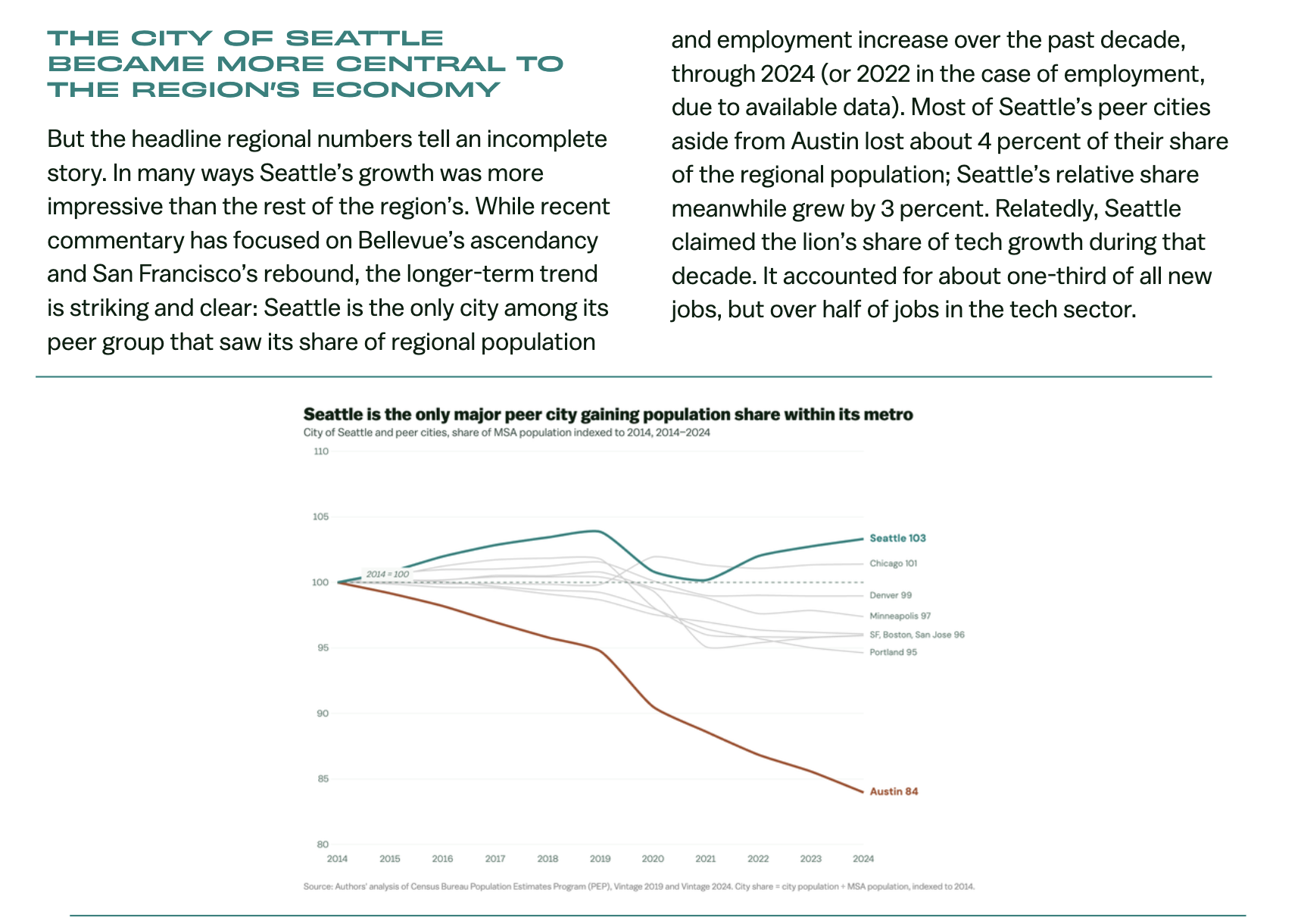
The 127-page economic report is titled An Assessment of Seattle’s Business Climate and an Agenda to Broaden and Strengthen Its Economic Base. Written by a local consultant for Seattle’s Department of Economic Development, the study makes the the case that Seattle city hall needs to help make our economy less dependent on a single crop, i.e. big tech. Or face economic decline. Rather than relying on firms like Amazon, the report urges the city to create a start-up-friendly culture by "helping software-adjacent 'hardtech' firms in areas like cleantech and life sciences scale in the city; enabling mid-career engineers leaving anchor firms to start and join new companies rather than leave town..."
The study’s unnerving data point: "Between 2017 and 2023, Seattle added [just] 16 net new mid-sized (50–249 employee) tech establishments…” while our direct competitors San Francisco, Austin, and Denver added 104, 53, and 42 respectively.
The report is self-conscious about its trickle-down POV, but confidently contrarian about it here in lefty Seattle. The authors state up front that they are "concerned with characters that do not necessarily elicit much sympathy,” adding, “this report, despite being motivated by economic inclusion, devotes most of its attention to a privileged and successful group of people and the businesses that they create and lead. ... If they leave, Seattle won’t become more equal, it will just become poorer."
That argument comes with this rationale:
The growth of its economy over the past decade, while often associated with disruption and inequity, created more widespread economic opportunity than almost any other region in the U.S. Wages grew across the income spectrum over the last decade, even accounting for the skyrocketing cost of living. And they grew fastest among low-wage workers.
I’m still a 1980s teen. So, in sync with my anti-Reagan DNA, I believe trickle-down economics is sus. I think demand-side policies are the best way to lower the overhead costs of living in capitalism, and thus the smartest way to drive economic success. Along those lines, I think Seattle’s progressive minimum wage policy is responsible for the good news about wages for Seattle’s low-income workers. And while the authors of this report are somewhat agnostic on that trailblazing policy—and also insistent on saying the city needs to focus on the corporate side of the economy to promote growth—their eventual list of recommendations is hardly conservative.
This report … is designed to help Seattle policymakers and civic leaders cultivate an economy that generates tax revenue for progressive policies and that produces abundant good jobs that give Seattle residents more economic freedom, more stability, and more upward mobility. Especially those excluded from the benefits of growth in years past
For example, the report advocates subsidizing childcare for families that can’t afford market-rate care. It also calls for accelerating density in traditional single-family neighborhoods.
P.s. With all its graphs and stats, I predict this study is going to be quoted for the next few years by both sides in Seattle’s endless debate about Seattle.
2) A Glass of Palo Cortado Sherry
I’m not going to get into the sherry-fermentation-science of aging fino grapes under foamy yeast (“flor”) to regulate oxidation, nor discuss the “solera” pyramid process of mixing batches from older and new barrels, nor factor in when the brandy gets added. I’m simply going to report that the rare glass of Palo Cortado Viejo I had last Friday night on the roof of my friends’ Brooklyn apartment before karaoke downstairs in their living room, expertly balanced the aging and oxidation equation and used the barrel mixing trick to heighten the nutty flavor without adding much of the sweetness.
This was a hit with me and afterward I crushed some of my new Karaoke selections—Billy Bragg's Great Leap Forward, Robin Luke’s 1958 one-off hit Susie Darlin' [I’m All Lost In, #116, 1/3/26], the Psychedelic Furs Torch [I’m All Lost In, #140, 6/21/26], and the Records’ 1979 jangle-rock standout, Starry Eyes. My true showstopper was another new pick: John Lennon’s Isolation; I flopped at my last test track of the night, though, the 1979 German new wave hit: Da Da Da, I Don't Love You You Don't Love Me.
P.s. I abandoned 2026’s no-booze experiment during the last couple of weeks for my birthday celebrations in New York. But as I return to regular life, I’m alcohol-free again.
3) The Dud Avocado by Elaine Dundy
This hilarious, literary 1958 bestseller (brought back into print this century by the New York Review of Books) is about a witty, manic, discombobulated 21-year-old American misadventurer in Paris named Sally Jay Gorce. The story careens from page to page as the pink-haired heroine neurotically fails to do her laundry and delivers her philosophical inner-monologue of one-liners and youth. “The vague nymphomania I had experienced at the window returned. What an awful lot of possible people there seemed to be around all of a sudden.”
Upon suddenly falling in love with a young theater director after a chance round of Pernod cocktails at the Café Dupont in the student district (“the whole vast panoramic carpet seemed to be woven out of old boots, checkered wool and wild, fuzzy hair”) Sally Jay decides then and there to become an actor, cueing her palpitating mind to gives us this: “A virtuous thought crossed my mind that in this new life dedicated to Art I should take the metro, not taxis.”
Sally Jay is prone to sharing her inner-monologue out loud too. “Thank you, thank you,” she says at one point to a boorish lover as she keeps her “head well down, eyes on the potato chips the whole time…” “‘For what?’ he asks….” “‘For restoring my cynicism. I was too young to lose it.’” says Sally Jay.
I’ve only just started reading this non-stop dispatch from parties, hotel bars, and galleries, but while Sally Jay—picture Esther Greenwood as a stand-in for Groucho Marx instead of Sylvia Plath—keeps cracking me up with her breezy philosophy, the proto, second-wave feminism has me on alert that her escapades are heavier than the banter admits.
The rushing, 50-page opening episode shatters into an account of sexual assault. It’s worth quoting Dundy’s conclusion to this whirlwind prologue in full.
I didn’t see why I, who had done nothing wrong, so to speak, who at any rate most certainly hadn’t started all this,, should wind up crushed and disheveled, with a torn dress, a burning cheek and lipstick all over my face, while he, the real culprit, was suavely ushering me out, and I strove to correct this injustice.
“Now that you’re free,” I said on my way out the door, “you must come to America. I’m sure you can fortune-hunt on a much larger scale there than you’ve been able to over here. Only you’d better start quickly before you turn into just another dirty old man.”
The blow commonly described as below the belt really went home. “You little slut, get out,” he shouted, his face all awry, “and take care. Nobody insults me like that and gets away with it. You will see. I can promise you.”
With these words singing in my ears as I felt my way down the stairs, too discouraged to find the minuteries, I reflected wearily that it was not easy to be a Woman in these stirring times. I said it then and I say it now: it just isn’t our century.”
P.s. The word "minuteries" refers to a light switch you’d find in Parisian apartment stairwell—a timer that turns on the lights for a fixed, short interval.