
I’m All Lost In, #126: Empty tables; my own personal prohibition; and Aria Aber’s Berlin. Plus the week in X > Y.
I’m All Lost In, #126
This Week in X > (is better than) Y:
My Memory of The Bats > The Bats The upbeat and gloomy sound of New Zealand’s The Bats. It’s the perfect example of the neo-1960s folk rock + garage rock equation that defined mid-80s alternative radio. Exhibit A: The band’s wistful ballad “Tragedy.” Or their equally miserable and jangly tunes “I Miss These Things” and “Candidate.”
I’ve written about this era before [I’m All Lost In, #101, 9/21/25]. It was my glum heyday. I was 19. I referred to the mopey swirling genre as “Smash Jangle.” I started an imaginary cassette label (for my own songs) called Sad & Groovy.
I don’t know why. But the Bats were hanging around my algorithm this week. So I tuned them in 40 years later. It’s sweet music, but it’s true what they say about going home again.
Café Mon Amour > All the Other Cafes in Palm Springs, CA I spent Sunday and Monday in Palm Springs, CA drifting from café to café. There’s no shortage of coffee shops and cafés in this languid bourgeois town. Stand in the sun-drenched center of the commercial district at S. Palm Canyon & W. Tahquitz Canyon and search on your phone for “nearby coffee.” You’ll get 20 results.
The one to choose is Café Mon Amour. Tasty quiche. Excellent croissants. Welcoming staff; the two people running this Parisian flight of fancy have the entrepreneurial air of a husband & wife team. And most of all: Step down into the sequestered salon to the left of the front counter and settle into one of the comfy chairs for hours of reading and writing at a votre propre table.
The 3 o’clock closing time goes against everything I believe about coffee shops [I’m All Lost In, #119, 1/25/26]. But I savored the quality time in the café’s quietude. They have perfect sandwiches too; I had the cucumber, tomato, onions, olives, pesto, and greens on baguette.
P.s. I feel compelled to note that I stayed at a magical motel during my Palm Springs getaway. It was located in the not-very-bourgeois outskirts of downtown. Only a 10-minute bus ride into town. Or a somehow lovely 20-minute walk past the car wash, the shuttered IHOP, the dusty gas stations, the dive-bar taquerias, and a sleepy escort walking along the nondescript drag early in the morning. The motel, the Stardust, came with free Oreos, Aztec-tiled floors, ballet costumes, and a dynamite shower. And as with the standout Café Mon Amour, the husband and wife entrepreneurs who ran this place were all TLC on their dream.
The glass door that opened directly onto the pretty pool next to my room was broken. They let me stay for free.

The Stardust, Palm Springs, Sunday, 3/8/26.
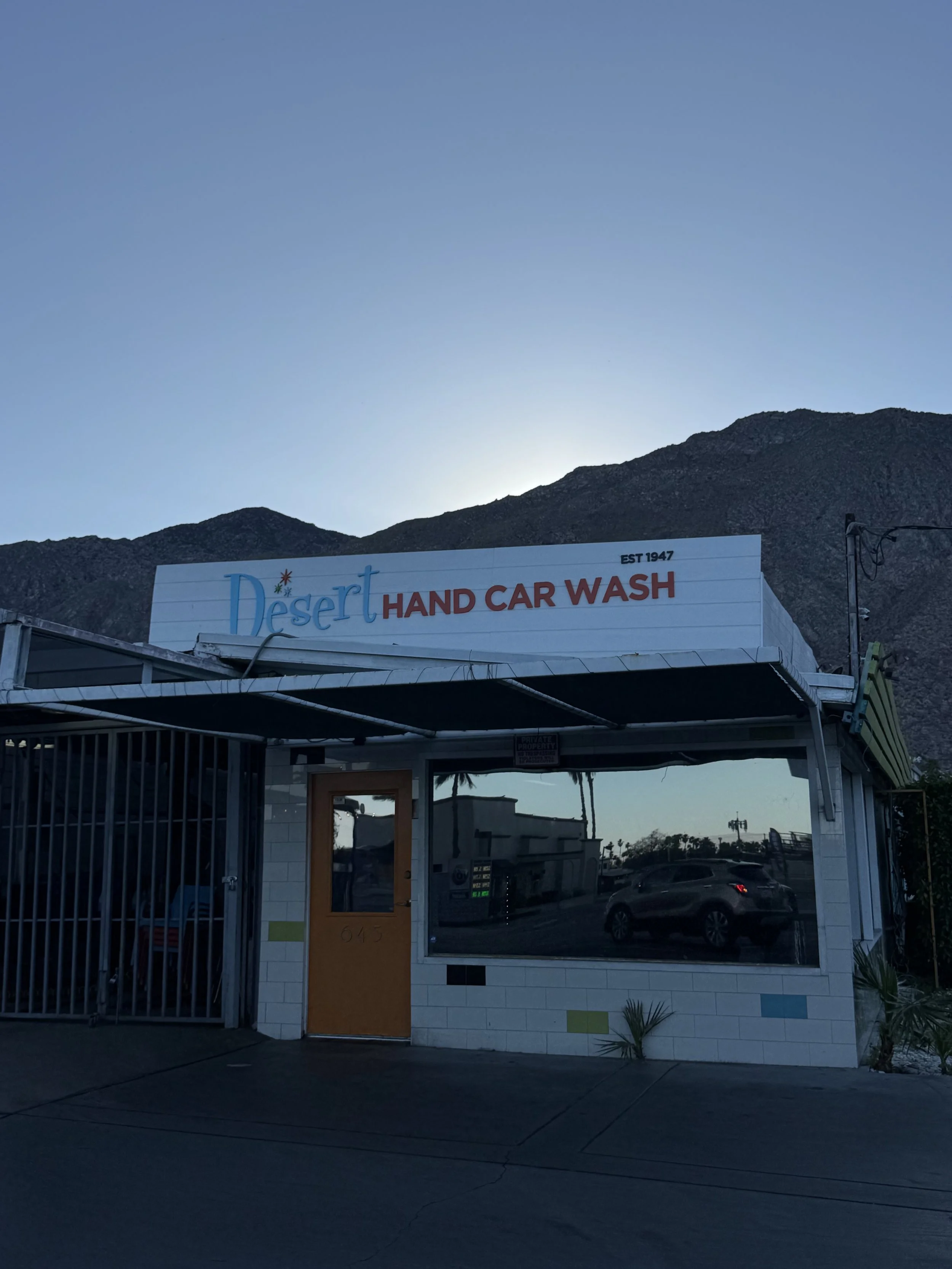
On the walk from downtown back to my motel, S. Palm Canyon Drive, Sunday, 3/8/26.
Saby > Mboko (for now) My favorite tennis player 27-year-old (soon-to-be 28-year-old) Aryna Sabalenka beat legit teenage sensation Victoria Mboko at the Indian Wells quarterfinals on Thursday.
World No. 1 Sabalenka was at the top of her game against Mboko. After trading service holds with the formidable heavy-hitting 19-year-old, Saby gave a flawless tennis clinic. She won the tiebreaker 7-0. And she went on to win the next set 6-4, taking the match in straight sets.
It wasn’t as clear cut as that sounds, though. Mboko, who has catapulted from No. 350 to No. 10 in the last 14 months, was fierce and cool. (Before facing Sablalenka in the quarterfinal, Mboko herself dismissed superstar Top-10 player Amanda Anisimova, 6-1, 6-4 in the round-of-16 stage.)
Sabalenka had the skills and insuperable form to stop the surging Mboko. But the poignant foreshadowing was impossible to ignore. I felt like I was watching something I was never going to see again: Sabalenka playing at hall-of-fame level and Mboko in pursuit. This dynamic will reverse during the next two years.
This Week’s Obsessions:
1) A Picture (of Empty Tables) is Worth 1,000 Words.
I can’t get this image out of my head:
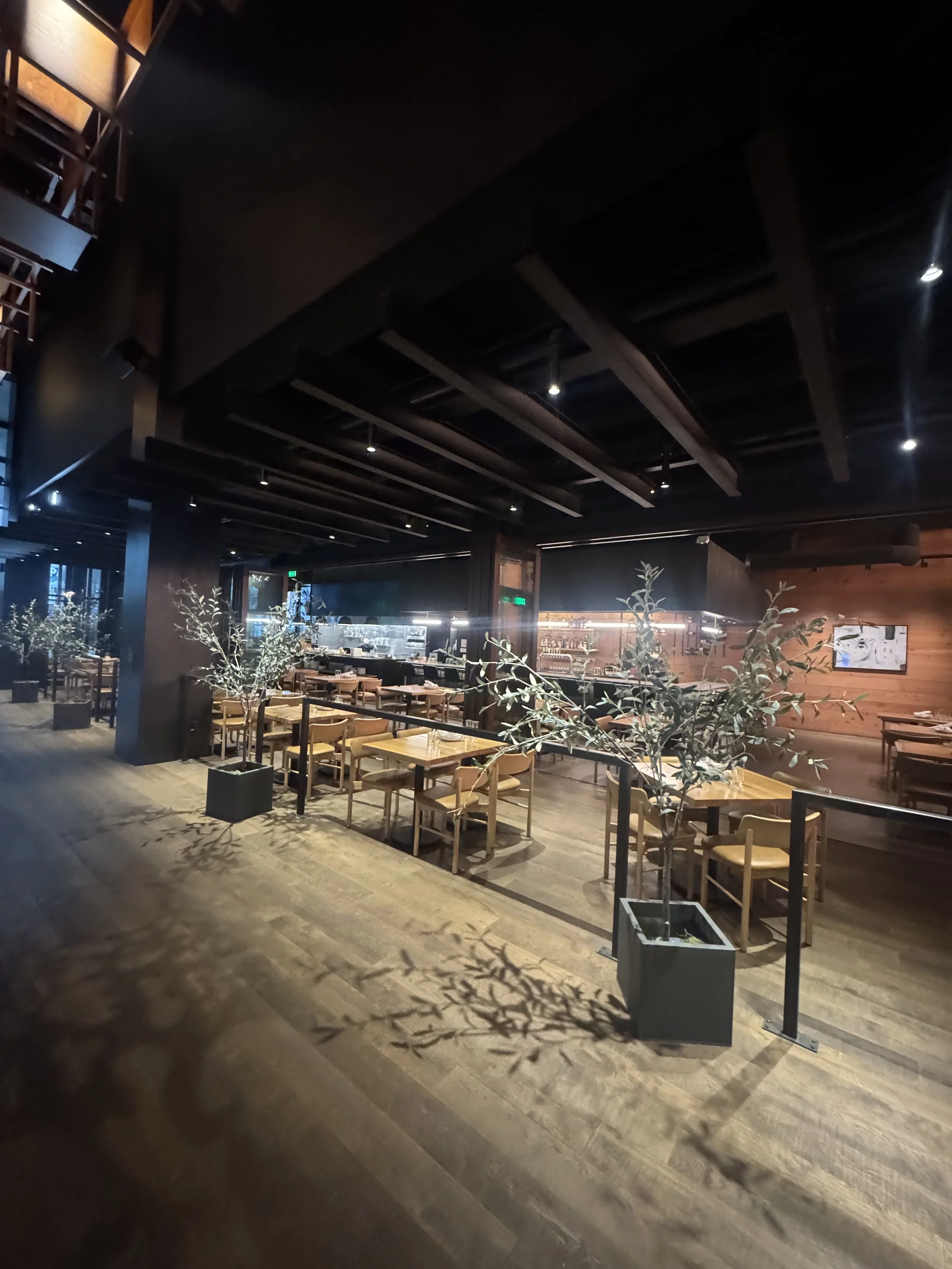
Dinner hour, Bombo Italian Kitchen at the new convention center, 3/11/26
Erica and I went to the Downtown Seattle Association’s annual shindig on Wednesday where dorky socialist mayor Katie Wilson spoke. Mayor Wilson’s playful remarks self-consciously called attention to the political differences she had with the audience—the capitalist-class busybodies who were in attendance that late afternoon on the fifth-level ballroom floor of our city’s new, publicly-financed $2 billion convention center.
Wilson’s socialist talk of affordability aside, the real indictment of Seattle’s economy was happening down on the ground level where the posh restaurant bar sat empty.
Annual attendance at the new convention center is up over the past year, but given the overhead of the massive expansion, the complex remains financially “fragile,” according to a recent Seattle Times article.
I couldn’t agree more with the article’s quotes from local architect David Dahl. Dahl was an original critic of the project when it was still in its planning phase. Fast forward: Dahl told the Seattle Times earlier this year that “the space should be better used to benefit people who live here.” And more:
He finds its presence to be a void — a city block empty of the bustling restaurants and bars blocks away on Capitol Hill. So while he remains skeptical of its long-term benefit, the reality is it already exists and therefore should be opened up to classes and public speakers and dancing.
In a way, he agrees with the center’s officials: “It needs people in those buildings.”
I have to wonder if Dahl was making a pun by suggesting that the ritzy complex should be “opened up to classes.”
2) No Booze, Week #3
As I was winding down on Tuesday night, I thought some wine or whiskey would be the perfect pairing for my night-table novel. However, I’m not drinking alcohol right now [I’m All Lost In, #124, 3/1/26.] I’m not sure how long this impromptu project in abstinence will last. And I’m not feeling any magnificent physical change. But it’s psychologically satisfying to know I’m exorcising poison from my body.
I’ll be honest: I seriously like drinking whiskey while reading novels. Furious note taking ensues. Is the pot shop still open? I wondered, surmising that reading while high might be fun; there’s a dispensary just a few blocks from my apartment.
I was surprised to find that yes Ike’s stays open until 11:45 pm. And it was busy when I walked into the store at 10:30. There’s a night-owl, stoner community I never knew existed. I bought lime gummy drops with five grams of THC. These were the chill option rather than the stoned option that had me laughing last week on the couch at my Indian Wells Airbnb. [I’m All Lost In, #125, 3/1/26.]
Tuesday night’s lime-drop gummies were more sleep inducing than comedic. And unfortunately, they didn’t seem to prompt the kind of genius that whiskey does.
Alternate theory, though: The lack of literary insights could have more to do with the novel I’m reading than with the cerebral shortcomings of THC.
3) Part Two of Aria Aber’s Novel Good Girl
The novel I’m reading is the same one I was reading on the plane to Indian Wells last week, Aria Aber’s Good Girl[I’m All Lost In, #125, 3/9/26.] And I’m being too mean. It’s no masterpiece. But it is fun.
Having read the first 100 pages on the flight from Seattle, I raced through the next 100 pages on the flight home Monday night. The second hundred pages are much better than the first.
Rather than settling into the story of protagonist Nila’s relationship with her blowhard boyfriend, Aber lingers instead in Nila’s internal monologue. This tact lets Aber’s thoughtful and poetic voice take over. The sensation of moving at such velocity against the rain felt as though my mind wasn’t really mine at all but someone else’s, the city’s, disintegrating in the wind.
That adrenaline-rush snippet is taken from a nighttime bike ride. It’s one of many examples from Nila’s reveries that turn the narrative into a long-form poem about youth and the city. Indeed, as with all coming of age novels, Good Girl is about the city. In this instance: Nila’s coming of age story in Berlin. She’s the first-generation daughter of Afghani immigrants who’ve moved to Germany where my origins could be vague and malleable.
Nila’s dreamy transformation blends her identity with city aesthetics. “Your father will be ashamed if he sees you like this. You look like a gypsy.”/I looked beautiful, I thought, elegant, even with mascara smeared on my cheek.
More so than city culture, Aber blends Nila’s character development with city infrastructure itself, including its buildings…
I thought of the elevator, the twelve stories the length it would take to run and go home;
They had survived Nazi Germany and the DDR. Buildings: a shelter for human activities; how little we think of them, these buildings, and yet they are so much more durable than we;
its trains…
Doreen and I sat in silence on the train … I could see our faces side by side in the black window, where our reflections seemed despondent, spectral, as if sketched in oil…
and its parks…
I lay down on my back, staring at the system of leaves comprising the crowns of trees; … the snowmelt unveiled networks of grass.
Unfortunately, young Nila’s malleability is also shaped by the aforementioned stupidly mysterious lech she meets in Berlin’s club scene, her boyfriend Marlowe. I’m onto the final section of the book now and as it begins, Nila leaves Berlin on a trip to Italy with Marlowe. By taking Nila out of Berlin (and sequestering her with him) the novel has suddenly lost its energy. I’m hoping this an intentional literary ploy, and that Aber will quickly place Nila back in the more formative setting of the city.