
I’m All Lost In, #121: High octane octaves; more on elevators; and city enjambment.
I’m All Lost In…
the three things I’m obsessing about THIS week.
#121
First, this week’s installment of X > (is greater than) Y
Reading Wuthering Heights > Listening to It WTF? Maybe as AI says, actor Billie Fulford-Brown is a “multi-award-winning audiobook reader,” which I take to mean mellifluous and easy to listen to. But I listened to her read Emily Brontë’s classic 1847 novel Wuthering Heights as I went to bed this week. And just like the Mr. Lockwood character in Chapter 3, I sprung awake in night terrors.
I wasn’t aghast like Mr. Lockwood from nightmares. I was jarred by Fulford-Brown’s belligerent, half-crazed reading.
Method-acting props to Fulford-Brown for leaning into the cantankerous mood of Brontë’s Gothic miscreants. And my bad for turning to this strange novel as an evening sedative. But. Yikes.
Intrigued now, I am putting Brontë’s literary masterpiece on my reading list. Meanwhile, I’ll be looking for a different nightcap.
Starting with Aria Aber’s Poetry > Starting with Her Novel I’ve been looking for a contemporary city-centric novel. And Aria Aber’s 2025 debut Good Girl looks like it might fit the bill. It’s about a bohemian teen coming of age in Berlin to the chagrin of her Afghani-immigrant parents.
While I was standing at the Elliott Bay Bookstore display table reading Aber’s bio on the back cover, I saw that she’d also published an award-winning poetry collection in 2019, Hard Damage.
I decided to read her poetry collection first; by the way, Aber’s bio also noted that Aber studied with one of my favorite poets, the legendary Louise Glück. In fact, shortly before Glück died in 2023 she officiated Aber’s wedding.
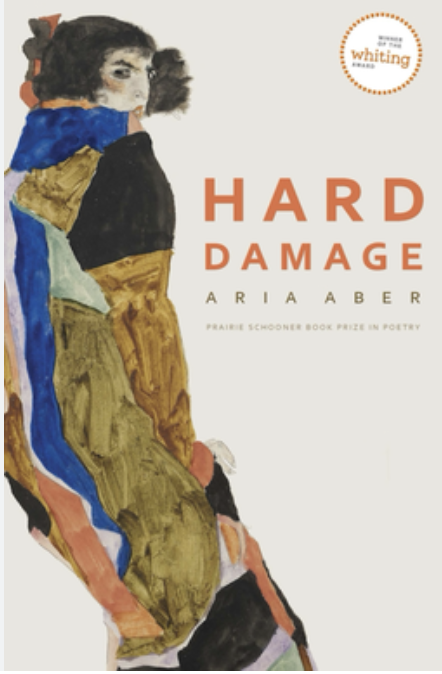
Aria Aber’s 2019 poetry collection Hard Damage won the 2018 Prairie Schooner Book Prize in Poetry and a 2020 Whiting Award.
Aber’s poetry, blowing up with youthful flair and rebellious despair, is packed with vivid language. Some snippets: I tipple the night’s thick milk/until it swallows me (from her poem Family Portrait); Like a comet’s coma. Robot-blood (from her poem Blessed Are the Rich) ; Entire days of gin tonics and turmeric moons (from her poem Foreign Policies); I feed her a spoonful of glass. By morning, she will be a window (from her poem Asylum); Grenade, it’s shape/so much like the fruit they named it after; pomegranate/fruit of the dead, or of fertility depending (from her poem I Wake Up Curled Up in a C.D. Wright Poem.)
Aber’s poetry also makes it clear that she’s a skilled storyteller.
In a poem about her mother’s indigent immigrant experience called What Your Life Was Like, Aber begins:
among the havoc/of Afghanistan, you had to leave your mother,/your diploma, your polluted walnut tree.
Building this cascading single-stanza of verse into “that sudden afterward,” Aber then concludes:
I can see you now, night after night,/on those strange northern streets,/shivering in front of a neighbor’s/glass-walled house. An oxford lamp, a nightgown,/ a piano; you beaconed toward/their music like a bug. Would you stand/ there, barking, again? Would you/ring the bell, stammer about the day/ you learned of symphonies/then beg to play a song?
Aber continues to reveal her family history in a two-page poem titled Sisterhood wherein she shares this:
Sister, we were such sweet/abandon. How small/we were. How unaware/that yearning would be/the only currency that awaited/us, out there, in the arboretum/of this language/
that was, exactly/like the glacial loneliness/of childhood, never-ending,/feral, the only house we’d ever own.
Neon Classical > Neoclassical
This week, I finally got around to checking out a 2025 year-end list I’d bookmarked in early January: The 10 Best Neoclassical Albums of 2025.
The list, curated by a German-based, witchy music website called Grains, includes recent releases with titles like: A Dawning, The Importance of Birds, and Sleep Circle from what seem like a disproportionate amount of Icelandic electronica composers.
Given how the glowing ambient overtones that define these records have more in common with Music-for-Films-era Eno than with Romantic revivalist Prokofiev, I’m going to reclassify this meditative set of jams as Neon Classical.
Best when shuffled.
I made a playlist of my favorite tracks from these downtempo 10 LPs this week. I subbed it in for the Wuthering Heights audiobook.
Onto this week’s obsessions:
1) Playing Vampire Weekend’s Oxford Comma on Piano
I tried to learn this insanely catchy Vampire Weekend song two or three years ago. I bought the sheet music online for $5. Printed it out. And sat down at the piano. But alas. I couldn’t get a handle on it. I joylessly hid the music in my piano bench (as opposed to reverently placing it in the ringed binder with my official piano set list.) And forgot about it.
Pop serendipity. Oxford Comma came on the coffee shop sound system this week, and I thought What a lovely tune this is. I bet it would be fun to lear… Oh, wait.
I opened up my piano bench later that day. There it was. The sheet music. Right where I’d left it. And this time I was able to connect my brain to my hands.
Learning Oxford Comma on piano also tipped me off on why the song’s irresistible post-chorus chorus—Why would you lie about how much coal you have?/Why would you lie about something dumb like that?—lifts the listener.
It’s this: Suddenly the recurring right-hand melody shifts from its established theme in G and launches a theme in C. At the same time, the supporting left hand below sticks with what it’s been doing all along, riding a C. The deceptive nonchalance of the left hand fortuitously matches the C in the right hand. Introducing this C-to-C octave is akin to sliding the brightness filter all the way up on an Instagram photo.
(I’ve obsessed over the glow of octaves before: I’m All Lost In, #54, 10/25/24 and I’m All Lost In, #113, 12/13/25.)
Unfortunately, much as I try, I can’t find a connection between the inscrutable lyrics and Oxford Comma’s radiant turn.
I also searched the final chorus when, knowing he’s got a drop-dead moment in play, Vampire Weekend songsmith Ezra Koenig extends the post-chorus chorus with two additional lines: Why would you tape my conversations?/Show your paintings at the United Nations.
Huh??
However, matching this high nonsense with the octane of the octave does allow you to pair the physical thrill in your body with any meaning you choose as you sing along. This creates a rare moment of weightless freedom in your day.
As the opening line of the song has it: Who gives a fuck about an Oxford Comma?
2) Elevators as Access to Affordable Housing
I remain stuck on my elevator obsession [I’m All Lost In, #120, 2/1/25.]
I wrote a Maybe Metropoliscolumn in PubliCola on Friday calling this hidden-secret, city infrastructure part of the solution to the affordable housing crisis.
Here’s the lead:
How can we increase affordable housing production? According to Senate Bill 5156, one button we can press is elevator reform. Sponsored by State Sen. Jesse Salomon (D-32, Shoreline), the legislation would allow the state to change current elevator rules that—practically speaking—force builders to buy from an elevator manufacturing oligopoly. His idea: Allow smaller elevators as a way to bring down the cost of housing.
In 2024, a 100-page white paper from the Center for Building in North America outlined how a clutch of firms, including Otis and Kone, have signed onto a binding labor agreement mandating a set of inflexible elevator specifications that define and limit elevator production in the US and Canada. These specifications, including exclusive propriety installation and repair standards, cut out a bevy of reputable and safe elevator makers that serve the rest of the world.
Prompted by the 2024 report, pro-housing advocates nationwide have been making elevators a YIMBY agenda item. As part of this lift, Sen. Salomon’s aspirational bill would allow changes to Washington state’s building code that could, according the urbanist nonprofit Sightline, increase the production of affordable, smaller-scale multifamily housing
3) The Enjambed City
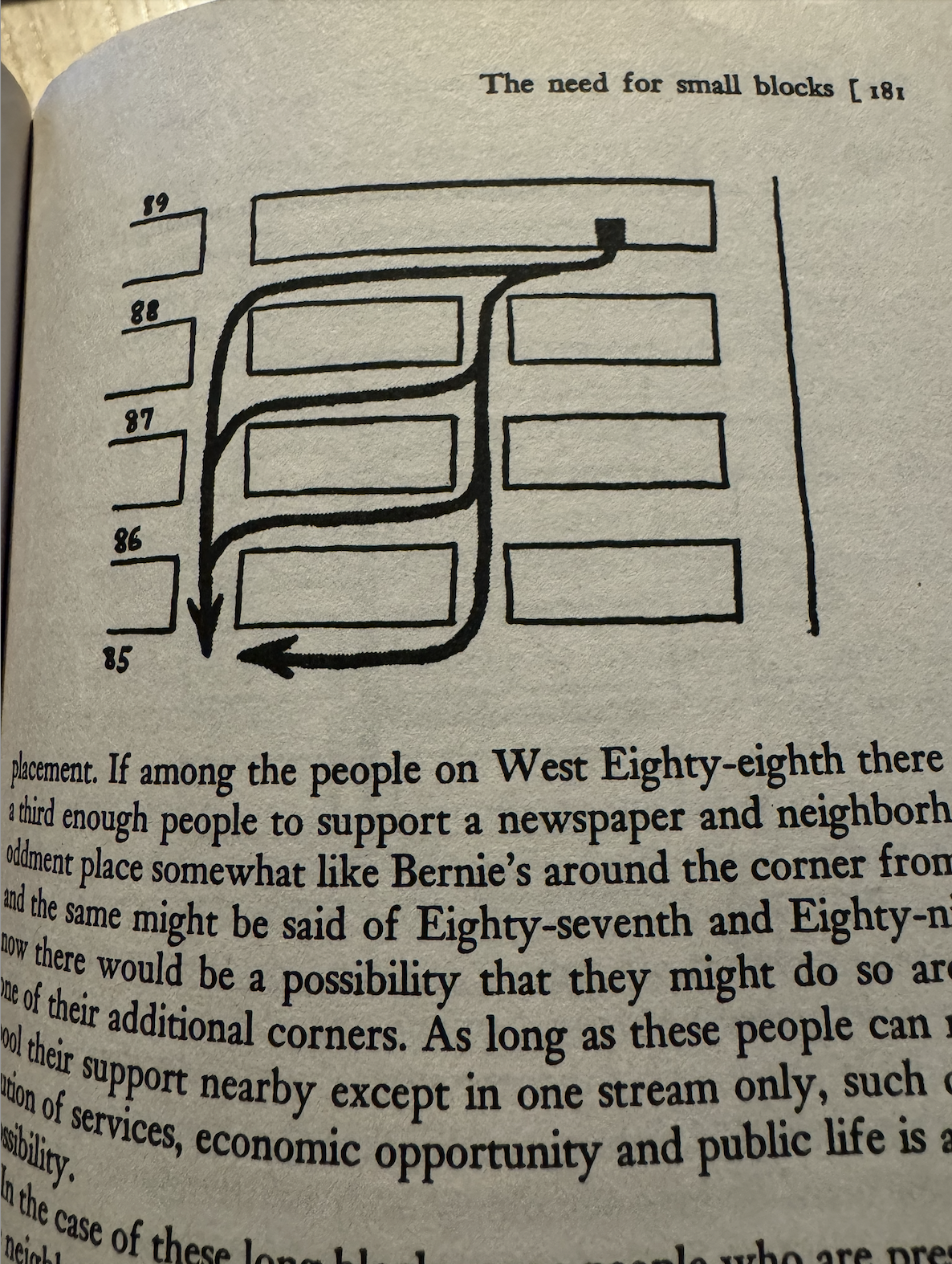
The poetry of short blocks. From Ch. 9 of Jane Jacobs’ 1961 city planning classic.
When I learned that enjambment, poetry’s word for carrying a sentence over from one line to the next, is derived from a ballet term meaning “to step over” or “to throw a leg over,” I thought of Jane Jacobs.
In “The Uses of Sidewalks,” Chapter 2 of Jacobs’ influential 1961 book The Death and Life of Great American Cities, she uses ballet as a metaphor to capture the intricate chaotic order of thrumming city life.
The stretch of Hudson Street where I live is each day the scene of an intricate sidewalk ballet. … This order is all composed of movement and change, and although it is life, not art, we may fancifully call it the art form of the city and liken it to dance—not to a simple-minded precision dance with everyone kicking up at the same time, twirling in unison and bowing off en masse, but to an intricate ballet in which the individual dancers and ensembles all have distinctive parts which miraculously reinforce each other and compose an orderly whole. The ballet of the good city sidewalk never repeats itself from place to place, and in any one place is always replete with improvisations.
Jacobs said that along with mixed use and density, short blocks, which offer bisecting and multiple paths through the city, are fundamental to creating the elegant anarchy—the ballet—that makes cities great. In Chapter 9 of The Death and Life of Great American Cities: The need for small blocks, Jacobs writes, “...frequent streets and short blocks are valuable because of the fabric of intricate cross-use that they permit among the users of a city neighborhood.”
And so I’ve come to think of short blocks as enjambed lines of poetry where one block leads you to the next and the rush of surprises you’ll find there.
I wrote a hyper-enjambed poem about this realization this week. Here’s a snippet. (Apologies if the short line breaks aren’t formatting correctly, technology is frustrating that way. You’re supposed to be looking at one long skinny parade of clipped lines.)
a dance of
serendipity and
mingling
prompted only,
she says, by
density, mixed use, and
short blocks.
Think of them
as enjambed
blocks, emphasis
on jammed with
pedestrians,
neighbors, and
shops that
carry
over
onto
another side-
walk where
you might find
a bargain or
Weill’s next whiskey
bar or a wild night
spot
to moor.

Seattle Mayor Katie Wilson trash talking before the big game..
A final note this week. I am not an NFL fan. I can’t remember the last time I watched an NFL game, never mind the Super Bowl itself.
I imagine this to be the case for Seattle’s dorky new mayor as well.
But her reel about our city’s big game tomorrow is wonderful.



Seattle Mayor Katie Wilson