
I’m All Lost In, #114: The Rob Reiner moment; her favorite horse aloft among space stations; predict and propitiate.
I’m All Lost In…
the 3 things I’m obsessing about THIS week
#114
1. Rob Reiner

Mike Stivic, aka, Meathead (Rob Reiner) comforts Edith Bunker (Jean Stapleton) in a 1977 episode of All in the Family after Edith’s gay friend Beverly (he) is murdered in a hate crime.
I don’t claim to be a Rob Reiner enthusiast. I saw Spinal Tap in the theater when it came out. I thought it was hilarious and clever. Also, like plenty of Gen Xers, I’ve always been fond and proud of All In the Family: Hard evidence for skeptical Millennials and Gen Zers that the 1970s (or at least 1970s TV shows) were smart and woke. Earlier this year, I wrote about another evolved, 1970s show, ABC’s brilliant Room 222 [I’m All Lost In, #95, 8/9/25.]
What I’m left with after the horrific news cycle about Reiner is this: 1) He was America’s quiet Steven Spielberg. Without all the self-aggrandizing fanfare, Reiner warmed American hearts with humane movies that spoke for themselves such as When Harry Met Sally (which I also saw in the theater when it came out), The Princess Bride, Stand by Me, and A Few Good Men. It turns out Reiner was the actual poet laureate of mainstream American cinema.
Related to that 2) Trump stepped in it with his vile, egotistical post about the shocking murder. For once, Trump’s dim bombast was broadly received by the general public as an unequivocal transgression against America.
Trump’s sick post about Reiner affirmed something I’ve been noticing since November when, unrelated to whatever White House “scandal” was in play early last month, I texted a friend to say I was officially declaring the Trump era over. Trump’s putrid Reiner statement shows us that his once-canny read of—and hold over—an uncomfortably large swath of mainstream Americans is now falling flat. His exhortations for unconditional allegiance as the heart of Trumpism are irritating his base as he obliviously wrecks the economy and erodes the constitution. It seems his corrosive rhetoric is finally coming across to his acolytes the way it’s been coming across to the rest of us for the past 10 years.
I don’t make this claim oblivious to the previous—and previous—and previous theories from outraged lefties that Trump has finally gone too far. He isn’t, as Democrats wish, likely to face a truth and reconciliation commission nor an impeachment conviction. And we remain in uncharted, perilous times with a president who openly talks as if he’s a card-carrying member of the KKK.
What I do see, though, is a shouty, shrinking wannabe dictator who goes on TV to yell at the American people as he inches closer to his fate. That of a deeply unpopular president who is widely ridiculed as a failure and loser. Wishful thinking perhaps. And maybe declaring war on Venezuela will lift his standing with his base. But as far as irredeemably bad polling numbers go, Trump’s gross Reiner post seems akin to Biden’s catastrophic Afghan-withdrawal moment .
Wherever Rob Reiner is right now, he may find comfort in the fact that a big-hearted liberal like himself could have in death initiated a turning point.
2) A Poem Prompted by a Hijacking
Had I been keeping this weekly list of obsessions back in the summer of 2023, Martha Hodes’ memoir My Hijacking would have gotten its due; I didn’t start formally itemizing my preoccupations until a few months later [I’m All Lost In, #1, 10/18/23.]
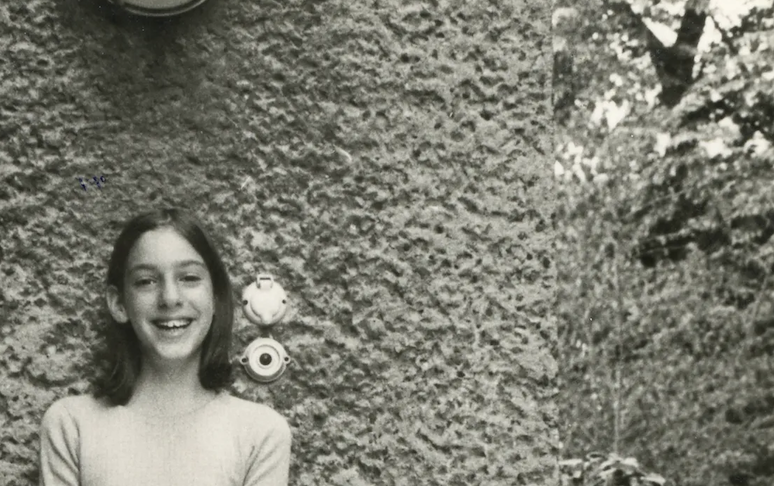
Detail from a photo of a 12-year-old Martha Hodes that ran in the New Yorker when the magazine excerpted her memoir in May 2023.
Hodes was 12 years old in 1970 when hijackers commandeered TWA flight 741 en route from Israel to NYC. Hodes and her older sister Catherine were on the Boeing 707 heading home after a summer in Israel visiting their mom; their parents were divorced, and they lived with their dad in New York. The hijackers were members of a radical group called the Popular Front for the Liberation of Palestine; this was pre-1979 when Marxism, as opposed to fire-and-brimstone religion, still shaped the Palestinian cause and allied “Third World” revolutionaries across the Middle East.
Hodes is older than me, but in reading her book back in 2023, I felt a keen and knowing kinship with her story. I was a precocious, mostly-secular Jew who grew up with a migraine about Israel’s right wing rush into settler expansion.
One story I remember from my antsy childhood, a hilarious one in retrospect, is the time in 10th grade when my friend Adina and I demanded an in-person meeting with the rabbi at our synagogue. We wanted answers about Israel. Hilarious because it quickly became clear Rabbi Adler thought Adina and I were in his office to talk about a teen pregnancy scare.
I didn’t go through something as dramatic as a hijacking. But like people do when they read science fiction, I took Hodes’ account of her intimate collision with the PFLP as an outsized metaphor for my own political angst growing up Jewish.
My Hodes obsession reemerged this week.
Doing some research for a fanciful new poem I was writing, I came across an excerpt from her memoir; the excerpt had run* [1] in the New Yorker when she first published her book two-and-half years ago. Once again, I found myself mesmerized by Hodes’ story.
Dawn seeped into the airplane. Was yesterday a dream?
No. We had slept on the plane. Sand stretched into an unforgiving distance, a flat landscape, dry and cracked. People marvelled at the vastness around us. It was Monday, Labor Day at home, the last day of summer for schoolchildren. My friends would be starting seventh grade tomorrow.
Excerpts all around. From my poem, TWA Flight 741, 1970:
The idea of a revolutionary airport made Martha think of Pegasus./She pictured her favorite horse aloft among space stations./In her book she drew storyboards of the jet age./Its invisible walkways and green lights./Saarinen’s curves of flights and tulips.
Patiently scroll down and down and down here to read a lengthy review I wrote of Hodes’ book back in 2023.
3) My 2026 Tennis Picks
2025 Crash Dive:
Catherine Whitaker, David Law, and Matt Roberts, the insightful hosts of my favorite The Tennis Podcast [“I’m All Lost In, #97, 8/23/25], were unstoppable this week with their 2025 awards and recap shows. Thank you Catherine for accurately identifying Trump in his U.S. Open Rolex-sponsored box seat as looking “like Hitler.”
Also a delight: The podcast’s pick for “funniest on-court moment”: They went with nobody’s-favorite-player-ever Jelena Ostapenko and her foot-fault at Wimbledon. Ostapenko got called for the misstep on the very-first-point played under Wimbledon’s new, electronic monitoring technology this summer.
For me, though, the year’s funniest moment on court or off was when World No. 2 Iga Swiatek broke the fourth wall and burst into laughter as she tried to dodge a reporter’s question about who she’d rather play in her next round at Roland Garros. Would she prefer admittedly tough opponent, World No. 5 Elena Rybakina (Swiatek leads 6-5 in their competitive head-to-head) or World No. 23 Ostapenko, who inexplicably beats Swiatek every time (Swiatek is 0-6 against Ostapenko) ?
Another personal favorite moment from 2025. And file this under Burn on the U.S. Open’s marketing team: It was tennis perfection when defending U.S. Open mixed-doubles champions, everybody’s favorite-names-to-pronounce-in-tandem, Sara Errani and Andrea Vavassori, torpedoed the corny mixed-doubles “upgrade” at this year’s glitzy tournament. Rather than inviting top mixed-doubles specialists to play, the U.S. Open decided to pair top singles players in titillating duos like tour hotties Carlos Alcaraz and Emma Raducanu. Errani and Vavassori had to petition to compete as wildcards. And then they fucking won the whole thing, successfully defending their title. For what it’s worth, they’re lookers themselves.
There was plenty more I loved about tennis this year too.
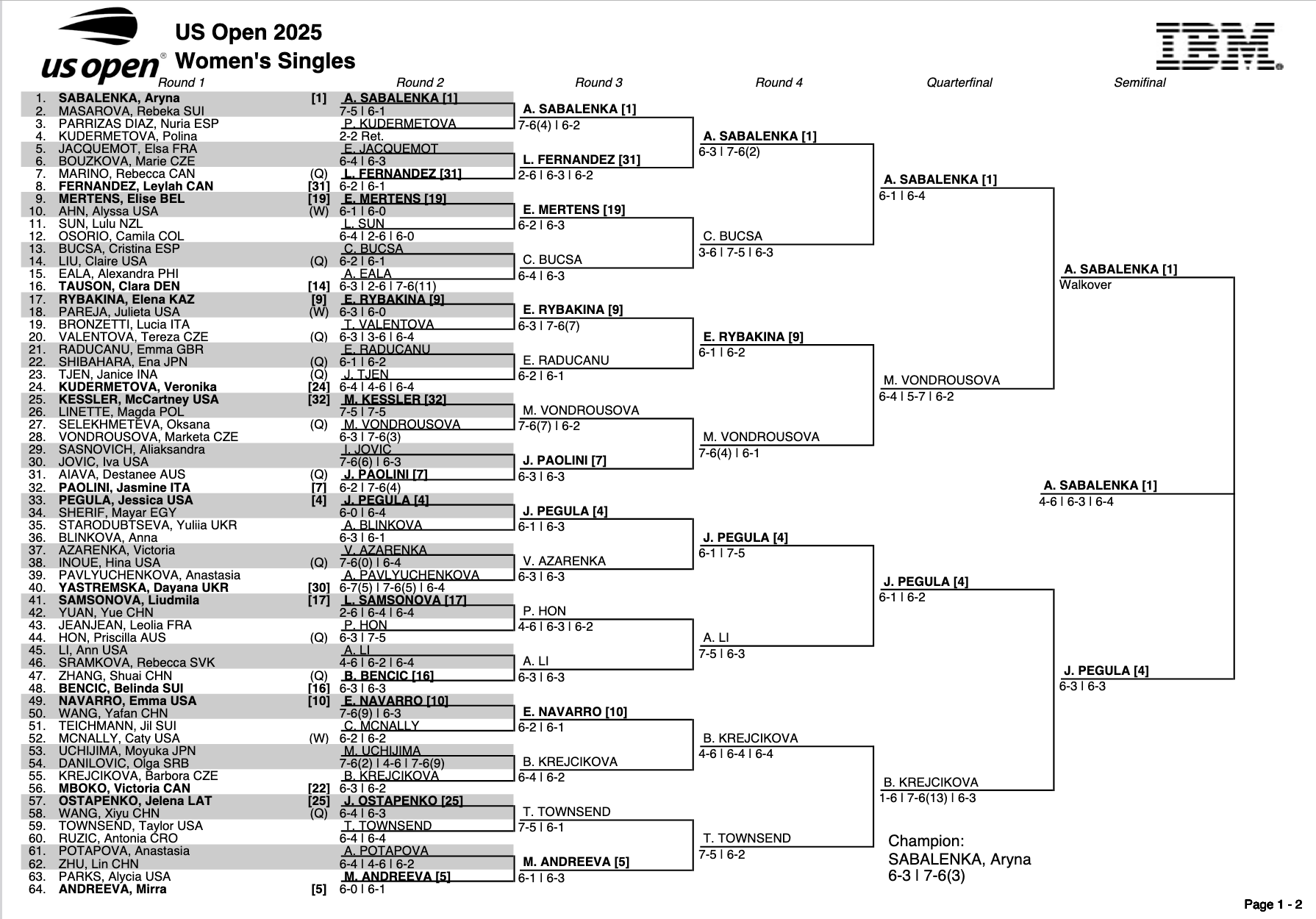
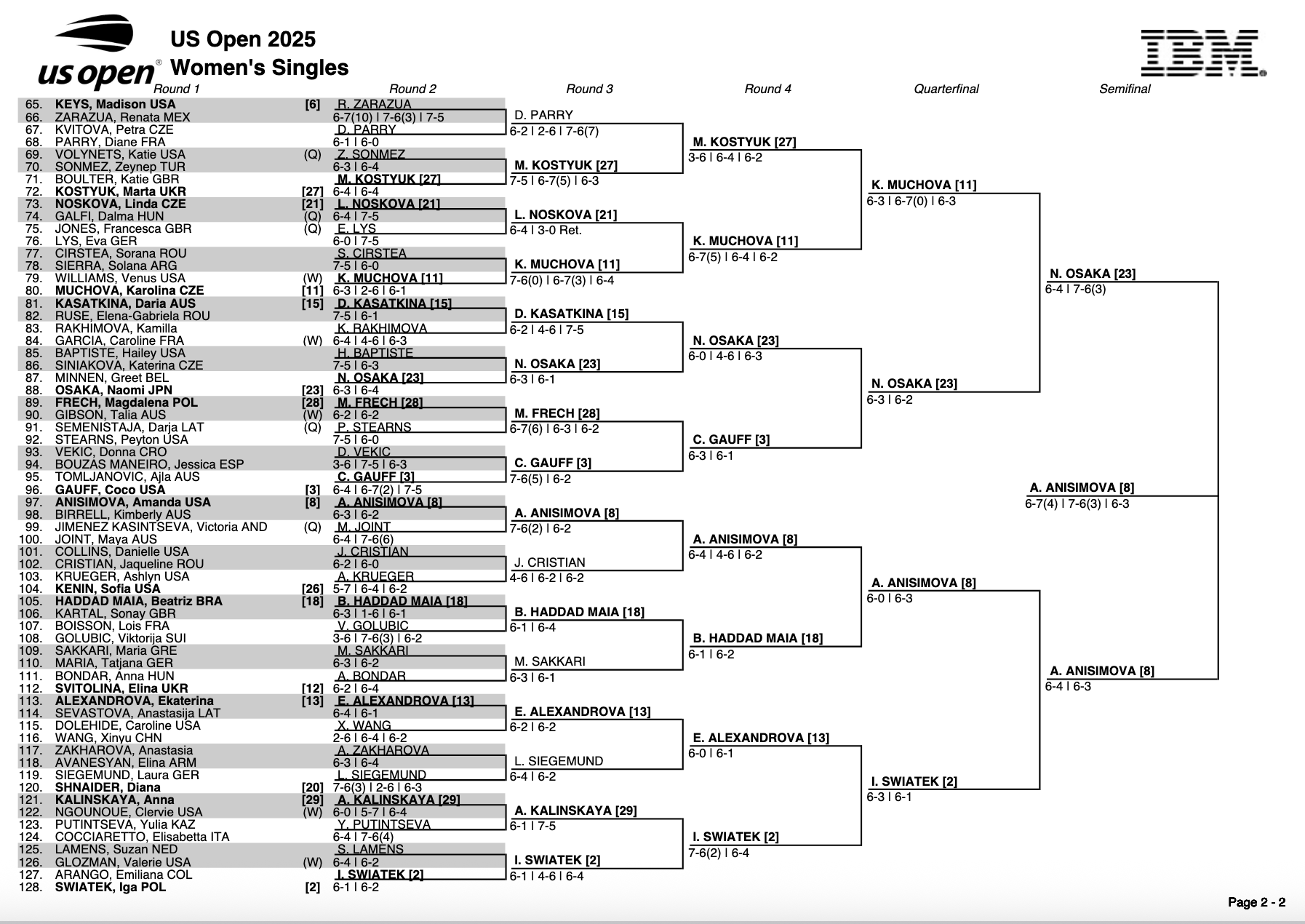
Aryna Sabalenka and Amanda Anisimova on a collision course to the 2025 U.S. Open final which Sabalenka won in straight sets, 6-3, 7-6 (7-3). Fittingly, Saby’s U.S. Open victory, vengeance after Anisimova beat her in the Wimbledon semifinal two months earlier, came with Sabalenka’s 16th consecutive tiebreak win. She was on her way to a women’s tennis Open Era record: 19 straight tiebreak wins.
It’s true. My favorite payer World No. 1 Aryna Sabalenka, or Daffy Saby as she’s known in my house, won the U.S. Open for the second year in row in 2025 [I’m All Lost In, #99, 9/8/25.] But there were other highlights for me this year: Louis Boisson’s alternate-universe run at Roland Garros; Leylah Fernandez’s undeniable form at the D.C. Open … which I peeked in on live [I’m All Lost In, #93, 7/27/25]; and Markéta Vondroušová’s parade of tournament-winning knock outs in Berlin (including over Saby, actually, and over World No. 7 Madison Keys.)
There was also the emergence of the third-highest ranked teenager in the world behind World No. 9 Mirra Andreeva and World No. 18 Victoria Mboko, Australia’s World No. 32 Maya Joint. And her tinted glasses. Joint had two, take-notice 250-level tournament wins in 2025.
Meanwhile, despite my initial aversion to the hype, there was now-World-No. 4 Amanda Anisimova’s convincing ascension. I saw backhand marvel Anisimova’s U.S. Open semifinal match against former World No. 1 Naomi Osaka live. Mesmerizing.
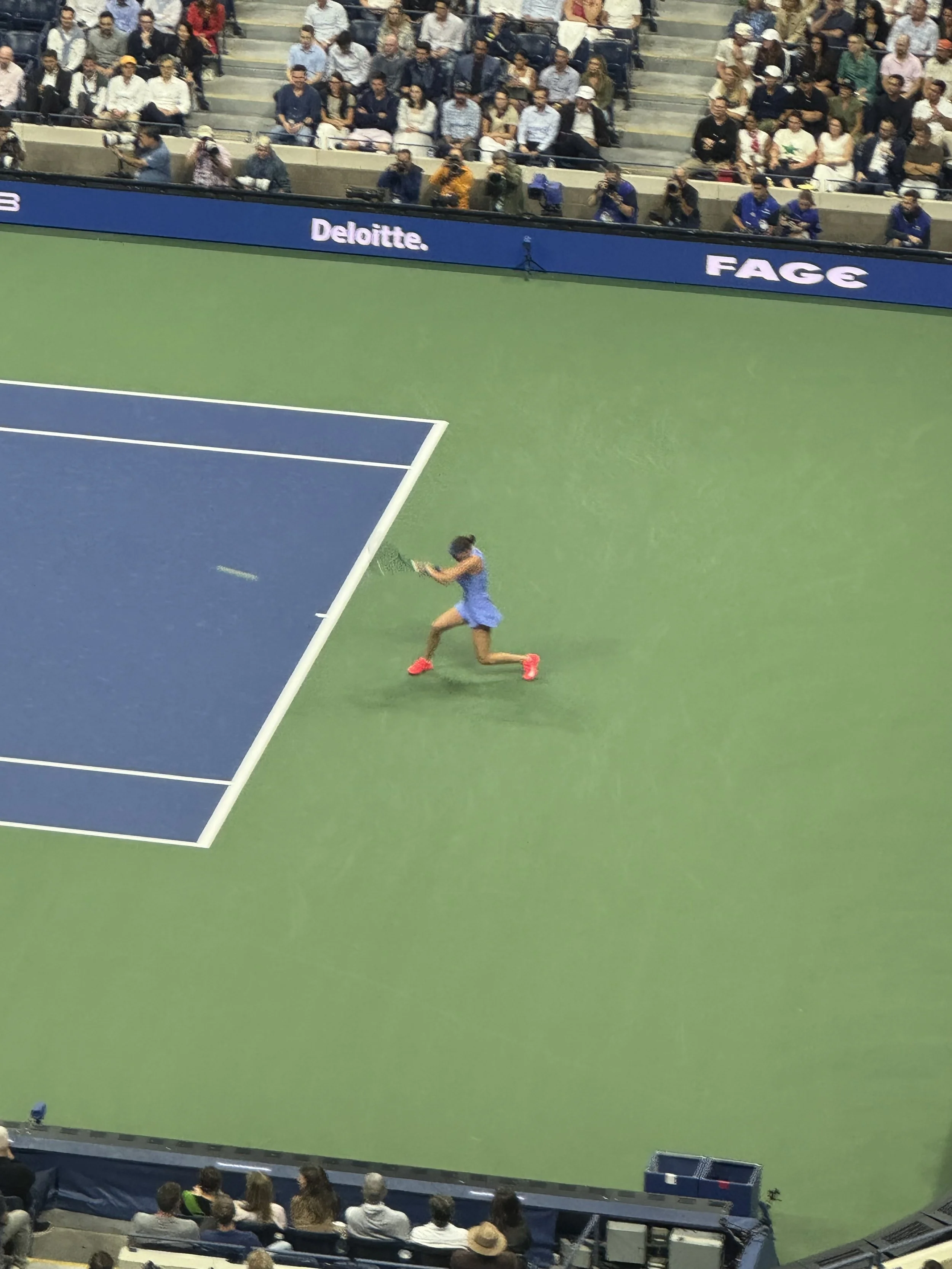
Tennis at its best: Anisimova beats Osaka 6-7 (4-7), 7-6 (7-3), 6-3, U.S. Open Ladies’ semis, 9/4/25. Photo taken by me. Live.
Speaking of Osaka, there was a pair of curiously riveting flame outs in 2025. Osaka’s cosmic implosion in the Montreal final against teenage breakout Mboko. And after Mirra Andreeva’s third-round U.S. Open loss to doubles-star-turned-singles-meteor Taylor Townsend, there was Andreeva’s ongoing disintegration for the remainder of the season. A reality check on the early hype?
I’m certainly high about Saby’s successful 2025 [I’m All Lost In, #112, 12/7/25], including that she was once again named WTA Player of the Year. But it must be said (and Catherine Whitaker said it best on the Podcast … with Billie Jean King scoffing along as well), Saby is finishing the year on a cringeworthy note with her convoluted Battle-of-the-Sexes match. Equally toxic: her “punching down” against trans-women athletes (as Matt put it, also on the podcast.)
2026 Predicts:
Before I go on record with my Top 10 predictions for the WTA*[2], I’m going to sneak in a couple of Ones to Watch. As you can tell from all the names in my slight 2025 year in review: Parity reigns in the WTA. Meaning there are plenty of players in the top 30 who can find form and wreck a tournament bracket. But there are three specific under-the-radar names I predict will climb the ranks in 2026: From the Czech Republic, No. 60 Tereza Valentová [I’m All Lost In, #98, 8/31/25]; from Indonesia, No. 54 Janice Tjen; and from the United States, No. 31 McCartney Kessler. The aforementioned No. 32 Maya Joint and her tinted glasses also seems poised to rise. And of course, former 2024/25 Top-10 player, China’s Qinwen Zheng (now No. 24), will soar up the rankings if she’s healthy; Zheng had an elbow injury in 2025 and eventually fell from the No. 5 spot she held throughout 2024 and much of ‘25.
As for my Top 10 picks: I’m feeling fully admonished for failing to have faith in Daffy Saby last year when I incorrectly predicted she wouldn’t win a slam nor hold on to her World No. 1 ranking. I had her finishing at No. 3. I will now propitiate the tennis ranking gods and keep her at No. 1 in 2026.
Aryna Sabalenka (will win the Australian Open and the U.S. Open)
Amanda Anisimova (Wimbledon)
Iga Swiatek (French Open)
Coco Gauff
Elena Rybakina
Qinwen Zheng
Belinda Bencic
Jessica Pegula
Mirra Andreeva
Clara Tauson
This means I’ve got three Top-10ers falling off the list as it stands today: Current No. 7 Madison Keys, current No. 8 Jasmine Paolini, and sadly, a personal favorite, current No. 10 Ekaterina Alexandrova.
***
Two important footnotes:
[1] This is an example of pluperfect, a word I learned this week that means: “Past perfect: Of, relating to, or constituting a verb tense that is traditionally formed with had and denotes an action or state as completed at or before a past time spoken of.”
[2] As for the ATP, the men’s professional tennis tour, my contrarian assertion to the ubiquitous notion of a Carlos Alcaraz-Jannik Sinner (Sincaraz) hegemony is this: While Sinner remains a sure thing, Alcaraz won’t dominate 2026. His split with his coach this week is a troubling sign.
I’m looking at you No. 9 Ben Shelton, No. 5 Felix Auger-Aliassime, and No. 8 Lorenzo Mussetti. Or as tennis Youtubers Ben & JG suggested in their ATP predictions this week: No. 22 Flavio Cobolli on deck.
There’s one other thought I keep having about the breathless Alcaraz-Sinner narrative. And it surely reflects 2025’s end-times aesthetics. As everyone asks What could possibly come next? How can anyone improve the level of play these two superhuman tennis stars have established? I find myself entertaining visions of the post-human A.I. age.
Now that A.I. is venturing beyond data consumption into incorporating “streams of video and spatial data… which will be used to develop autonomous robots,” as Stephen Witt put it in a recent New Yorker article about A.I. [I’m All Lost In, #108, 11/8/25], I find the What comes after Alcaraz & Sinner question deeply creepy.
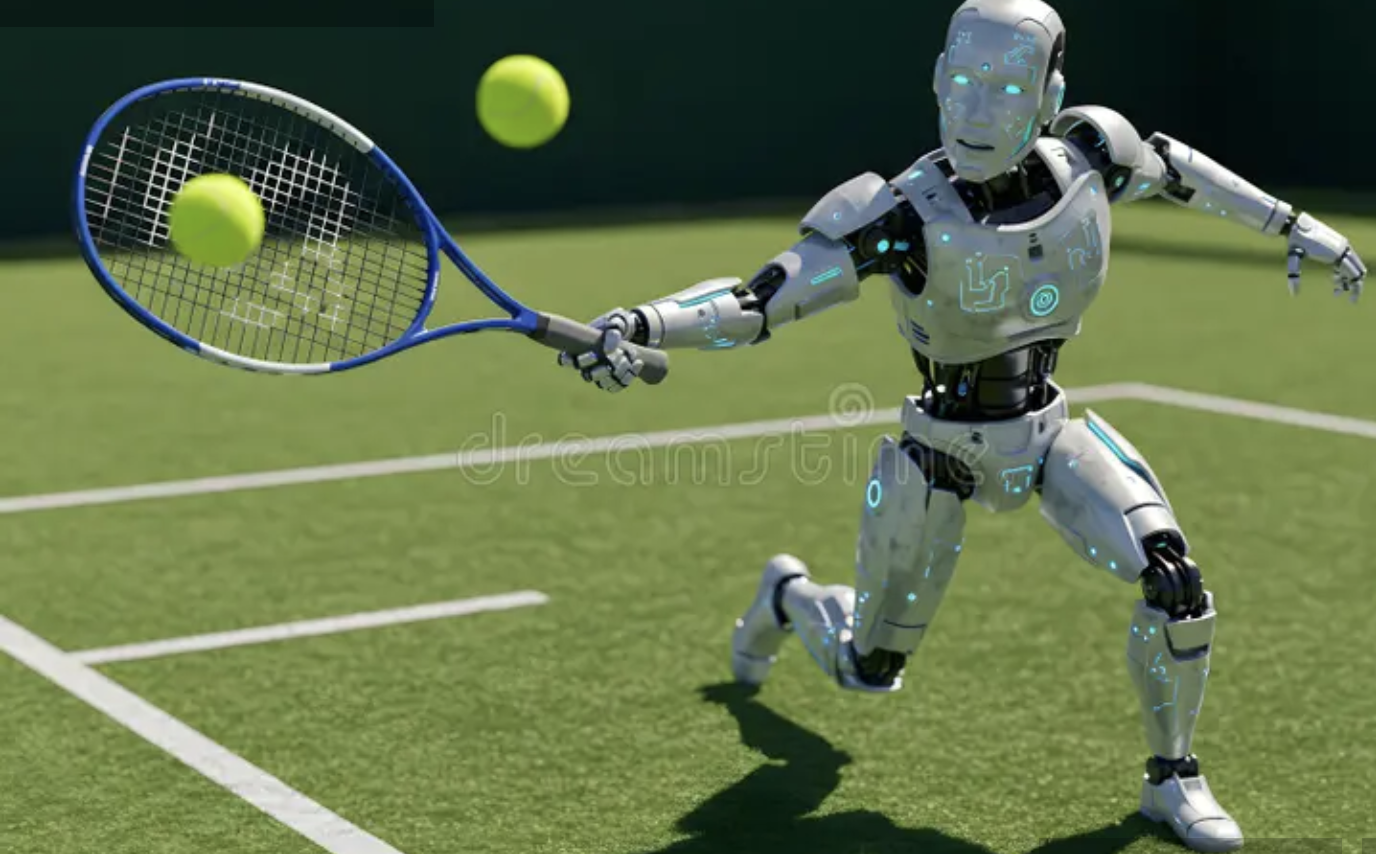
I’m picturing a Wimbledon of the future. Played by rival corporate robots. I’m certain tennis writer Giri Nathan didn’t mean it this way in the conclusion to his fun new book Changeover: A Young Rivalry and a New Era of Men’s Tennis [I’m All Lost In, #113, 12/13/25.] But when I read this passage in the context of 2025’s A.I. anxiety, mine doubled.
The blend of speed and topspin that can make a ball feel like an immovable melon on an opponent’s racquet. That had been [Rafael] Nadal’s game, but the new duo were alredy hitting heavier than their predecessors. … As the coach and analyst Hugh Clarke saw it, this style of play was an outgrowth of the technologies they’d grown up using. Even our most singular artists are, in the end, still the product of their historical context. Alcaraz and Sinner bleonged to the first generation of players raised on lighter carbon-fiber raquets (which allowed for faster swings) and polyester strings (which generated even more spin). Their technique and tactics had developed in symbiosis with their racquet tech… These new techniques gave way to new tactics.