
I think, therefore I think too much. I’m All Lost In, #156: Three years of obsessing.
I’m All Lost In …
the 3 things I’m obsessing about THIS week.
#156
With this post: I’ve been writing about my obsessions every week three years straight since I first started this unintentional autobiography in October 2023.
I think, therefore I think too much.
On Week One, 10/18/23, my three obsessions were: practicing Smokey Robinson & the Miracles’ 1963 hit “You Really Gotta Hold On Me” on piano; a droll comedian named Andrea Jin; and a TikTok piano teacher named Joanna Garcia.
On Week 52, 10/11/24, my three obsessions were: a 1929 novel called Ex-Wife by Ursula Parrot; antisemitism; and the city council’s city budget discussions.
On Week 104, 10/12/25, my three obsessions were: an urban planning book called Shade by environmental journalist Sam Bloch; Trump’s anti-city rhetoric (which I countered by summarizing my exciting week in Seattle, including going to an Iroiro show at the Substation in Ballard); and honing my seven-song piano set, including songs by Blondie, the 5 Satins, Dexys Midnight Runners, Junior Murvin, the Penguins, and Dandy Livingstone.
As we proceed this week, Trump’s anti-city blather continues; on Monday, the comedian president offered L.A. or San Diego to Iran as bombing targets. And antisemitism is still coursing through the body politic— hyperventilating toward a pogrom it seems to me.
Also: I coincidentally bought another copy of Ex-Wife on Thursday—which brings me to this week’s first obsession: The City Canon.
1) The City Canon
I bought a crisp new copy of Ex-Wife, Parrot’s 1929 novel about 1920s Manhattan, so I could include it in the set of books I’d curated for an auction item as part of Transportation Choices Coalition’s annual gala.
TCC’s executive director had asked me to donate signed copies of my two poetry books to their annual fundraising auction, but I felt self-conscious about that. I also didn’t think the $31 street value would bring in very much. So I offered a more exciting item: The City Canon. This is a conceit Valium Tom and I have been preoccupied with for 15 years. A list of great literature about city life.

Two titles in the City Canon, courtesy of Phinney Books. London’s youth culture in the late 1950s. Tokyo’s after-hours culture in the 2010s.
The mass-transit zealots at TCC are allies in Seattle’s urbanist cause, so I took the opportunity to officially put the City Canon into play.
New York City. Ex-Wife by Ursula Parrot. 1920s Manhattan. Flapper feminism meets George Gershwin’s Rhapsody in Blue.
Tokyo. Goodnight, Tokyo by Atsuhiro Yoshida. Overlapping storylines about loneliness collide after midnight.
London. Absolute Beginners by Colin MacInness. Notting Hill in the late 1950s. The youth culture finds common cause with Caribbean immigrants. (Notting Hill used to be an alienated, working-class neighborhood defined by overcrowded housing and poverty.)
Paris. Dud Avocado by Elaine Dundy. Left Bank Bohemia in the late 1950s.
Cairo. Palace Walk by Naguib Mahfouz. A family soap opera, omnibuses, and internal monologues on the political streets of Cairo, Egypt’s capital of conspiracies and secrets.
Los Angeles. Farewell, My Lovely by Raymond Chandler. Los Angeles in the hard-boiled 1930s of double-crosses, pistols, marijuana cigarettes, and cynicism.
Lagos. Everyday is for the Thief by Teju Cole. Lagos’ hustlers, bazaars, gated air-conditioned privilege, and corrupt governance in the aughts.
Future Megalopolis. Mona Lisa Overdrive by William Gibson. Adrift in cities of the Future. Biochips, SimStim stars, holographic A.I., and safe houses.
And just to add one more book about my favorite city: The New York Stories of Edith Wharton, a collection of short stories about the rich and poor in Manhattan at the turn of the 19th into 20th centuries.
Less self-conscious now, I also included my two poetry books, Shops Close Too Early and The Night of Electric Bikes.
2) Contempt by Jean-Luc Godard and Starring Brigitte Bardot
I’ve seen Godard’s 1960 New Wave classic Breathless and his herky-jerky mid-60s set of Marxist-pastiche mood pieces: Alphaville, Weekend, and the great youth manifesto Masculin Féminin (an honorary entrant in the City Canon). But I’d never seen his most commercially successful film, 1963’s Contempt.
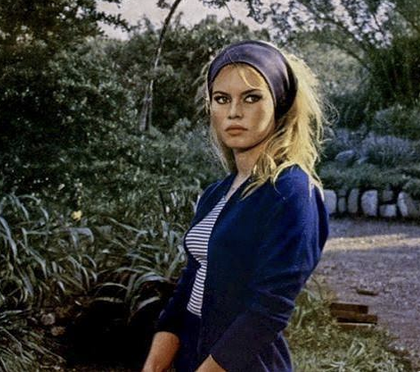
Brigitte Bardot in Contempt, 1963
More importantly, I’d never seen Brigitte Bardot in action (before she turned into a right-wing grotesque later in life.)
As opposed to the mostly black & white, DIY, live-mic mashups in Godard’s seemingly improvised agit-art films like the neo-slapstick Masculin Féminin and the neo-noir Alphaville, Contempt is a proper movie. It has a classic narrative, a swelling orchestral soundtrack, and formal, precise, and gorgeous cinematography. I saw it on the big screen at SIFF Uptown Wednesday night with XDX. It’s all shot in Crayola technicolor in Rome and on an Island villa in Capri.
While it was a delight to see Godard’s hands freed by a big budget, it was more exciting here to see his inimitable hijinks fingerprints—absurdist assaults on the fourth wall, moody jump cuts, and candid philosophical snark—besmirching his foray into mainstream cinema. Godard announces from the get-go that this is not a straightforward bedroom drama. In the meta prologue (meta is Godard’s default vernacular), Godard reads the opening credits in a voiceover as the credits themselves scroll on screen. In the background there’s a tracking shot of a film crew filming a tracking shot that eventually comes to a stop and turns the camera directly on us. There’s more meta-commentary in the subsequent, opening scene as well: Bardot, lying on a bed naked, itemizes her own body.
Bardot is in cahoots with Godard. Her lethargic tour-de-force performance, with her tousle-haired nonchalance trashing the era’s movie goddesses ideal, outfoxes the trappings of commercial filmmaking. Always in mid-stride, Bardot seems to be constantly fleeing the frame as she turns the script into a feminist weapon, detonating over-the-shoulder hand-grenade mic drops with nearly every line. Her evasive delivery reminds me of the way larger-than-life Marlon Brando always seemed to be punching his way out of the script. And Bardot’s bad-girl/’60s-girl-group black wig—often interpreted as Godard’s attempt to make her look like his own wife Anna Karina—struck me more as an F you to the studio. A smart-aleck reclamation of commercialized American culture. They wanted her blond bona fides, but she gives them street-smart Leader-of-the-Pack pop.
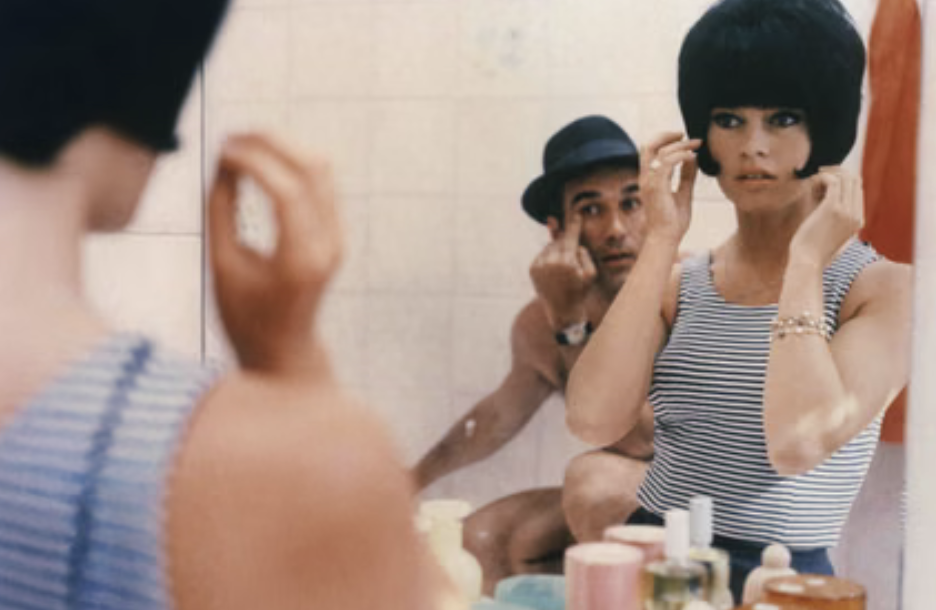
Brigitte Bardot as the lead singer in a ‘60s girl group? Contempt, 1963
Godard has put us on alert that the notion of contempt doesn’t merely reference the mood between wife and husband. He’s put the producers on alert too; they had demanded more shots of Bardot in her birthday suit after they saw a rough cut sans any nude scenes.
The film’s plot gingerly orbits a film-within-a-film production of Homer’s Odyssey being directed by a chill 73-year-old Fritz Lang playing himself. As with Homer’s story, the cocky mortals in Godard’s film all come to tragic ends. Michel Piccoli as the tortured screenwriter (a stand-in for Godard) is left emasculated and alone. Jack Palance, playing that era’s version of a tech bro as a boorish, pseudointellectual American producer carrying around Mao’s little red book so he can crib non sequitur aphorisms, dies in a highway smashup. His red Alpha Romeo collides with a BP oil tanker! And Bardot, the screenwriter’s besieged wife (a pawn who’s figuratively debilitated throughout the struggle between screenwriter and producer) dies alongside Palance in the sports car.
Godard’s Marxist thesis? The dialectic wrestling match between the commercial movie industry and the agitating artist destroys them all.
3) The “Poems” Link on My Website
One thing that’s been missing from my poetry website is my poetry.
While I’ve had a link to a “Poems” page, I hadn’t actually updated it since I first set up my site three and a half years ago; the same three poems have been there ever since. Time for some new content. 25+ additional poems. All the poems I’ve had published in different literary journals over the past few years.
I stayed up late Monday night adding them.
For some of the poems, I also included links to mini-essays and backstories—like how “The Ball Kid Faints” is part of a sequence that casts tennis ball kids as something akin to Fagin's gang from Oliver Twist.
A few of the poems also now come with audio or a reel of me reading.
And one poem, “I’m Delighted My Young Avant-Garde Friend,” even comes with an indie-rock version that an old avant-garde friend wrote and recorded with a distorted electric guitar a few years ago
For a few of the poems, I was only able to provide images from the journals.

Published poems. now linked on my website.
This Week in X > (is greater than) Y
1960 > 1959 As captivating as Hettie Jones’ (née Cohen’s) thrilling dispatches from late-1950s Greenwich Village are, her autobiography, How I Became Hettie Jones [I’m All Lost In, #155, 10/4/26], ascends around page 110 when 1959 turns into 1960. When the restlessness of her beatnik circle’s amorphous opposition to mainstream America, their experimental theater, new directions poetry, and androgynous clothes finds its focal point in the civil rights movement. And for Hettie, white and Jewish, it’s feminism too:
"Day after day the students leaned on Formica counters in Nashville. They were young, younger than we, led by a woman of twenty-two." (That would be Diane Nash, leader of the Student Non-Violent Coordinating Committee.)
Only a few pages later as Jones’ memoir unfolds diary-like in real time, the electricity is palpable. “It was April 1960 then. In the following year, eleven African countries would declare their independence, altering the world’s political balance, and the civil rights movement in America would reflect this change.”
Of course, change was afoot for Jones herself. Her husband LeRoi Jones, the Beat, but soon to be Black-Power poet, would be her ex-husband by 1966, the jump-cut year to 1960’s inflection point.
Walking the Last Mile > The Bus, Bike, or Scooter If you feel safe, if you have the time, and if you’re able to, I recommend walking the first mile/last mile of your daily trips. This always makes me feel better.
“First mile/last mile” is transit and city planning jargon for the awkward commuter limbo to and from transit stops. To cover this interstitial ground, DOT planners connect feeder bus routes to transit hubs, and they license e-bike and e-scooter companies to get you to and from bus stops.
Even though I evidently love e-scooters, I typically forego first mile/last mile transit myself and go by foot. I walk between home and the Drag, for example, rather than taking a Lime bike or a Lime scooter or the #12, which stops right across the street from my apartment. I also usually walk the 15 minutes to the Capitol Hill light rail station instead of taking the #8, #43, or #11, which all stop two and a half blocks from my apartment.
But it didn’t occur to me until this week that I’d been making a specific decision to walk. And savoring it as well. To “foot it back across the city to my home up the north in Napoli” as the protagonist in Colin MacInnes’ Absolute Beginners puts it when he waves off a taxi and decides to walk back home to Notting Hill after a late-night house party; Napoli is the teenage narrator’s esoteric nickname for his disaffected but exciting Notting Hill neighborhood.
On Thursday evening, I absentmindedly got off the #61 a mile too soon en route from the Northgate Station to Phinney Books; I had my nose in How I Became Hettie Jones by Hettie Jones, and I thought the bus was going east on N. 85th instead of West. When the driver called out Aurora, I thought we’d passed my Greenwood Ave. stop and were about to get on the highway. We were actually heading away from the highway and toward Greenwood Ave. I was momentarily irked as I got my bearings standing by the Jack in the Box and the pot shop and realized my mistake—that we’d been headed the right way. But rather than waiting for another bus, which whizzed by soon enough, I decided to walk the mile to the bookstore. A minute or two later, I was in a great mood.
I’m writing this as a reminder and advisory to myself because I’ve noticed I’ve been opting for the bus more than usual lately.
A Veggie Sub without Cheese > A Veggie Sub with Cheese Perhaps it’s my version of keeping kosher: Don’t mix dairy and vegetables.
I don’t like cheese (unless it’s on pizza, or on bar nachos when someone else at the table has ordered them). And so I’ve been bemused over the years whenever I order a veggie sub and the first thing they want to know is “What kind of cheese on it?”
And I’ve been grossed out too. Even though the menu says, ”Veggie Sub—mushrooms, onions, olives, green peppers and tomatoes,” the sandwich arrives aggressively entombed in mozzarella, like the veggie sub at Harry’s Bar on 15th. Harry’s is my only resort for late-night food. And as I did late Wednesday night after the Godard movie, I’ve taken to ordering their veggie sub with a side of Marinara sauce as my kick instead of all that gloomy cheese.