
A 1985 CBGB ad; the Night Mayor; and Anne Sexton. I’m All Lost In, #155. This Week’s Obsessions and Comparisons in Six sentences.
I’m All Lost In.
The Week in 6 Sentences.
#155
X > (is greater than) Y
A Memoir About Greenwich Village in the 1950s > A Memoir About Facebook in the 2010s I eagerly started reading Sarah Wynn-Williams’ best-selling Facebook tell-all this week, hoping her up-close account of working for one of high-tech’s megacorps and its CEO-oligarch Mark Zuckerberg would be the tour-de-force exposé of “power, greed, and lost idealism” the subtitle promised, but I’ll never know; Wynn-Williams is not a good writer, and I gave up after the confusing intro and chapter one’s endless shark attack-as-metaphor, and instead I flipped open the bargain-table book I’d luckily picked up this week, How I Became Hettie Jones [I’m All Lost In, #123, 2/21/26], an up-close account of the heady jazz-and-poetry days of late-1950s Greenwich Village told as a first-person bebop love story by poet Hettie Jones (née Cohen), the first wife (white and Jewish) of Black-power poet and much more famous LeRoi Jones/Amiri Baraka.
Dine-In > Ordering Online for Window Pick-Up Seattle’s version of a fast-casual salad chain, Evergreens (like L.A.-based Sweetgreen, where I walk in on the fly for a Create-Your-Own at least twice a week), has reopened its Pioneer Square location on 1st Ave. for dine-in, rather than short-circuiting the block as it’s done for the last several years with its limbo, pre-order online, take-out-only option; it’s another sign that Pioneer Square has some urban momentum [I’m All Lost In, #85, 6/1/25] and the kind of momentum, as the lunch crowd fills up the storefront, that begets more—groups of work friends gossiping their way along the salad bin assembly lines before settling into the tables and window seats instead of the anti-city-serendipity formula of tapping a solo order into a phone in advance, dashing over and dashing off.
Fall Fashion > Athleisure Fashion This is mainly to say I absentmindedly left my new Adidas zip-up jacket [I’m All Lost In, #146, 8/1/26] hanging in Lee’s apartment after my recent trip to New York City, and with Seattle weather suddenly turning (in sync with the equinox) and prompting me to put the heater on for the first time since last winter, I found myself basically naked in the elements this past Saturday afternoon out and about in a T-shirt and jeans, shivering as the sun set too soon (before 7pm), rushing into my favorite thrift store (where they’re always playing catchy early ‘80s dark wave dance music) to look for an immediate replacement; this necessary shopping emergency at Out of the Closet netted me an autumnal archetype—a coat that looks like 1970s carpeting with its light browns and gray checkered pattern on off-white, its turtle-shell buttons, and fuzzy collar all transforming me into a dad, a fireplace, a lumberjack, and a fashionable dude at once.
This Week’s Obsessions
1) A 41-year-old Village Voice Ad
Speaking of late-September weather, on the first day of UW’s fall quarter last Wednesday evening, I went to their leafy campus to visit the lower-level of the gothic Suzzallo student library where a happily courteous young librarian led me to a long, pullout metal drawer filled with neatly arranged jewelry-box sized Kodak-yellow cases of microfiche and then to a nearby archaic microfiche terminal so I could spool through the music-club ads in the July and August 1985 issues of the Village Voice, eyes peeled for my smash-jangle college band’s name to show up in a CBGB ad; the Shivers did a handful of shows during that Manhattan bildungsroman summer I spent crashing on a cot next to our rehearsal setup in a friend’s parents’ empty 102nd & Riverside, post-divorce apartment and working at a Times Square movie theater while playing a few gigs, including on a Monday night generic “Audition Showcase,” as the ad I’d finally found anticlimactically put it without naming any bands, at that famed venue ten to eight years after its heyday as a metonym for underground culture.
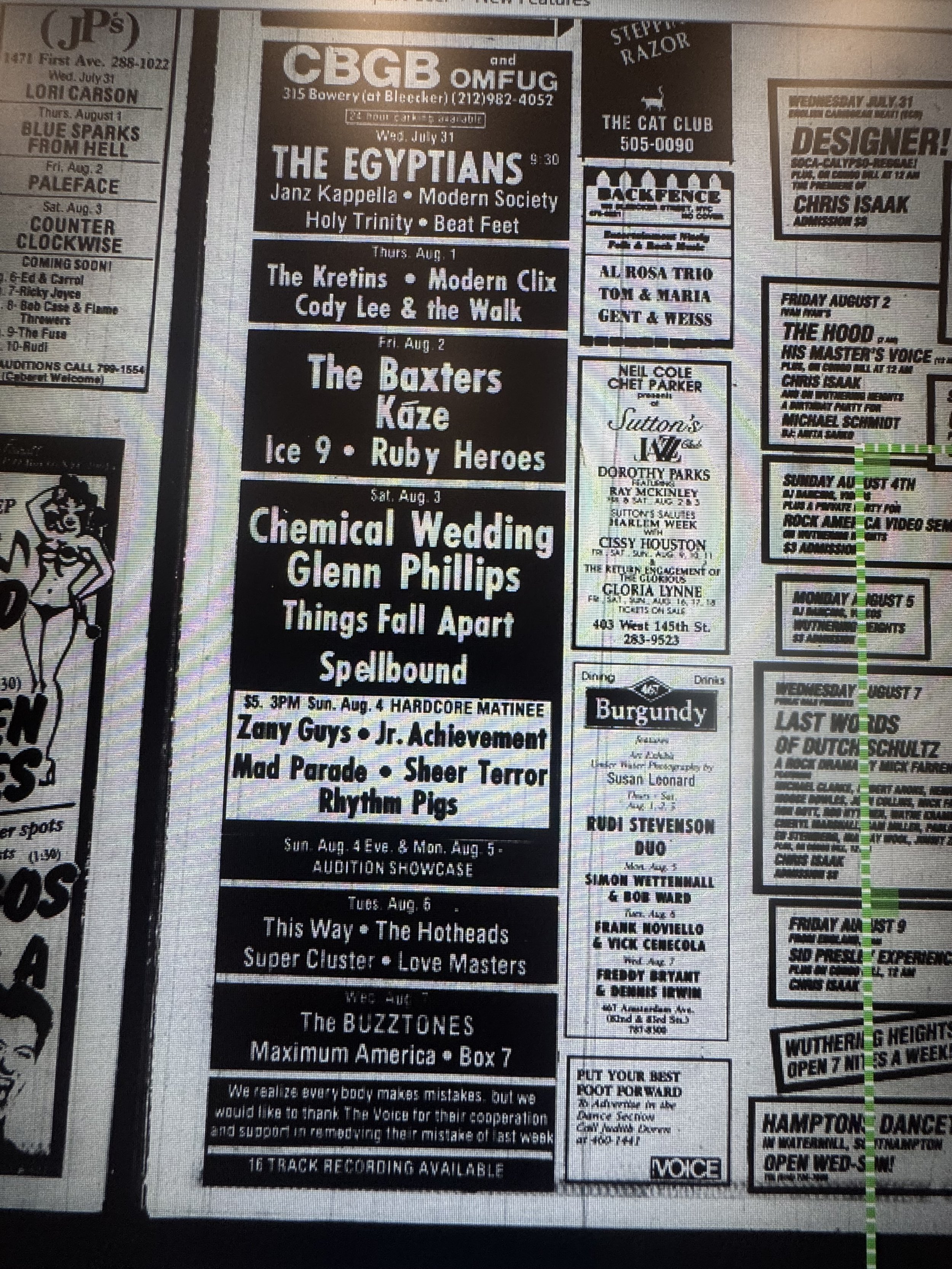
Village Voice, Volume XXX, Number 32, August 6, 1985.
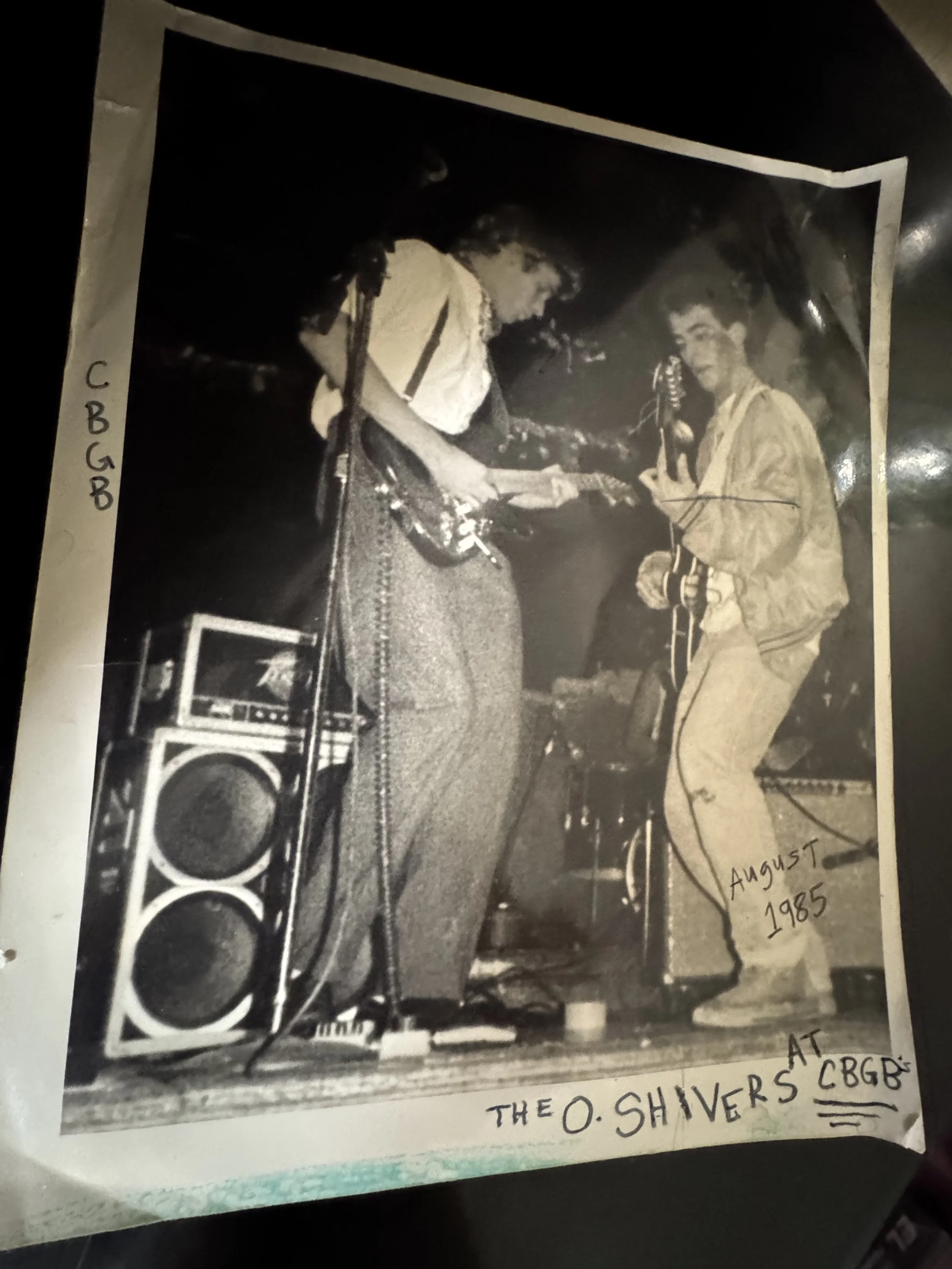
Bildungsroman summer. Me (R) and bandmate Sid Whelan at CBGB “Audition Showcase,” 8/5/85.
2) The Night Mayor
When I saw a CityLab article titled “The World Cup Brought Back Nightlife. Can Cities Keep the Fun Alive?” quoting someone whose professional title was “Associate Professor at the University of Pennsylvania’s Weitzman School of Design who specializes in nighttime policy,” I was confident I’d found, oh, I don’t know, a former underground DJ and composer-turned-city planning academic who now researches: Safe mobility spatial and non-spatial data analysis; reimagining the civic commons; new metrics for transportation safety with cyclist and pedestrian eye-tracking data; and most of all, informational tools and engagement to help musicians, artists, and venues navigate regulatory bureaucracies, i.e. mapping all the cool underground music spaces in New York City; I also knew I’d found, in this fellow Michael Fichman, a kindred spirit who’d turned to data science rather than poetry to catalyze and celebrate the hope that great cities generate in the human heart.
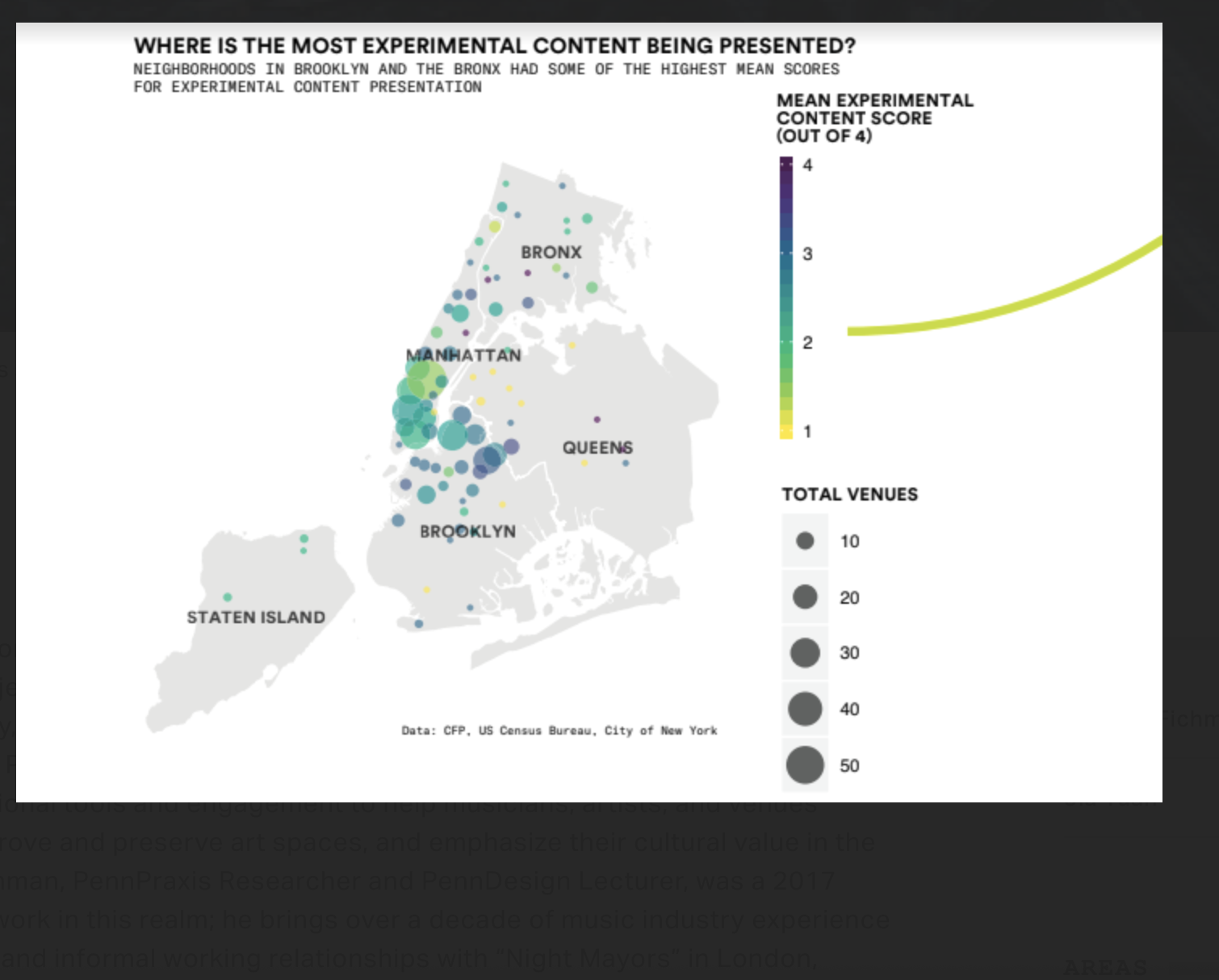
The first slide from the Night-time Economic and Cultural Planning deck.
3) The Introduction to the Selected Poems of Anne Sexton
This 12-page essay by poetry professors Diane Wood Middlebrook and Diana Hume George, written as the intro to a 1988 collection of poems by mid-20th century, second-wave feminist icon and “severely anxious” and “morbid” “poet of loss” Anne Sexton, outlines the famous poet’s career in four phases between 1960 and 1974 (when she committed suicide by carbon monoxide poisoning), culminating in two final overlapping periods of esoteric spiritual writing and “collapsing rationality” after Sexton had swapped out the classics that her simpatico social conspirator Sylvia Plath channeled for a fairy-tale cosmology narrated by Sexton’s “middle-aged witch;” Middlebrook and George’s essay exploded my brain as they detonated their precise and wild observations: “Sexton would no longer speak as a sufferer of madness but as a survivor of it, confronting and interrogating the conventions of mainstream American culture”; “She patterned her poems in what might be described as drifts of association”; “‘Need is not quite belief,’ Sexton comments in [one] poem; but need led her to religion the way madness led her to fairy tales—in search of cultural explanations”; “The speaker seems less a personality than a porous membrane through which life streams in syllables”; “No matter how florid and irrational the simile a mind may form, Spirit resides there”; “in the architecture of syntax, the irreducible intelligence of metaphor… a poem is like Communion bread placed on a believer’s tongue”; “Sexton occupies a privileged place among modern poets in that she created a spacious mythopoesis for the uniquely twentieth-century form of spiritual healing and psychic epistemology represented by psychoanalysis;;” “Integration is often experienced as disintegration; the self fused to the point of origin does not always survive the transition.”
****
Two recommendations that are not limited to one sentence.
Definitely read this e-flux article by my lovely friend Charles Mudede [“I’m All Lost In,” #136, 5/24/26, and “I’m All Lost In,” #54, 10/25/24] about “tombstone architecture,” a term Charles coined and defines as “an emergence, in architecture and public art, of works that have little or nothing to do with their present fourth-boom surroundings but instead represent what’s disappeared or is in the process of disappearing.” Among Charles’ examples of Seattle tombstone architecture: The display panels celebrating Black Seattle culture at Midtown Square on 23rd & Union, formerly the center of Seattle’s Black community. Across the street from gentrifying catnip like the PCC Market, the “Black population has collapsed” here, as Charles puts it.
Charles also cites the AIDS memorial walk on Capitol Hill, Seattle’s original LGBTQ neighborhood; I’d quibble with Charles on this example—while Capitol Hill is no longer the “gayborhood” it once was, it’s still the city’s queer social center and its Bohemian and counterculture hub. More so, I tend to roll my eyes at narratives of nostalgia, which strike me as story lines both the left and the right tell in their respective parochial politics of delusional purity. But Charles is a genius, and his nuance does not to go there. He recently told me, for example, he considers flags hanging out of windows to be a disheartening sight in cities.
I also recommend reading last week’s installment from the New York Times “Overlooked” series, a project dedicated to obituaries that should have been written when the subject originally died, but thanks usually to racism or sexism, or perhaps because the subject was simply so ahead of their time, the NYT didn’t consider them newsworthy in the moment.
This week’s subject is a mid-1960s counterculture NYC filmmaker and teenage provocateur named Barbara Rubin. She died in 1980 at the age of 35.
Rubin, yet another post-war teen who abandoned her sequestered Queens childhood for the electric Bohemia of the Village, sounds fascinating. I’d never heard of her.
She turned solemn poetry readings at the East Village café Le Metro, a hangout for young writers, into impromptu dance parties at a dive bar around the corner, and she prodded two regulars, Ed Sanders and Tuli Kupferberg, to channel that spirit into a satirical rock band called the Fugs. She also escorted Warhol and his entourage into the tourist trap Café Bizarre, and introduced them to a raw young band, the Velvet Underground.
She filmed the scenes she helped create. Her best known film, shot intermittently between 1963 and 1965, began with an unprintable working title before she borrowed its name from a line in the poet Arthur Rimbaud’s “A Season in Hell”: “Christmas on Earth.”
The film could be clinically described as an exercise in gynecological exploration. Essentially performative, it was first shown at the Film-Makers’ Cinematheque, on a double bill with Warhol’s “Outer and Inner Space,” with two reels projected side-by-side.
More often, her film was shown with one image superimposed on the other. Occasionally she showed the reels sequentially or ran them backward and upside down. She continued to edit as well, cutting one print into four-frame shards and resplicing them at random. In every case, the content — an alternately obscure and bleached-out but always in-your-face entanglement of naked bodies — was impossible to ignore.
Writing in Artforum in 2022, the critic Amy Taubin called “Christmas on Earth” “the most transgressive and transcendent” of American underground movies.