I’m All Lost In, #123: Tom’s 100 book recommendations; my poem about a historic letter; and my new blue glasses.
I’m All Lost In…
the 3 things I’m obsessing about THIS week
#123
First, this week’s X > (is better than) Y …
Noise Complaints > No Noise Complaints
There’s a classic urban story out of Ho Chi Minh City this week:
A traditionally rambunctious neighborhood is gentrifying. The new professional class that’s moving in has started complaining about the nightlife noise; karaoke bars and motorcycles in this instance.
I’m not taking sides. But I will say this: I’d rather live in a city where a standoff between social vibrancy and economic vibrancy exists, than in a place where it doesn’t.
The Supreme Court >The Left Complaining About The Supreme Court
The left is cheering this week’s 6-3 U.S. Supreme Court decision against Trump’s tariffs. Let our glee serve as a reminder. The Court is a good thing.
Or at least let’s understand that we can’t have it both ways. Progressive need to stop badmouthing SCOTUS so often even as we turn to it for relief. Deriding the Court is a line of populist thinking that undermines democratic thinking.
Has there been a recent run of terrible Supreme Court decisions? Of course. Overturning a federal right to abortion in Dobbs. Giving Trump presidential immunity in Trump v United States. And in recent years prior to the Trump era: 2000’s infamous Bush v. Goreruling curtailing the democratic process.And2010’s Citizens United ruling making the way for unlimited corporate campaign cash. But there’s also a sweeping history of great Supreme Court decisions such as: Brown v Board mandating desegregation in public schools; Miranda outlining civil rights during police stops; and Obergefell legalizing gay marriage. And certainly—like this week’s ruling—important remedial decisions that save the day with legal basics such as confirming that our derelict president did in fact need congressional approval to enact these tariffs.
It’s worth noting that Trump-appointee Amy Coney Barrett sided with the majority against Trump’s tariffs.
Ask my friend Glenn: Long before everyone was so surprised by Coney Barrett’s status as an iconoclast and long before the New York Times started printing agog articles like this one about her, I predicted she’d disappoint Trump. She’s a civil libertarian. A radical Christian? Yes. But a civil libertarian.
This is exactly why I’ve always been at odds with my fellow lefties’ tendency to vilify the Court. Coney Barrett’s anti-MAGA streak provides a perfect example of just how multilayered and intellectual the Court can be (as opposed to strictly partisan.) As the popular political arena gives way to bullying and shoving, I’m all in on a formal institution like the Court. It should be heralded as an example of the left’s ideal, versus Trump’s mob-rule model.
Yes, the court is made up of ideologues. Always has been. Many of the left’s own cherished precedents were decided through an ideological lens rather than through an unimpeachable legal one; just google penumbra and the U.S. Supreme Court.
The saving grace is that rather than making policy based on deceptive sound bites, divisive appeals, and populist rage, SCOTUS has to engage with precedent, the rule of law, and complex reasoning. Justices can still issue terrible rulings. And have. Like in 2024 when they kneecapped the authority of federal agencies to regulate the marketplace. But in an era when sweeping executive and legislative decisions are made outside the boundaries of logic and fair play, our judicial system remains the last guardrail.
By way of example: The civil-rights left is currentlyand successfully fighting ICE in the federal courts—along with legally defeating many other Trump transgressions, such as: his cuts to federal funding; his attack on DEI programs; and his assault on our elections system. And certainly progressives are looking to the Court to overturn Trump’s dangerous rejection of the EPA’s underlying rationale for and power to regulate greenhouse gases.
But our simultaneous hostility toward the Court echoes Trump’s own ongoing poisonous rhetoric; immediately after this week’s ruling, Trump attacked the court as “unpatriotic” “fools,” “an embarrassment” and “lap dogs,” as he careened into conspiracy theories about the Court’s political motivations and allegiance to “foreign interests.”
Last June, after another good ruling against Trump’s tariffs [I’m All Lost In, #85, 6/1/25], he reacted similarly, and I wrote this:
The Trump administration’s reaction to this legal reality check on their policies—telling judges to run for elected office themselves and condemning the judiciary as “tyrannical”—mimics a traditional tenet of fascist movements: Attack the rule of law by trying to de-legitimize the courts. It’s a dangerous escalation of the “activist judges” talking point that was popular with Republicans during the Reagan-through-Gingrich era. This is why I was never comfortable with a recent leftist cause celebre (after Roe was overturned) to blame the Supreme Court for our problems.
As we cheer this week’s tariffs decision, let’s not lose sight of the idea that this ruling represents more than a victory against the core policy of Trump’s nativist economics. Respecting the Court also represents a victory against Trumpism in general.
In the Year of the Fire Horse, Action and Spontaneity > Planning
Yes. But don’t be reckless.
According to Vogue, during this year’s specific Chinese Zodiac combination of element (fire) and animal (horse)—last seen together in my favorite year, 1966—you shouldn’t confuse being busy with being productive.
Onto this week’s obsessions:
1) The Phinney By Post Book
I could make this another X > Y item: Book Recs From Valium Tom > Book Recs From Anyone Else.
Valium Tom is Tom Nissley, my preternaturally calm, but more importantly, brainiest of bookworm friends. Tom established his super power for recommending books long before he opened his successful shop, Phinney Books, which celebrated its 10-year anniversary one-and-a-half years ago [I’m All Lost In, #37, 6/28/24.] Time flies.
Two memorable book recommendations Tom has given me are: Marshall Frady’s literary, political biography Wallace (1968) and John McPhee’s artistic sports biography Levels of the Game (1969). One chronicles demagogue candidate George Wallace’s racist campaigns for governor and president. The other details the origin story of trailblazing tennis genius and civil rights icon, Arthur Ashe. The poetic symmetry of these two American gems of late 1960s journalism should give you a titillating inkling of Tom’s bibliophile brain. But that cultural sweep is simply Tom in default mode. He unobtrusively yet enthusiastically suggested these books to me on separate occasions. The Frady back in 2017 when Wallace was becoming relevant as a Trump corollary. And more recently in 2024, the McPhee [I’m All Lost In, #21, 3/7/2024] when my newfound tennis obsession was first finding form.
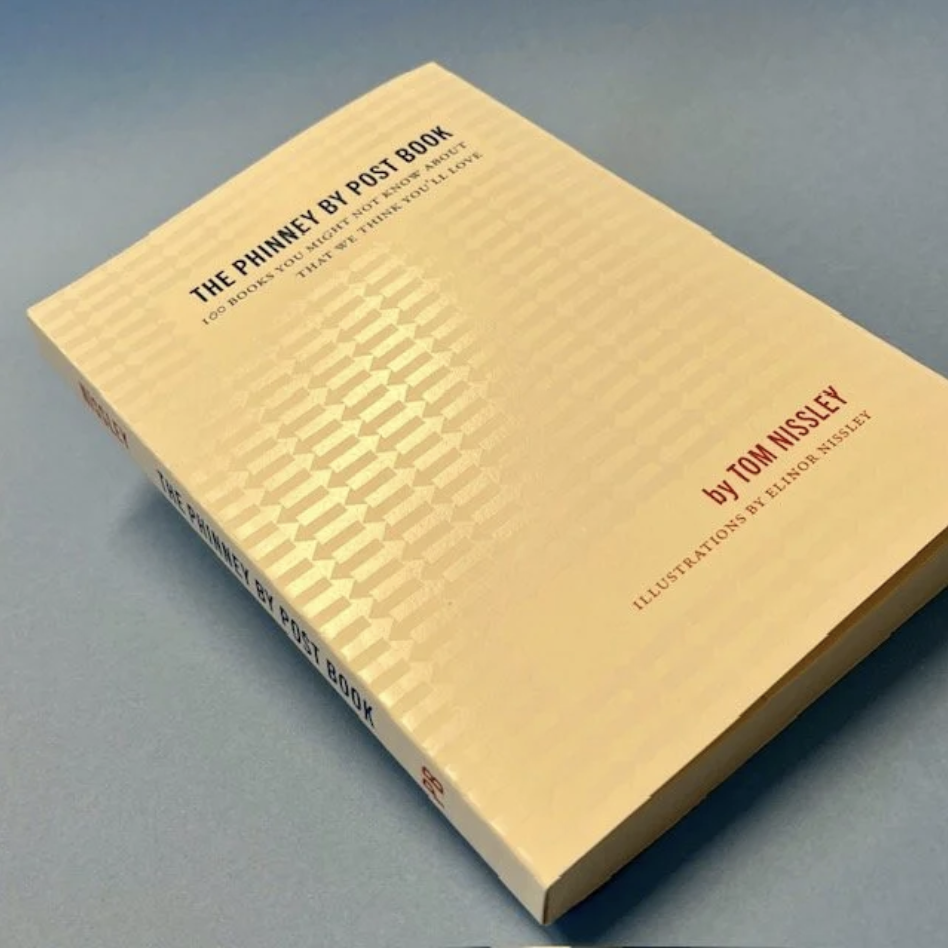
Both of these exquisite, on-point recs are included in Tom’s new book: The Phinney By Post Book: 100 Books You Might Not Know About That We Think You’ll Love.
This stately book, which reminds me of an understated indie film (and features gorgeous prints by Tom’s talented sister Elinor), collects 100 casual yet in-depth micro-essays about some of Tom’s favorite non-fiction (“true”) and fiction (“made up”) literature. All the essays were originally published on postcards and tucked inside Phinney’s monthly picks as part the store’s bespoke subscription program. Unlike publisher-driven subscription models, Phinney’s features “books from the past, ones we love, but think our well-read subscribers likely haven’t read.”
One I’m seeking out right away: No. 51, How I Became Hettie Jones (“true”) by Hettie Jones, the white, Jewish ex-wife of Beat poet-turned-Black-Power poet Amiri Baraka, aka, LeRoi Jones.
For those that don’t have the privilege of knowing Tom (the person who prompted my move to Seattle 27 years ago, by the way), his lovingly curated list and accompanying essays approximate the revelation of hanging out with him. Or specifically, coming to appreciate how gracefully his brain works.
From his postcard essay on Frady’s Wallace:
The further I read into Wallace, the quieter the echoes of Trumpism became. It is less a portrait of a type than of a person… The louder echoes are literary ones: Frady, a Southerner himself, saw Wallace as a character in the Southern novel… a ‘palpable, breathing articulation into flesh’ of All the King’s Men’s Willie Stark (himself an articulation into fiction of the real-life Huey Long)…”
And from his postcard essay on Levels of the Game, which McPhee premised on Ashe’s 1968 U.S. Open semifinal match against tennis rival Clark Graebner:
The contrast between the two players is almost mathematical, laid out by McPhee (and by the men themselves, who analyze each other’s game and character in long candid paragraphs) with the clear, straight lines of a tennis court. On one side there’s Ashe, black, liberal, artistic, free-swinging, and cool, and on the other, Graebner, white, conservative, businesslike, stiff, and anxious.
With those lines set, I’ll leave it to you to find how McPhee blurs them with the patient, wry precision of his portraits.
2) I’m Trying to Write a Poem About a Historic Letter
Speaking of Arthur Ashe, I started writing a new poem this week prompted by a documentary I watched two years ago, American Son [I’m All Lost In, #20, 2/29/24.] The film was actually about 1990s Taiwanese-American tennis star Michael Chang. But the scene I remember most, and that I’m stuck on this week, is about a five-page letter that tennis elder statesman Ashe sent to 15-year-old Chang in 1987; Ashe died in 1993.
Citing his own experience as a role-model minority and describing the worn trajectory of new, young stars, Ashe urged Chang not to turn pro as a teenager.
There is something epic about a seasoned grown up trying to counsel a cocky, ascendant youth. In this film, it reads as a fable.
As I set out to write my poem, I had 15-year-old me in mind wearing my Converse high tops and blue button-down Oxford. And I’d hoped for a sweet coming-of-age dispatch that reflected on the sudden adolescent cognizance of agency. But my words seemed to be telling a different story. One that was influenced by the fact that I knew how Chang’s story ultimately played out. His career ended with a yearning sense of disillusionment.
My poem seemed to be about fate as opposed to free will. Here’s the opening stanza:
Poem for 15-Year-Old Michael Chang
Ashe sent you a five-/ page letter warning you not/ to turn pro so young./ The subconscious is timeless./ Your decision means nothing./
I’m a good Marxist. And I still believe in seizing the historical dialectic as an action figure in the material world. But lately, I’ve been reflecting on the slightly heretical idea that the details of isolated decisions are subservient to a larger super narrative. A quip from Oscar Wilde’s The Picture of Dorian Gray, which I started reading for the first time this week, strikes me as a metaphor for this grander, paradoxical version of free will that’s on my mind:
Every portrait that is painted with feeling is a portrait of the artist, not of the sitter. The sitter is merely the accident, the occasion. It is not he who is revealed by the painter; it is rather the painter who, on the coloured canvas, reveals himself.
3) New Glasses
My Warby Parker life.
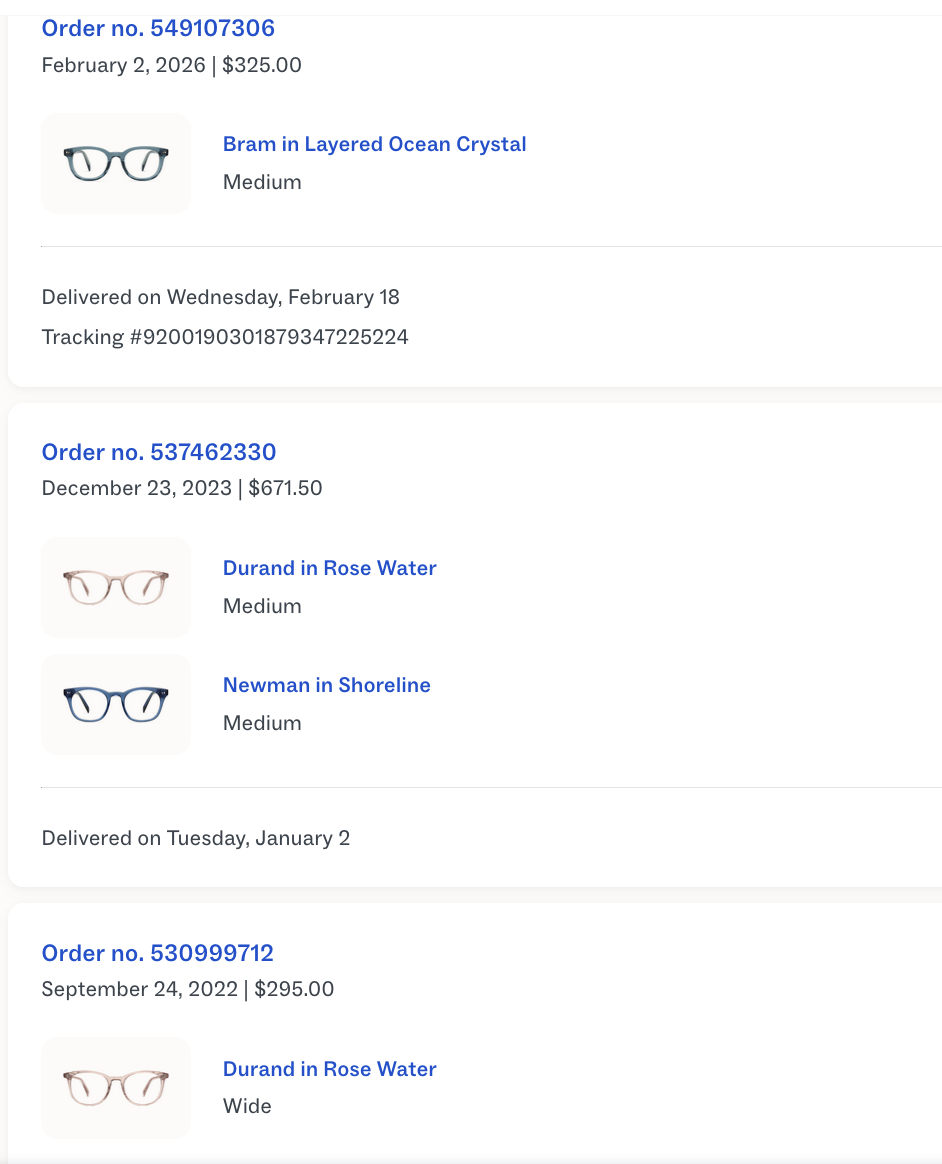
I lost my glasses in June 2022; I left them on the roof of XDX’s car while we were taking an I-5 road trip south to northern California. In September, 2022, I decided to replace them with a subtle fashion upgrade. Rather than reordering the clear Warby Parker “Chamberlain” frames I’d lost, I bought a pair of rosewater tinted Warby Parker “Durands.”
I lost my glasses in November 2023; I dropped them somewhere along Westlake Ave. N. as I biked in the rain to a failed piano lesson. To replace them, I ordered two pair in December 2023 [I’m All Lost In, #12, 1/4/24.] More Warby Parkers. Once again, I bought a pair of the quiet rosewater “Durands.” But this time, instead of my traditional wide frames, I went with smaller, medium frames. I also got a dark blue (“shoreline”) pair of “Newman” frames, one of Warby Parker’s more fashion-conscience looks.
I lost both pairs of glasses in September 2024 and June 2025, respectively. First, the blue pair went MIA on the floor of the Booth Theater on W. 45th St. in Times Square when ECB and I saw a Broadway matinee. Next, the rosewater pair went missing at Poquitos, the trendy Mexican restaurant on the Drag. I’ve been without glasses ever since.
I finally ordered new glasses earlier this month. Just one pair. Luckily, the optometrist reports that my eyes haven’t gotten worse even though I’ve gone glasses-free for the past seven months.
The new pair arrived on Tuesday. Synthesizing the best of my Warby Parker history, I got medium frames in their “Bram” style, a similar fit to the arty “Newmans.” And I went with a slight teal color; a combo of the former dark-blue shoreline pair and the rosewater pair.

New glasses, on the #8, 2/18/26.
They arrived just in time for me start reading Wilde’s The Picture of Dorian Gray.
——
As a WTA super fan, I’d be remiss if I didn’t mention the two instant-classic semifinal matches that took place Friday at the tour’s 1000-level tournament in Dubai.
In the first match, World No. 5 Jessica Pegula beat World No. 6 Amanda Anisimova, coming from 1-6, 1-3 down to win 1-6, 6-4, 6-3; Pegula also beat Anisimova last month in the grand slam Australian Open quarterfinals before she lost there herself in the semis to eventual AO champion, World No. 3 Elena Rybakina.
Pegula and Anisimova, along with their compatriot, World No. 4 Coco Gauff, are the top American players on the women’s tour.
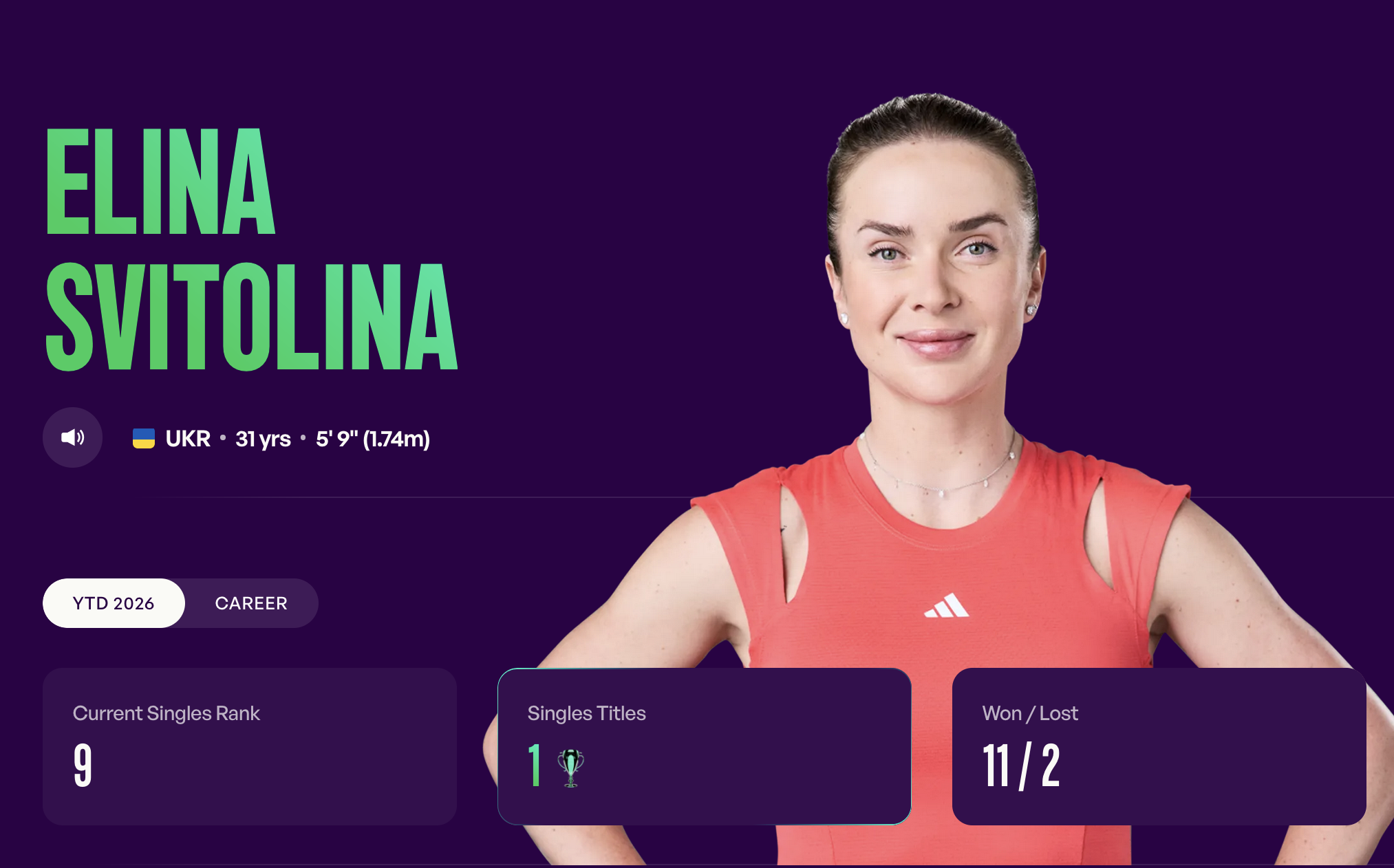
In the day’s second semifinal showstopper: World No. 9, Ukrainian Elina Svitolina, beat Gauff 6-4, 6-7 (13-15!), 6-4. You can watch the entire, insane 28-point, second-set tie break here, which Gauff won before Svitolina beat her in the third and deciding set. Svitolina seems to have Gauff’s number. She beat Gauff last month in the Australian Open quarterfinals as well, dismantling her 6-1, 6-2 before losing to World No. 1 Aryna Sabalenka in the AO semifinal. (By the way, Saby and World No. 2 Iga Swiatek opted out of this week’s tournament in Dubai, pushing back against the WTA’s pressing schedule.)
Svitolina, who’s practically elderly by WTA standards at 31, was ranked as high as World No. 3 in her youthful heyday back in 2017. She seems to be having something of a renaissance this season after returning from maternity leave three years ago in 2023.
I’m a little smitten with Svitolina. (Pegula beat her in the final on Saturday, 6-2, 6-4.)