
I’m All Lost In …
The 3 things I’m obsessing about THIS week
#162
The Week in X > (is greater than) Y
Coconut Milk Detangle Elixir > All My Other Shower Products Among all the shampoos, conditioners, gels, and soaps that have gathered along my shower basin and in my shower caddy over the years, I suddenly find myself with a mystery bottle of Coconut Milk Detangle Elixir©. This surprise salve is made by a California-based, vegan and cruelty-free company called Pacifica; founded-in-Portland, Oregon, of course.
It’s unclear to me how this hippie beauty product found its way into my shower. But where has it been this whole time? Thank you, Pacifica. I’ve got a full bottle of the stuff, and I’ve been adding a generous dose of the scented mist to my morning shower routine all week. I’m feeling detangled daily.
A cup of Blueberry Rooibos Tea > an Almond Milk Latte As part of my attempt to avoid sugar, I’ve stopped drinking almond-milk lattes [I’m All Lost In, #161, 11/15/26]. But I’m still a coffeeshop regular. So, I’ve switched to ordering a mug of herbal tea. Specifically: Blueberry Rooibos tea. Drinking tea has always made me feel disproportionately full, so it’s never been my favorite. But that’s not the case when I drink this calming blend. Now I know what people mean when they refer to herbal tea as a warming sedative.
Ryuichi Sakamoto’s Piano Music > Ryuichi Sakamoto’s Drone Music for Making a Relaxing Playlist Electronic music pioneer Ryuichi Sakamoto (originally of Yellow Magic Orchestra circa 1978) has a deep catalogue of ambient tracks. But if you want the best prompt for evening background music, start a playlist with one of his lulling piano compositions rather than one of his synthetic numbers. The latter lean into the ominous whereas his piano lines, in jams such as “20211130” or “2022302 Sarabande” from his 2023 album 12, drift into the spiritual.
This Week’s Obsessions
1) Zi
The reason I’m listening to Ryuichi Sakamoto this week is because I saw a movie Sunday night at Northwest Film Forum that sampled four of his albums: cendre, async, Summvs, and the aforementioned 12. The movie was a small yet sweeping cityscape reverie by Korean-American director Kogonada called Zi.
Kogonada’s patient camera drifts alongside three introspective characters caught in an ambient, unspoken love triangle on Hong Kong’s slightly run-down streets, parks, pedestrian overpasses, and nightly outdoor karaoke malls. It’s also a sci-fi film about time travel. Or ”temporal drift.” That’s what one of the three characters, Min, a sincere young man who works at a neurological research lab, calls it. This is how he describes Zi’s mysterious condition. Zi is a famous concert violinist who thinks she’s glimpsing snippets of herself in the future, like when she sees herself a block ahead of herself crossing a busy intersection. Min says it’s not that Zi is seeing the future, but that she’s seeing the past as her perception of reality lapses further and further behind time into delayed experience. She also has visions of her future lover Elle, an American expat and struggling artist, who Zi then suddenly meets in person on the landing of a worn city staircase upon looking up while perched there weeping about her bewildering asynchronous condition.
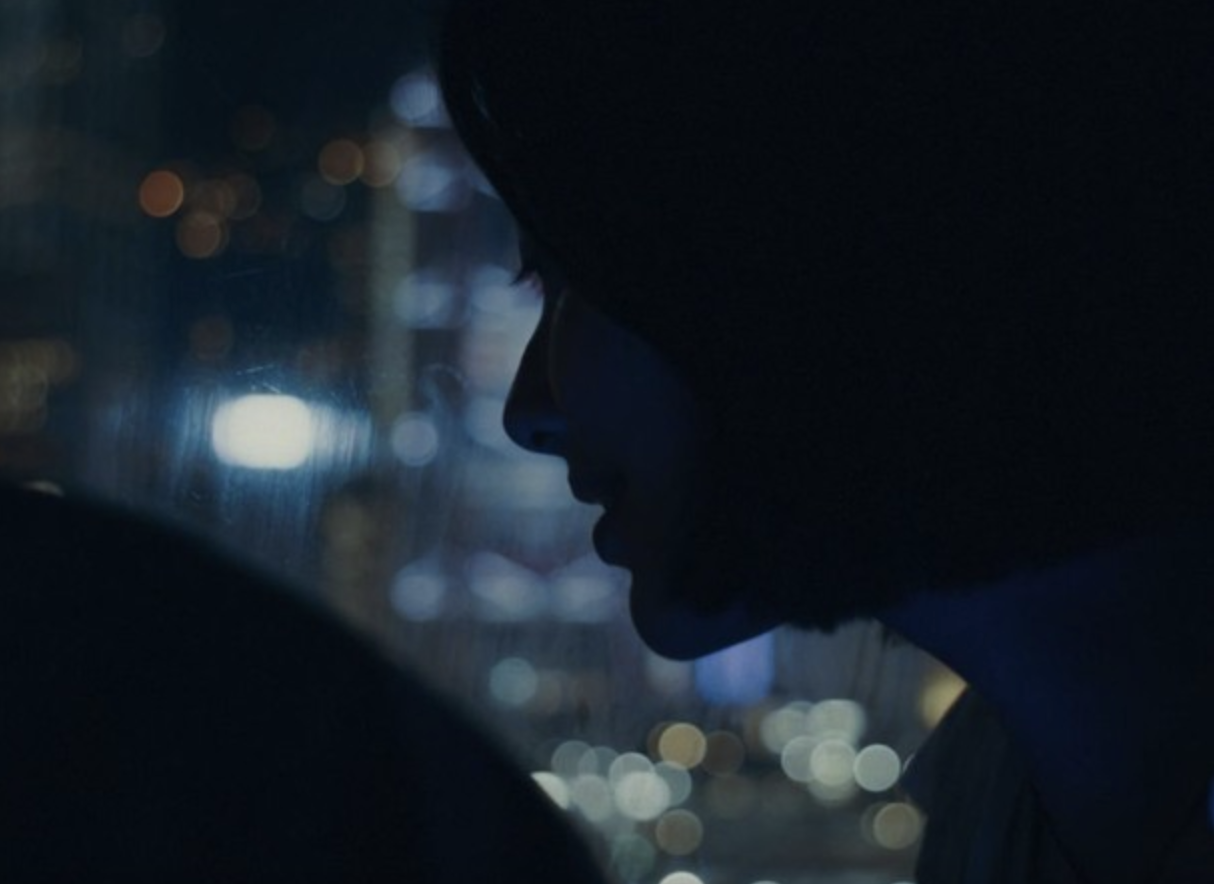
Michelle Mao as Zi in Kogonada’s experimental DIY 2026 film.
The reviews, positive and reverently grasping for words such as “ineffable,” nudge you to ignore the quantum mechanics and just take in Kogonada’s artful cinema. I disagree with that advice. After following the trio’s romantic narrative in earnest as it was refracted through something akin to a Ted Chiang short story with a host of marvelous metaphysical premises to consider, I was sitting up and scooting forward in my seat, catching my breath in awe at the final scene: Zi and Elle, older now, sitting on a park bench. Zi and Elle, much younger, standing on the sidewalk before them. Elle in both scenarios asking Zi what she sees. Zi looking at Zi.
2) Tchaikovsky’s “Valse Sentimentale”
In addition to using Sakamoto’s ethereal music, Kogonada’s otherworldly film also uses Tchaikovsky’s plaintive “Valse Sentimentale (Op. 51, No. 6).” I mistook Tchaikovsky’s famous nimbus-of-a-piano-tune for Chopin, Camille Saint-Saëns, Fauré, Massenet, or even Satie. I knew I’d heard it before, and I don’t listen to Tchaikovsky!
Surprised by how gorgeous his wistful late-Romantic study was, I used the tune as a prompt to create a soothing playlist. With the exception of giving me a handful of other Tchaikovsky songs, which I quickly deleted because as far as I can tell, “Valse Sentimentale” is an inexplicable anomaly in the Russian composer’s grating and heroic repertoire, the “Valse Sentimetnale” prompt rendered a set of daydreams that I played all week.
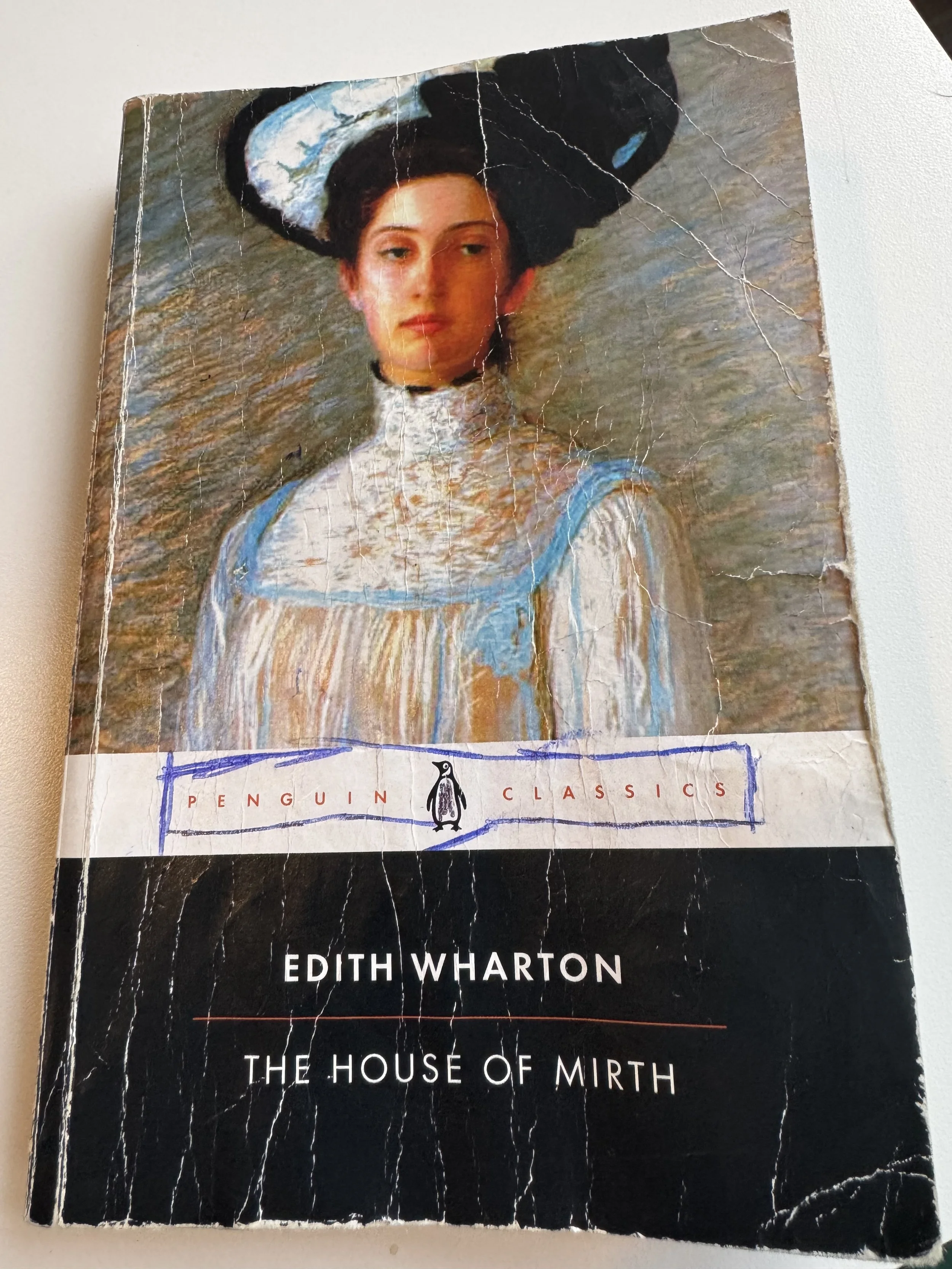
3) The House of MIrth
About 280 pages into Edith Wharton’s House of Mirth, already a thoughtful, philosophical (and beautifully written!) critique of Manhattan’s Gilded Age coterie, the story shifts into darker and more profound territory. The change begins with about 50 pages left, in Book 2, Chapter 10. At this point in the novel, protagonist Lily Bart, a once-eligible bachelorette aloft in the horse-drawn hansoms, hushed gardens, and luxurious guest rooms of the county-house class, officially joins the ranks of the working poor where “poverty simplifies book-keeping.” Losing her evening-slipper footing after a series of financial and social missteps, Lily desperately begins working in a sewing production line. Spoiler: This is an inexorable downward spiral. Due to her creeping chloral addiction and her “useless” bourgeois skill set (“I can hardly be said to have an independent existence,” Lily reflects, “she had been brought up to be ornamental … failing to serve any practical purpose”) her “dismissal” is inevitable. She is quickly submerged into a castoff world of cheap diners, damp park benches, and “cheerless” boarding houses of “deeper loneliness.” It seems more like the Manhattan of Rico Rizzo’s Midnight Cowboy than of Astor and Vanderbilt’s 5th Ave.
In Chapter 12, Wharton herself explicitly tells the reader that her novel has changed from book-smart page-turner into a philosophical manuscript. “It seemed incredible,” Wharton reports from Lily’s inner monologue during the final meeting between Lily and her co-star-crossed lover, Mr. Selden, “that any one should think it necessary to linger in … word-play and evasion.” A novel once whisked along by Bart’s clever retorts—”I think I should prefer a half-husband” she once quipped several chapters earlier after being told that one of her suitors is married—is now a book about the cosmic matters at hand rather than about running away from them.
From the existential scene in Selden’s apartment, where marriage and death become conflated, and onto the end of this brutal novel, there is no longer any room for evasion. Before exiting Selden’s apartment, Lilly first tells him she’s leaving her old self behind. “When I go out presently, she will not go with me.” Seconds later, she amends that. “In its light everything else dwindled and fell away from her. She understood now that she could not go forth and leave her old self with him: that self must indeed live on in his presence, but it must still continue to be hers.”
The novel’s momentous penultimate chapter chronicles the result of this decision as she leaves the warm fire of Selden’s apartment and “felt the dull pavement beneath her feet.” First, as the “weariness returned with accumulated force, [and]… she felt that she could walk no farther … besides, what was there to go home to?” she finds a lonesome bench in “almost deserted” Bryant Park. “The penetrating dampness … struck up from the wet asphalt.” Next, temporarily rescued and standing in Nettie Crane’s tiny but clean tenement apartment, she holds Nettie’s newborn. “At first the burden in her arms seemed as light as a pink cloud or a heap of down,” but suddenly, “as she continued to hold it the weight increased, sinking deeper, and penetrating her with a strange sense of weakness.” Finally, Lily Bart confronts reality back at her boarding house. “The terrible silence and emptiness seemed to symbolize her future … she alone left sentient in a lifeless universe.”
Heavy stuff. But check out Book 1, Chapter 1 and Book 2, Chapter 13 for a sample of this remarkable novel. Edith Wharton makes me proud to be an American.