
I’m All Lost In, #135: Fiction at the Bolshoi; Modular Seattle; and Desmond Dekker’s inversions in A-flat major. Plus the Week in X>Y.
I’m All Lost In …
the 3 things I’m obsessing about THIS week
#135
The Week in X > (is better than) Y
Adagio > Andante, Moderato, Allegro, Vivace, and Presto. And Largo is the best.
I cued up a 16-hour box set of Franz Joseph Haydn’s complete string quartets this week; in addition to inventing the form, Haydn wrote 68 string quartets in total between 1775-1803. They span his Op. 1 through Op. 103.
I prefer the slower movements, and I started collecting Haydn’s adagios—and his occasional (even slower) Largos—all in one soothing playlist. If only Haydn’s BPM had slowed more dramatically to the near-”Grave Lento” as well. There would be world peace.
The Vegan Menu at Moonlight Cafe > The non-Vegan Menu at Moonlight Cafe I know that sounds like I’m stating the obvious—after all, the Central District’s no-frills Moonlight Cafe on 19th & Jackson is one of Seattle’s vegan bright lights [I’m All Lost In, #66, 1/18/25.] But Moonlight has a full, traditional-Vietnamese menu as well, and my non-vegan friends fall for it every time.
I try to warn them: While the parallel vegan menu is presented as a substitute for the “regular” menu, the nod-and-wink conceit at Moonlight Cafe is that the vegan menu is the raison d'être at this Vietnamese comfort-food institution.
And so it was on Wednesday evening that while XDX remained politely reserved over a tallow-burdened pork soup, I dug into a Seattle classic: The Saute Broccoli with vegan chicken.

Moonlight Cafe, 5/13/25
Hart Crane > Hart Crane After squinting through several cryptic poems in Hart Crane’s 1926 debut White Buildings (as in: the bright glow of urbanism), I’m sad to report he’s not living up to his canonical hype as America’s machine-age bard. Crane supposedly up-cycled 19th century Romanticism and its reverence for the natural world by celebrating the beauty of America’s young, new century, its subways, skyscrapers, and most famously, one of its harbingers, New York City’s majestic Brooklyn Bridge.
Reclaiming cities as wonders of the natural world is exactly how I frame my own poetry project; traditionally, cities are seen as symbols of sinister inauthenticity. And so I was excited to learn that exalting the city had been Crane's project. I hoped reading him on this centennial of his debut collection would prove to be a highlight for me in 2026. The year’s not quite half over yet, so we’ll see.
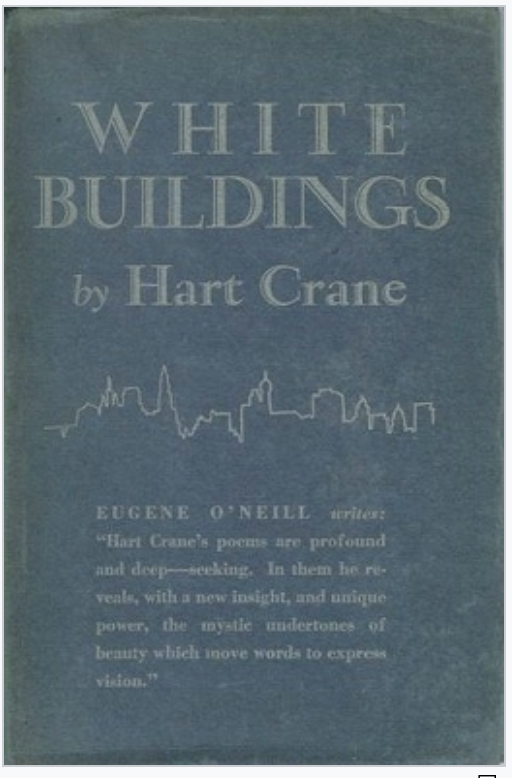
Hart Crane’s White Buildings, First Edition, 1926
This Week’s Obsessions
1) City of Night Birds
Well this was predictable. After 30 unconvincing pages, I included this novel on my list of last week’s obsessions under the header: “I’m Not Obsessed with This Contemporary Novel“ [I’m All Lost In, #104, 5/10/26.] It turns out I am.
I realized this when I fished the book out of my backpack on the #8 bus Wednesday evening and started reading it again. I nearly missed my stop. I eagerly picked it back up few hours later; that’s when I began underling. “We all had the emotional stability of an atom missing an electron.”
Before the night was. over, I had read another 80 pages.
The book is about a fictional elite Russian ballerina named Natalia Leonova. And as I noted last week, Natalia’s murky history—told in flashbacks—kept me from abandoning the book right away. Accordingly, when that story line came to its surprising crescendo around page 60—going to see her mother meant going to the cemetery—I was hooked. Natalia’s past has now collided with the increasingly intriguing real-time story of her minefield relationships with Nina (an old bestie) and with her mysterious Bolshoi rival Dimitri. I’m sensing more secrets to come in this world where ballet is metaphor.
More underlining: “She didn’t want anything frilled and beaded that would remind her of a costume…;”
“I meandered to the center—the middle of the stage, the center of gravity in our universe, to which everyone—dancers from the corps to the principals, the conductor, the orchestra, the light designer, stagehands, and even the director—were inexorably pulled…;”
“…her face would light up in recognition—not of the choreography or the music, but the turquoise-embroidered bodice and tutu…”
2) Modular Seattle
Speaking of metaphors: Think of a modular synth artist as a DJ whose circuit patches are samples. Modular synthesizers are electronic music rigs that musicians patch together during performance to iteratively create new combos of sound effects as opposed to using a pre-programmed synth.
Avant-garde and retro all at once, modular synth music is crackling in Seattle right now thanks to Modular Seattle, an informal collective of experimental musicians who host generative synth nights
They usually hold the shows at Substation [I’m All Lost In, #27, 4/19/24], a former industrial site on the edge of old Ballard. But last Saturday night they set up shop at Pacific Science Center, the kid-friendly museum at Seattle Center transformed on this evening into a lingering hipster music scene. The event was branded as Science After Dark, SAD.
Like Haydn’s contemplative adagios ^^, we were in 60-BPM mode. Rather than arcing cello lines and plaintive violin melodies though, it was transistor drones, archival sound clips, and blocs of sound waves. You could practically see the atoms gathering in collapsed time.
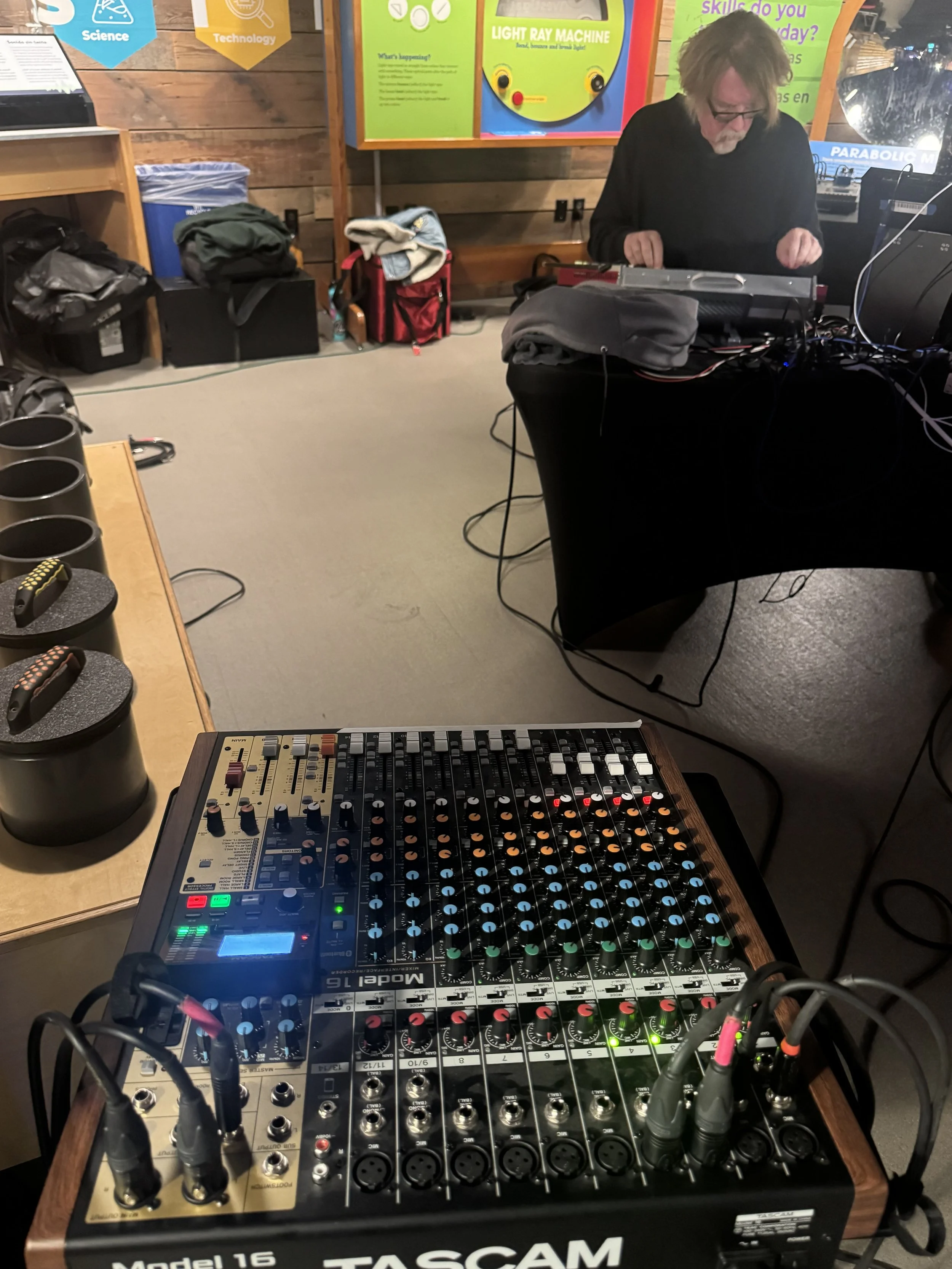
Modular Seattle at Science After Dark, 5/9/26
3) Playing Desmond Dekker’s Shanty Town on Piano
Between his two rock steady hits, “007 (Shanty Town)” (1967) and “The Israelites” (1968), you wouldn’t be faulted for believing Jamaican artist Desmond Dekker descended from Orpheus. This fellow could write a catchy pop tune. And perform it with star power.
I’ve been miming his star power in the privacy of my apartment all week practicing “007 (Shanty Town)” on piano. I’ve dedicated weeks to this song before [I’m All Lost In, #29, 5/3/24.] This is an obsessions column.
It’s a pleasure to play thanks to Dekker’s pallet of inversions. Written in the key of A-flat major, his score playfully flaunts all three voicings of the root: A-flat/C/E-flat; C/E-flat/ A-flat; and holding down the wistful verses, E-flat/A-flat/C, the second inversion. Dekker lingers in the wistful mood in the final bar of his I-IV-VII verses with an inversion of the IV chord (a D-flat major played as F/A-flat/D-flat) and then rushes mid-verse to the VII, an aching G-diminished passing chord (G/B-flat/D-flat). This premature chord change creates a dragging blur against the right-hand melody, the D-flat IV note, which stays put despite the moving chords below. Remaining stationary like this, the D-flat highlights the tug underneath as Dekker sings: “Rude boys take the wheel/Toss them all to jail/Rude boys cannot fail/’cause they must get beer” stretching out the words “wheel,” “jail,” “fail,” “beer” to emphasize the rude boys’ mundane cycle of aimlessness.
In contrast, the chorus is all energy, showcasing an overload of tied notes and smashed-together triplets as Dekker starts the melody line from the III note, the C, to string together the repeated opening line: “I’m a loot/I’m a shoot/at my will.” This sets up the last two lines of the chorus where Dekker drops the melody to the root, the A-flat, and ready-set-go, climbs 9 half steps to the VI note, the F, for the first two weighted words of a triplet: “Step up,” and “bomb up.” As in: “I’m a rude boy, step up diversion” and “I’m a rude boy I bomb up the town.”